In the early years after World War Two the Hungarian government needed new small arms, but chose to license Soviet designs instead of developing their own. when it came to submachine guns, this entailed production of the PPSh-41 at FÉG in 1950. Josef Kucher was a talented Hungarian arms designer who had worked with Pal Kiraly on a number of designs, and when Kiraly left post-war Hungary, Kucher remained. He was able to successfully petition the government to adopt his submachine gun as a supplemental weapon for tank crews and others where the fixed stock of the PPSh-41 was inconvenient. It is formally adopted in 1951 as the K1 light submachine gun.
Kucher followed the K1 with a machine gun development program, but in 1953 he was prosecuted for political crimes and imprisoned. He was released in 1956 and went back to work at the Danuvia arms factory until his death in 1976. He was eventually pardoned posthumously in 1992.
KGP9 Video: https://youtu.be/ftlgUbz98jY

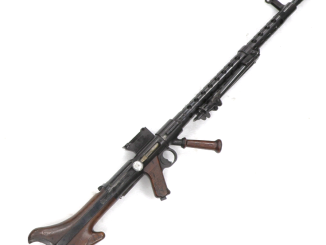
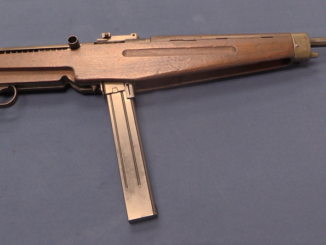
“(…)formally adopted in 1951(…)”
http://hungariae.com/KuchK1.htm reports that alternative hypothesis exists namely gun was adopted in 1953 and received a 53.M designation.
“(…)weapon for tank crews and others (…)”
Aforementioned article claims This machine pistol was often referred to as ‘Pénzügyőr Géppisztoly” [Treasury/Customs Guard Machine Pistol]. suggesting it was used (or at least destined to be used) by organization other than Magyar Néphadsereg.
Note that field stripping via unscrewing cap is very different from PPSh-41 and quite similar to older Soviet design, namely PPD-40 https://www.youtube.com/watch?v=y5ueAvlmzfk&t=59s
We should forget Hungariae.com: it is very inaccurate. – I understand: Hungary is a small country, Hungarian weapons exist in small numbers and they are far from significant, and Hungarian language is simply difficult, and has a few speakers. – But Hungarian weapons history is full of white spots. I am really sorry.
* * *
Yes, the K1 submachine gun not only used by the Magyar Néphadsereg [Hungarian People’s Army], but also the police, the border guard etc.
Thanks to the development of the translation with computer, you would find interesting:
1. Original manual of the K1 submachine gun:
https://kalasnyikov.hu/dokumentumok/k1konnyugeppisztoly.pdf
2. Biography of colonel Kucher József on the website of the defunct Hungarian Institute of Military Technology, which coordinated all military development work from 1920:
https://www.haditechnikaiintezet.hu/kucher-jozsef
No, he was not involved in the Király’s submachine guns developed and made by the SIG. At that time he was an airforce officer.
3. Haditechnika magazine is a Hungarian popular science magazine in military technology, and also it was the official scientific journal of the Institute of Military Technology. In the 6th/2018 issue, there is a brief biography about Kucher József:
https://real-j.mtak.hu/11526/6/HT_2018-6_internet.pdf
4. The K1 submachine gun covered in the in the February 2025 issue of the Kaliber magazine:
https://www.kaliberinfo.hu/hirek/uj-kaliber-2025-februar-322/
The big (and not so detailed) picture of the Hungarian armament after 1945 to the end of the 1950s.
During WW2, Hungary was completely destroyed: due to the fighting, due to the Soviet plundering, and due to the German army, which stole everything what it can get, or simply destroy it during its retreat. Even the brass door handles were stolen in my grandmother’s village in 1945 by the retreating Germans.
“Thanks” to Yalta and the Soviet occupation, the never perfect, but democratic Second Republic of Hungary destroyed in 1948, and Hungary find itself on the wrong side of the Iron Curtain.
And yes: the root cause was the stupid optimism of the germanophile Hungarian political elite, which pressed the country into a world-wide robbery and murder.
So, there was a country with a completely destroyed industry, with communist servants of Moscow, and a Soviet command to build a large army. Most of the Hungarian army’s armament was destroyed in the war, obviously.
At first, they bought used Soviet weapons fromt he WW2. After that, they bought licences. So they have the
TT33, as 48 M. pistol,
PPS-41, as 48 M. submachine gun,
Maxim-Tokarev, as 48 M. machine gun,
DPM, as 48 M. light machine gun,
TOZ-8, as 48 M. small caliber rifle,
Mosin-Nagant, as 48 M. rifle.
48 M. police pistol is an exception: it is a modification of the .32 ACP Walther PP copy with firing pin block. And some original Walther PP parts, which were made in the FÉG factory, in Budapest.
48 M. grenade is also an exception: it is a re-named WW2 Hungarian stick grenade, used into the 1980s or 1990s.
“(…)Maxim-Tokarev(…)”
Wait… they made license version of bi-pod and wooden stock version of https://modernfirearms.net/en/machineguns/russia-machineguns/maksim-m191030-eng/ after WW2.
This raises question why, considering that they have access to newer DPM?
“Wait… they made license version of bi-pod and wooden stock version of https://modernfirearms.net/en/machineguns/russia-machineguns/maksim-m191030-eng/ after WW2.”
I never ever heard about Maxim machine gun with bipod and wooden stock used by Hungarian armed forces.
This is the original manual:
https://kalasnyikov.hu/dokumentumok/48m_geppuska.pdf
I think – but I am not certain – Maxim machine guns ere never made in Hungary. They were bought from Soviets.
“This raises question why, considering that they have access to newer DPM?”
I think, because the DPM is a light machine gun with mobility, but for sustained fire, it is not so great.
Sidenote: after WW2, there was an attempt to build gas-operated Hungarian “MG42”. Due to the lack of experience in sheet metal technology, it went nowhere.
Thanks a lot, Poresz, for giving us a little insight into Hungarian small arms history. The Haditechnika journal is quite impressive in the broad spektrum it obviously (judging from the images) covers. Who would have expected an article about the Gebauer machine gun?
Your mentioning the “48 M police pistol” is the first time I learn the Hungarian designation of this gun, which in the West is exclusively known by its export name “Walam”. Most people here do not realize that it has an automatic fring pin safety.
You are welcome. 🙂
“Your mentioning the ’48 M police pistol’ is the first time I learn the Hungarian designation of this gun, which in the West is exclusively known by its export name ‘Walam’. Most people here do not realize that it has an automatic firing pin safety.”
48 M. was the police pistole in .32 ACP, and the Walam is the same, but in .380 ACP.
Sidenote: “Walam”: WALther-LAMpart.
As far as I know, Germans ordered Walther pistols from the FÉG during WW2. After the war, the debris of aerial bombardment and siege were cleaned, and some parts and technical drawings saved. So, the first 48 M. pistols were made with Walther PP parts.
By the way: an another Hungarian-made Walther is the Walther PPK/E, from the early 2000s.
Lampart: it was the FÉG. FÉG has an awful number of names. Even the abbreviation is the same, the words were different. Lampart is one of them, after the fusion with the “Lámpagyár” (literally: lamp factory).
The rotating/lifting firing pin block really was an invention of József Kamineczky, one of the most important engineer in the FÉG after WW2. According to an interview with him, he shooted through his hand with a Walther PP when the 48 M. formed, and he really want this safety feature. And the RK59, R61, PA-63, AP, and other FÉG “Walther” pistols inherited it.
This feature is widely hated in Hungarian shooting community. – Why?
The idea is great.
But the quality is not the same, as experienced with FÉG pistols sold to the West.
The top grade FÉG pistols went to West. There were the cheapest pistols. Hungary really need hard currency from the other side of the Iron Curtain… And yes: this is why you can find FÉG pistols as Mausers, for example.
The not so good ones went to the internal market. Before 1989, for the “reliable, good and important comrades”. After 1989, for the unsuspecting members of the really few Hungarian civilian gun owners.
The remnant went to the Hungarian armed forces… Yes, in the last shameful years the FÉG could supply the army and the police with newly made and already rusty pistols, direct from the factory.
In the last agonizing two or three decades, FÉG had the “one out of five”-problem. Four pieces from five pieces of FÉG pistols were fine. One piece is a reject, which reached the customer.
As the elder shooters said.
Thank you for the additional detail. Much appreciated.
To add: I remember a short lived “Mauser Oberaudorf” -with the typical FEG outline- being advertised (or just mentioned) in German journal DWJ. Obviously the “sellers” using the fact that Oberaudorf (really existing in Bavaria) instead of Oberndorf could mislead the unwary. It did not show the typical Mauser factory symbol.
WW II after WW II has a good article on the postwar Hungarian PPK derivatives, including the profoundly absurd story behind the “Mauser Oberaudorf” marked guns. I highly encourage checking them out
I wish I could accept this weapon, but sadly, it cannot accept 9×19 parabellum.
I think technically it is quite far from the impossible. There are converted PPSh-41s and PPS-43s to 9×19 mm Luger. Interestingly, nothing as rare, as the alleged most manufactured Hungarian submachine gun. Oh, wait: and the gun laws (open bolt)…