Today we are out at the range with the .45 ACP Steyr-Solothurn MP-34. I was curious to see how this submachine gun, much more commonly found in 9mm, would handle with the big .45 caliber cartridge. The answer? Quite nicely! It has a slightly lower rate of fire than the same gun chambered for 9x23mm Steyr, and is very pleasant to shoot.

Bolt Action Rifles
Schlegemilch 1896: Closest Competition to the Mauser 98
Louis Schlegemilch had been one of the contributors to the Gewehr 1888 and when the German military decided to replace it, Schlegemilch was there with a design he hoped would win. His model 1896 rifle […]
Prototype
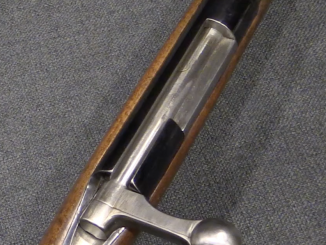
Mauser-Norris Prototype: Origins of the Mauser Legacy
Today we are looking at one of the rarest and earliest rifles built by Paul and Wilhelm Mauser, a design which would set in motion all the events that led to the Mauser company becoming […]
Bolt Action Rifles
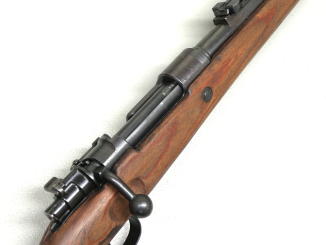
Late-War Commercial K98k – Production in 1944 But Not for the Wehrmacht
Available from Morphys here: https://auctions.morphyauctions.com/_C__RARE_LATE_WAR_COMMERCIAL_GUSTLOFF_WERKE_BCD_4_-LOT662278.aspx Late in 1944, a number of small companies assembled a batch of K98k rifles and commercially proofed them. These are a known group of guns to the collecting community, although […]
What some would not have given to produce this in America… Oh, wait, Auto Ordnance wouldn’t be too happy about that. And yet again, this was intended for a right handed user. What would be the ideal reloading cycle for this?
“(…) What would be the ideal reloading cycle for this?”
Used example do not have forward pistol grip as what https://guns.fandom.com/wiki/Steyr-Solothurn_S1-100
show as .45 ACP version of the S1-100 (Model 1934) with foregrip
according to https://modernfirearms.net/en/submachine-guns/austria-submachine-guns/steyr-solothurn-mp-34-eng/
For South American markets, Steyr produced version of S1-100 in .45 ACP caliber; this version was distinguished by additional pistol grip under the forearm.
which imply it was default for weapons made for South America.
How it would affect handling?
The slow motion video seems to agree with your theory. When the bolt goes all the way back to the end of its travel, the bolt handle gives a little flick. And with most .45 shots, no flick. Interesting!
…NYPD chucked ’em into the sea?! Good grief…
Waste of good weaponry unless they ran out of spare parts…
Forget it Jake, it’s New York.
Open bolt firing sub machine guns have many of the features of constant recoil actions. Since the firing pin is fixed to the bolt, cartridge ignition is dependent on bolt speed. The bolt has an extra long travel from sear release to chambering to get the speed up. After firing, when the bolt is moving back it has enough travel for the recoil spring to slow and stop bolt movement before it hits the receiver. This also cuts the cyclic rate way down (50%?), also improving controlability.
The firing-on-bolt-closing is another element. As the cartridge fires the bolt is crashing into the back of the barrel which throws the gun forwards to help reduce recoil. you can see this when the gun runs empty, the gun will lurch forward.
As always, thanks for bringing us another Forgotten Weapon, especially the live fire videos.
In many of those early SMGs including the MP-34 firing pin is not fixend to the bolt. It does not harm to your “semi-constant recoil” description but is a technical inaccuracy
It remains only to understand what kind of beast this “constant recoil action” is. 😉
Sounds like a “triple action revolver.”