In the early days of World War Two, Britain had a branch of the SIS for sabotage operations, called Section D. It became part of Special Operations Executive in 1940, but in the early days British operatives did not have the specialized weaponry that came later, like the Welrod or DeLisle. Instead, they simply had access to what was readily at hand – which included a good number of Luger pistols. Government appeals to buy back guns to use in the national defense resulted in many commercial-sale Luger pistols in government hands. With exposed barrels and German manufacturing provenance, these were easy to fit with silencers and use as deniable arms for sabotage agents on continental Europe.
Many thanks to the Royal Armouries for allowing me to film these for you! The NFC collection there – perhaps the best military small arms collection in Western Europe – is available by appointment to researchers:
https://royalarmouries.org/research/national-firearms-centre/
You can browse the various Armouries collections online here:
https://royalarmouries.org/collection/
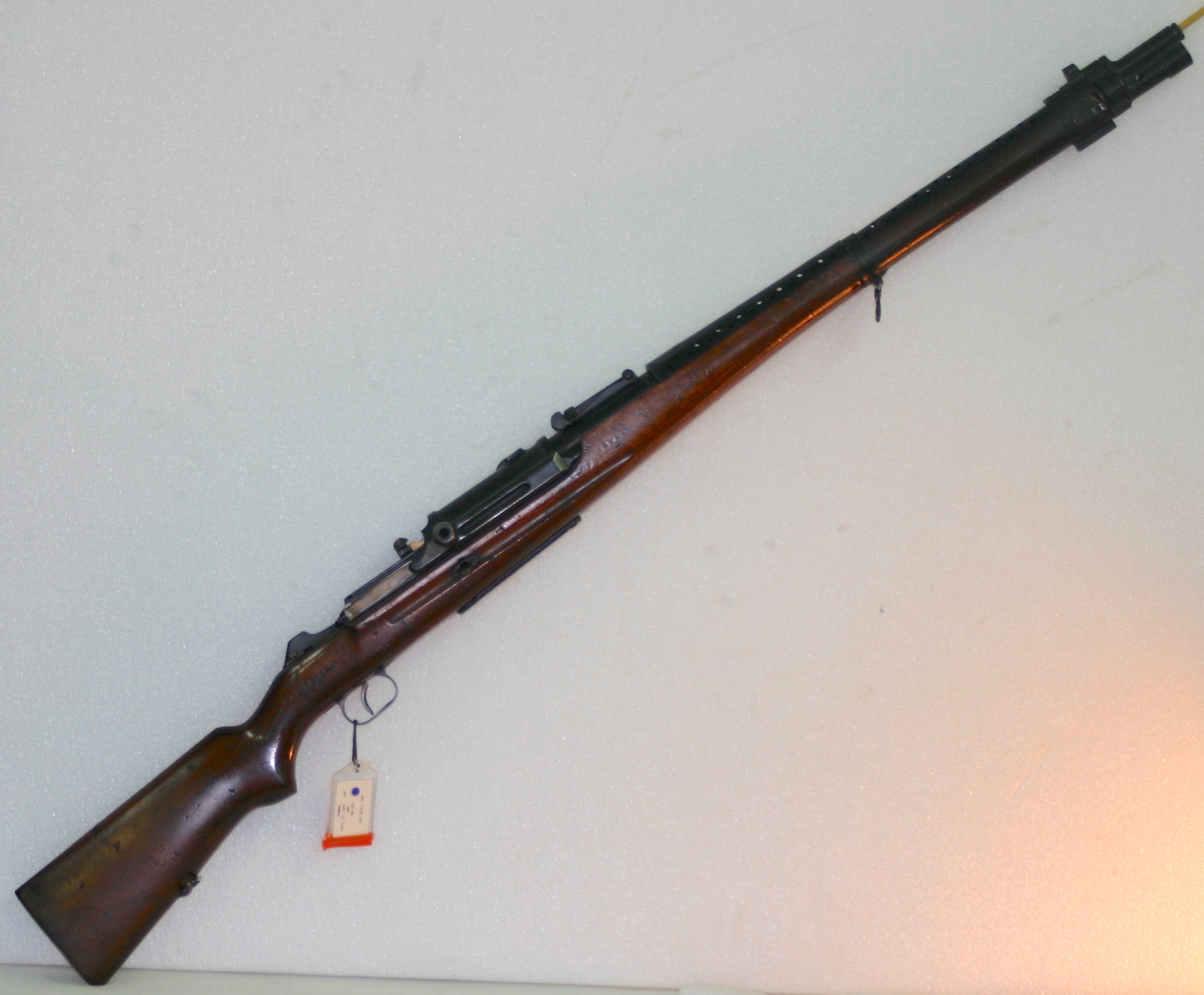
“(…)many commercial-sale Luger pistols in government hands(…)”
What about subsonic ammunition? Was it available commercially in 1930s? How well Parabellum-Pistole worked with said ammunition with and without silencer attached?
There should be enough existing contemporary Lugers still around to allow for testing, without risking trashing museum specimens.
If you look at German sources of the time, you will find muzzle velocity 327 m/s from the 102 mm barrel of the P08.
Y’know… I’ve always wondered why they bothered with the whole “plausible deniability” with weapons in intelligence work.
I mean, seriously… The fact that someone shot your key personnel? Kind of a tell, you know? What it was done with? Not a major issue; you really don’t care at that point, because your guy is dead.
A lot of this crap strikes me as just plain silly, when you get down to cases. What is to be gained, by obscuring what weapon came from where? If you get caught, then does it matter that you’re armed with something the enemy carries? They’re still going to play Gestapo on your ass, regardless. It’s not like SIS having a Luger was going to get the Abwehr counterintelligence types to go “Ah… They have Lugers; they must be OK…”
Similarly, when the murder weapon for an Abwehr agent is a silenced Luger, so what? Later on, they issued Welrods, so they couldn’t have been too concerned with imaginary secrecy.
The whole thing just strikes me as ill-thought gamesmanship, dreamed up by the same folks who brought us James Bond and all the CIA flim-flammery in the way of tools that didn’t work for assassinating Castro.
The entire genre of “tradecraft weapons” strikes me as being useless affectation.
I always thought the deniability game was part of diplomacy. ‘What?! Your Presidente For Life was shot? Wasn’t we Yanks. If it was us the assassin would have dropped a Peacemaker not Hi-Power. Blame those nefarious Belgians.’ The whole game is predicated on the naive notion that using another country’s signature weaponry in a false flag operation is for some reason forbiddingly difficult. The whole thing is a lot like Kabuki theater: the participants in the game impute meaning to what the rest of the world finds a pretty transparent bore
I have the biography of French resistance fighter Michel Thomas, a Jewish Pole who successively escaped Germany, Austria, and Vichy France. In 1943 he was captured by the French Nazi militia, held and beaten for two days, but convinced his captors he was not a member of the Resistance but a Gentile Pole who was working the black market. He was turned over to a regular criminal court, fined by a sympathetic magistrate, and released. He had not been armed, but heaven help him had he been carrying a Webley rather than, say, an Astra or Beretta. Agreed that it’s not THAT important but there’s a point to deniability.
He was unarmed so the issue of deniability really does not arise.
I agree Kirk, especially with 2nd to last paragraph.
It’s not for deniability in the act, it’s for deniability prior to it.
An “american” caught by police or having their home raided on suspicion of espionage for the turks will be more readily able to deny the charge if their CCW is a 1911 rather than, I don’t know, a Sarsilmaz SR 38.
Some – and eventually most – nazi citizens were permitted personal arms – so the same logic applies.
The major problem was that the mass of a Parker-Hale suppressor on the barrel threw off the dynamics of the P.08 action. Meaning, smokestack jams were a frequent occurrence.
There’s a reason the long-barreled 7.65mm Parabellum sporting carbine had a wooden forearm, other than just being something to hold onto with your off hand. It also was the housing for an extra coil recoil spring, parallel to the bore, that “helped” the comparatively weak leaf spring of the OM version haul the barrel and bolt back into battery.
A better choice was the Walther PPK in 7.65mm Browning (.32 ACP). Fitted with a slightly longer barrel (basically one the length of that on the PP) threaded for a suppressor, it worked perfectly well because of course the PPK and PP barrels are fixed in the frame and don’t move.
clear ether
eon
Another possible explanation for lack of provenance is that they were made by amateurs … like the “Nazi belt-buckle” guns forged after WW2 – by a German gunsmith – and sold to gullible American servicemen who occupied West Germany during the Cold War.
More likely, if there are five of them in the UK all with similar workmanship, that they were assembled for the SIS and then never went abroad, rather in the manner that many DeLisles never saw active service in Europe. Presuming that these silencers are identical to Parker-Hale commercial models. (Sure looks about right: https://64.media.tumblr.com/5748fca338e865ab52689c87c224ca36/ tumblr_peyw9qKY6d1s57vgxo1_1280.jpg ) If any of altered Lugers got sent overseas with agents, how would we know? Did any of these five get sent and come back?
1. Sneaking up on the Hun and shooting him isn’t “nefarious”. Clandestine, secret, sneaky, sure. But it’s not wicked or evil, which is what nefarious means.
2. They parachuted guys into Prague to kill Heydrich after all. And they didn’t even get silencers.
No, they got a Sten Gun that jammed and two Mills Bombs that didn’t.
Heydrich still managed to drop one of them with his P.38. (He wasn’t impressed by the PP.)
As for Heydrich himself, he got some of the horsehair upholstery stuffing from the back seat of his car blown into him, and three days later succumbed to peritonitis.
A smarter way of doing it would have been like the Spanish PM who was done in by a classic American Civil War-style “mine”.
https://en.wikipedia.org/wiki/Assassination_of_Luis_Carrero_Blanco
clear ether
eon
Heydrich was apparently armed with a Luger. He did not manage to shoot either of the Czech agents before the grenade exploded. His driver tried to, but managed to eject the magazine from his pistol. He must have been used to a heel magazine catch. He was then shot by one of the Czechs armed with a .32 Colt 1903. The SOE bought 7,000 of these to arm its agents. The idea was that .32 pistols were common in Europe, so the ammunition was available, and anyone caught with one would not automatically be identified as a British agent.
Luckily Hayedrich’s Nazi arrogance was the death of him. If he had ordered his driver to speed off from the scene of the attack when the Sten jammed he would have survived. Instead he told the driver to stop so he could shoot his attackers. The rest is history.
What exactly dictates describing an action as arrogant as opposed to brave? The flick Patton has George Patton/C. Scott popping away at German planes with a .380 Colt. You know the part where everyone nudges his buddy and schoolgirly gushes ‘What balls he had!’ I don’t see anything in either event to draw any line between courage and arrogance in and of itself.
Heydrich was the chairman of the Wannsee Conference and architect of the Holocaust, so I tend not to cut him any slack.
He may have displayed some level of bravery during this attack, more likely he was furious that subhumans should have had the effrontery to attempt an attack on him. He refused any escort and drove through Prague in an open topped car to demonstrate that the Czechs were completely under the German thumb and would never have the nerve to attack him. Even Hitler and Himmler urged him to use an armoured limousine, but he refused. So I think “arrogant” is a very fair description of a very evil man.
Whether it is ‘nefarious’ depends on whether oneself is the Hun, nein?
The Germans had an interesting mentality, one that really leaves you going “WTF? Seriously…?”
On the one hand, they were completely A-OK with violating the accepted standards and practices of war, but on the other… Objected mightily to things like Francs Tireurs doing naughty things to German soldiers.
As in the bombings of major cities during WWII, it was like “Well, yeah… We’re gonna destroy Warsaw and Rotterdam, but if the Allies come after a German city, that’s a war crime…”
I’m with Bomber Harris on that one. The precious German mentality that they could do no wrong, while what everyone else did to them in return was “nefarious and criminal”? Yeah. That.
You’ll note that the same arseholes who did the thing at Gleiwitz were also the same lot who declared what the Commandos and others did “criminal”, authorizing their execution when captured.
Truthfully, I have a lot of trouble with the sanctimonious BS coming out of Germany for most of the 20th Century. There’s a lengthy list of disingenuous claptrap; starting with the whole “Dum-Dum bullet” issue from the Boer War, the way they agitated for the various conventions before WWI, and then spent as much of that war as possible violating both the spirit and the letter of the laws they’d forced on everyone else…
WWII speaks for itself, but the sanctimonious jackasses during the post-WWII era? Oi. All those lovely “peace protestors” that were really only protesting one side, not the other, and while they were proudly banning HK from selling small arms around the world, they were completely fine with selling Saddam all those lovely dual-purpose pesticide plants and the precursor chemicals to run through them. You’re never, ever going to see an accounting from that, any slimy industrialists brought to book for the people that killed.
Germany has a uniquely odious brand of hypocrisy going, and I really find them rather disgusting in that regard.
Their postwar “economic miracle” was mostly driven by the rest of NATO, especially the U.S., pouring a shit-ton of money into West Germany to make it a credible bulwark against a Warsaw Pact land invasion.
But all through it? They were preaching “unilateral nuclear disarmament”.
Not to mention playing Che Guevara wannabees at every U.S. or British base in their country from the Berlin Airlift to the Berlin Wall coming down.
Everybody spoke highly of their Leopard I and II tanks. Nobody wanted to talk about the fact that every one built was paid for by the U.S. taxpayer.
Up to the “new” Typhoon, every aircraft their Luftwaffe flew was paid for by U.S. “offshore funds”, as well. Yes, even the Tornado.
The FRG, UK, and etc. wanted the U.S. Air Force to buy the Typhoon, as well. So we would once more foot the bill.
Our procurement types, in a rare moment of lucidity, took a close look at it, realized that far from the advanced fighter it was claimed to be it was in reality a cheap knockoff of the French Rafale we had already rejected (they tried to sell Rafale M to the U.S. Navy), and refused to have anything to do with the kludged-up mess.
Like every other fighter project in the West since the Tornado, F-15, and F/A-18, Typhoon and Rafale took a quarter-century apiece to go from drawing board to IOC, and like F-22 and F-35 were pretty much obsolete ten years before their first flights.
But as long as the U.S. taxpayer was paying for it, that left the Eurodolts free to pay for their vast “social welfare” (vote-buying) programs.
And the beneficiaries of same free to keep shouting anti-American slogans.
When Ringo and Kratman wrote Watch on the Rhine they didn’t know the half of it.
clear ether
eon
“(…)IOC(…)”
What is this?
Initial Operational Capability.
Kirk:
I have no problem with RAF Bomber Command’s attempts to defeat Germany, the question is, did it work?
Bomber Command used up 25% of Britain’s entire war economy. Unless it did more damage than that to the German war economy, it was not working.
The USAAF’s 8th Air Force also failed in 1942/3. The advent of the P51D Mustang in 1944 finally gave the bombers the freedom to attack German industry. The attacks on German transportation and oil really crippled Germany, but even then their hidden and underground factories were still churning out weapons, but they lacked the ability to transport them or fuel them.
Kirk, I’ve never read anywhere that germans protested in ww2 international community against bombing of their cities. Francs tireurs was a thing in german-french war in 19th century; youve got a lot of things mixed in here, and I dont think its enough or precise enough to warrant a conclusion. Boer wars but germans protested? wtf
One thing that puzzled me the most, I’ve even asked my primary school history teacher about it long time ago, if nefarious and evil as they are, how come they never used chemical weapons; but I think we had such discussion here before. Iirc her(!) answer was something along the lines: they were not completely disregarding any warfare regulations
Hitler was gassed in WWI and temporarily blinded, so that may have contributed to his reticence over using gas. Obviously, he did not extend that courtesy to the Jews and the other people who were gassed in the Holocaust. From that perspective, gas killed far more people in WWII than it did in WWI.
That “ww1 experience” was post war explanation, but who knows. Why would they develop anything and spend resources on it if Hitler verboten it all from getgo.
As for death camps, technically its not in any mean a type of gas like used during ww1, but more of an improvised usage of byproduct of pest extermination chemical.
According the Albert Speer, the German Minister of War Production, that had very little to do with it.
What actually did it was Speer pointing out to Field Marshal Wilhelm Keitel, commanding general of the Wehrmacht, who was all in favor of gas warfare, that;
1. Their “top secret” gas, Tabun, the first “nerve gas”, was an alkyl thiophosphite adduct.
2. DuPont in the United States, the world’s largest chemical manufacturer, made a variety of insecticides for agriculture based on the same compounds, notably 2-4-D.
3. In 1941, DuPont had manufactured and sold more total tonnage of such insecticides to farmers in North America than the entire production of all war gases, from chlorine to mustard gas, that the German chemical industry (I.G. Farben and BASF) had produced from 1915 to 1940.
4. If Germany used gas warfare, within six months DuPont could supply the U.S. Army with enough tonnage of war gases, from Lewisite (enhanced mustard gas) to Sarin (“our” version of “nerve gas”, based on insecticides) to bury every square meter of Germany in a flood of such agents a half-meter deep- without in any way affecting DuPont’s purely civilian/commercial insecticide production for agriculture. (NB; yes, DuPont had just that much excess capacity that had been idled by the Great Depression.)
Faced with that prospect, Keitel decided not to roll those dice. There is evidence that the decision never even came to the Fuhrer’s attention. The story about Hitler making the decision based on his WW1 experiences didn’t show up until it was recounted in William L. Shirer’s book The Rise and Fall of the Third Reich, published in 1960. Speer repeated the story in his book, Inside the Third Reich in 1969.
The story about Speer’s talk with Keitel came from Gen. Reinhard Gehlen, the chief of Wehrmacht Intelligence, who came over to the U.S. side in May 1945, bringing his entire network- and all of his files- with him.
I’d sooner trust Gehlen than Shirer or Speer on this subject.
clear ether
eon
The Germans did protest against the bombing of their cities.
They did it from the very first city bombed by the French.
Yes the French navy bombed Germany during the Battle Of France.
That was the first city wide carpet bombing in history.
Still and all, looking at today’s ‘Festering Europa’ it is impossible to convince oneself the right side won the war.
Whilst I bemoan the current state of Europe, I am not persuaded that the triumph of Nazi Germany would have been preferable.
The same thing happened in WW1 when they used mustard gas and flamethrowers in the trenches etc but went bitching to the Geneva Convention when the US expeditionary force used 12 Gauge M1897 Trench Shotguns on them
Transportation and fuel were cut because of the bomber campaign.
Now bombing whole cities is a war crime.
Bomber Command had to operate at night, and given the technology of the time, had to target cities, there was no way to target specific industries. The USAAF could do that, more or less, by bombing in daylight, but that only worked when they had fighter escorts from Mustangs. But for the happy marriage of the Packard Merlin with the Mustang airframe, it would have been a different matter.
Actually, the first effective escorts were the P-47D Thunderbolts. They began escorting B-17 and B-24 formations to Berlin and back as early as the first daylight bombing “Baedeker” raids, once Hap Arnold “explained” the need for escorts to Washington.
The “Jugs” caught the German fighter force flat-footed. Willy Messerschmitt had told the Fuhrer that fighter escort from England to Germany and back was impossible, because the fighter would need to carry so much fuel that it would “be no more agile than a furniture van”.
Ernst Heinkel disagreed, but then he and “Willi” generally did, and the Fuhrer generally sided with Messerschmitt.
Then came Party Day in 1943. During the official ceremonies in Berlin, the music was drowned out by the roar of two dozen P-47Ds making a spire-top level pass, waggling their wings as they did. No shooting or bombing, just 351st Squadron of 350th Group saying “Hi!”
As the Jugs receded in the distance, Heinkel looked at Messerschmitt and said, “There are your G*d-damned ‘furniture vans’.”
The Jug went on to be the Wehrmacht’s least-favorite American aircraft. They called it the “Jabo”, for “Jagdbomber” (“fighter-bomber”), because once the P-51D became available for bomber escort duties, the Thunderbolts with their greater payload capability were generally reassigned to close support and tactical bombing duties.
When my uncle who commanded a Sherman troop called for an air strike against a “point of resistance” and the artillery was otherwise occupied, nine times out of the response was two to four “Jugs” packing 500-pound bombs and two triple 4.5 inch rocket launchers each. The P-51s could carry a pair of bombs, or a pair of rocket launchers, but not both at once. The Jugs normally did carry both at once, plus of course eight .50 Brownings. All of the above made short work of anything up to and including Jagdtiger tank destroyers lying in ambush.
https://www.warhistoryonline.com/military-vehicle-news/jagdtiger.html
(Some historians say the 12.8 cm-armed Jagdtiger only showed up on the Eastern Front. My uncle would have begged to differ, as it along with the only slightly-less-lethal 8.8cm-armed Jagdpanther were standard vehicles with the SS Panzer and Panzergrenadier divisions on both fronts.)
My uncle always said that his most important anti-tank weapon was his radio. And the Jugs delivered the response.
clear ether
eon