
Remington introduced the No.7 Rolling Block in 1903, and it was the last pattern of the action to be introduced. They were expensive, hand fitted guns, costing $24 in 1903 (compared to $12 for a standard No.2 pattern Rolling Block). The only reason Remington made them was that they were built on 1871 pattern Rolling Block pistol frames, which were left over and unused in Remington’s warehouse – so why not sell them in a new configuration? The standard barrel length was 26 inches, with 24 and 28 available optionally, and they were chambered for .22 Short, .22 Long, .22 Long Rifle, .25-10 Stevens Rimfire, and .32-20 centerfire. The grip of the pistol frame made for a very nice target rifle, and these were sold with fancy tang mounted aperture sights. Only 350 were made between 1903 and 1910, numbered from 300001 to 300350.

Optics
One Cartridge Two Zeros: SIG Romeo 9T
In its continuing effort to provide everything for the US military from shoelaces to fighter jets, SIG has developed an optic which resolves a challenge with .300 Blackout and other calibers which offer both supersonic […]
Accessories
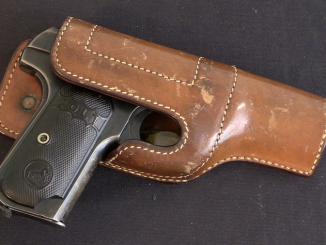
Audley Safety Holster and an OSS Colt 1903
F.H. Audley was a saddler who ran a business in New York City starting in the 1870s. As his business in horse tackle declined with the spread of automobiles, he found himself looking for other […]

Commentary
BAR Comparison: M1918 vs M1918A2
I was doing some reading up on the BAR, and some shooting with a semiauto Ohio Ordnance Works A3 model BAR recently, in addition to the recent 2-gun match we did with it. I got […]
Would still make for a nice target rifle today, but as was the case a century ago restarting manufacture of the pistol sized rolling block receivers is too expensive. Too bad… I could totally see me buying this in .22 WMR.
I think it would be inexpensive to produce these by modern methods, especially at that end of the performance spectrum.
Hmmm, ‘The Late’ they were – but were they really ‘The Last’?
How about the 1914 French 8 mm Lebel-chambered Rolling Blocks then?
Well they were Remington’s last, the French did not yet give up the Tradition 🙂