
Remington introduced the No.7 Rolling Block in 1903, and it was the last pattern of the action to be introduced. They were expensive, hand fitted guns, costing $24 in 1903 (compared to $12 for a standard No.2 pattern Rolling Block). The only reason Remington made them was that they were built on 1871 pattern Rolling Block pistol frames, which were left over and unused in Remington’s warehouse – so why not sell them in a new configuration? The standard barrel length was 26 inches, with 24 and 28 available optionally, and they were chambered for .22 Short, .22 Long, .22 Long Rifle, .25-10 Stevens Rimfire, and .32-20 centerfire. The grip of the pistol frame made for a very nice target rifle, and these were sold with fancy tang mounted aperture sights. Only 350 were made between 1903 and 1910, numbered from 300001 to 300350.
Conversion
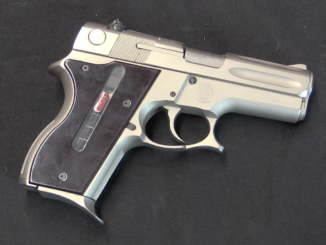
A Connoisseur’s Pistol: Devel’s Full House S&W 59 Conversion at James D Julia
Produced by gunsmith Charles Kelsey, the Devel “Full House” package was a conversion of the Smith & Wesson Model 39 or Model 59 pistol (the 39 was a single stack and the 59 a double […]
Single-shot Pistol
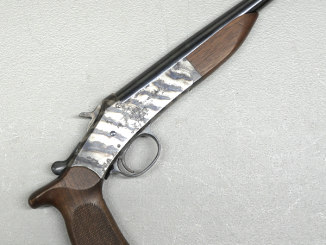
H&R Handy Gun: A Smoothbore Pistol Killed Off by the NFA
The Handy Gun was introduced by Harrington & Richardson in 1924. H&R took their Model 1915 single-barrel break-action shotgun and cut it down into a handgun. It got a pistol grip and an 8” barrel, […]
Prototype
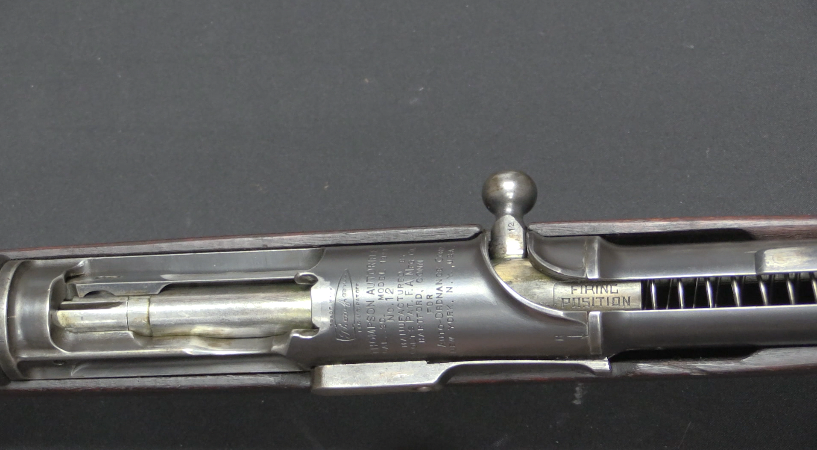
RIA: Thompson Model 1923 Autorifle
One of the very early entrants into the United States Ordnance Department’s semiauto rifle trials was the Auto-Ordnance Company, makers of the Thompson submachine gun. For the rifle trials, they designed a .30-06 rifle using […]
Would still make for a nice target rifle today, but as was the case a century ago restarting manufacture of the pistol sized rolling block receivers is too expensive. Too bad… I could totally see me buying this in .22 WMR.
I think it would be inexpensive to produce these by modern methods, especially at that end of the performance spectrum.
Hmmm, ‘The Late’ they were – but were they really ‘The Last’?
How about the 1914 French 8 mm Lebel-chambered Rolling Blocks then?
Well they were Remington’s last, the French did not yet give up the Tradition 🙂