
One of the less common accessories for Colt percussion pistols is the original factory shoulder stock. And far less common still is the factory stock made with a canteen inside it! The stocks were made of two pieces of wood pressed together over a pewter drinking water canteen in the center of the stock. Very few were originally made, and this particular one also happens to be on a pistol presented by Colt himself.
Museum Review
Cody Firearms Museum Virtual Tour
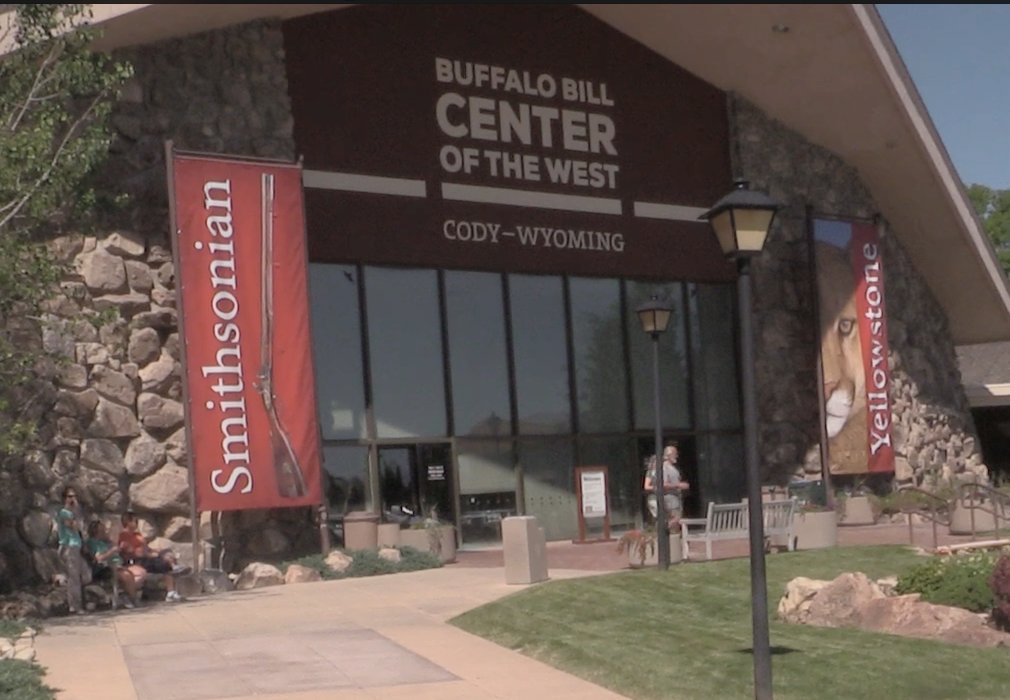
The Cody Firearms Museum is a part of the Buffalo Bill Center for the West, and one of the very best firearms museums in the US (if not the world). It incorporates a number of […]

Fake
1852 Slant-Breech Sharps
Reader Kymm was kind enough to load me this rifle to video, with a particular interest in seeing the amount of gas leakage (or lack thereof) on high-speed footage. This early model of Sharps featured […]
Competition
Boombox / Clarion Thermal at MOGO24: Zee Goggles! Zey Do Nuthink!
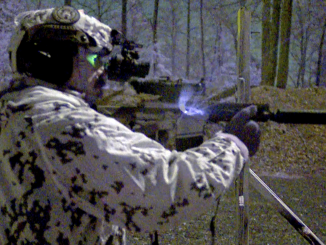
For my Passive Division run during the staff match portion of Moons Out Goons Out 2024, I used a borrowed prototype Boombox from Q, with an AGM Clarion thermal scope. The Boombox is essentially a […]
Very interesting piece!
Agreed,
1) That normal non-ornate guns were ‘presentation’ pieces as well. Does make me wonder about the levels and reasons behind different values of presentation Colts. How far was Mr. Sheffield from getting a Tiffany gun? or just a hand shake?
2) Hearing the C96 inferred to as a more modern gun.
Did anyone sneak whiskey past the captain with this weapon?
So would the effect of the weight in the stock increase ones accuracy? I prefer CA wine by the way…
The stock keeps the revolver just far enough from one’s eye to let the iron sights focus and close enough to allow for the best possible way to hold the grip. Mass balance is not the primary concern but it does help with recoil.
Did I mess up?
Nope. Although the mass of a full canteen would tend to damp recoil more than an empty one.
Since the canteen is fixed (i.e., no “moving parts”) I wouldn’t expect much “fluid effect” damping. If it were less than full (half to three-quarters), though, there might be some due to “wave effect”.
(Fluid dynamics. Serious math. Slightly above my pay grade. No, I have never designed screws for USN SSNs.)
Note that shoulder stocks abruptly disappeared from Colts when the cartridge conversion era began, because the new Richards loading gate and breech ring took up the space in the recoil shield previously available for the notches for the upper attaching iron.
They didn’t make shoulder stocks for revolvers again until the long-barreled 1873 Flat Tops in the 1880s and ’90s.
cheers
eon
I have seen homemade canteen-insert for Sten wire stock, made during WW2…
Why did it take so long to learn to shoot a handgun: pistol or revolver, with both hands? Considering firing even a Colt Model 1851 .36 Navy
“cap and ball” revolver with two hands and both arms extended would increase practical shooting accuracy considerably over firing same handgun
one handed. This would eliminate the need for a stock attachment and reduce dead weight while on foot or horseback. Even firing from a so
called “Weaver Stance” would have increased accuracy by alot. The late Colonel Charles Askins once wrote an article on two fisted handgunning.
This of course was penned back in the 1960’s or early 1970’s when the venerable .38 caliber revolver (primarily the .38 Special) was still
the quintessential sidearm of law enforcement.
Two handed firing of a revolver on horseback is tactical suicide. Suppose you fall off the horse?
Cherndog: I see your point here. Still if I were a frontiersman with a .36 caliber Model 1851 Colt Navy revolver, while dismounted,
I’d still opt for the two handed grip. This would be especially so if I were taking a rabbit, squirrel, or prairie chicken for
the campfire skillet or pot. The two handed grip would still increase practical accuracy and shot placement. —–Jim Farmer