
Holograms are pretty close to space magic, but today I will try to explain how they work in an understandable way. They have also proven surprisingly difficult to find commercial use for, but one program at the University of Michigan Ann Arbor led to the creation of EOTech to produce holographic weapon sights. So once we (hopefully) have a better understanding of how these sights work, we will look at how they differ from red dot sights, and why their specific pros and cons are.

Uncategorized
A Vet Returns to Civilian Life: Richardson Industries Slamfire Guerrilla Shotguns
Iliff Richardson was a US Navy Lieutenant assigned to PT 34 during the campaign in the Philippines. His boat was sunk in April 1942, and he ended up spending more than two years fighting with […]
Semiauto Rifles
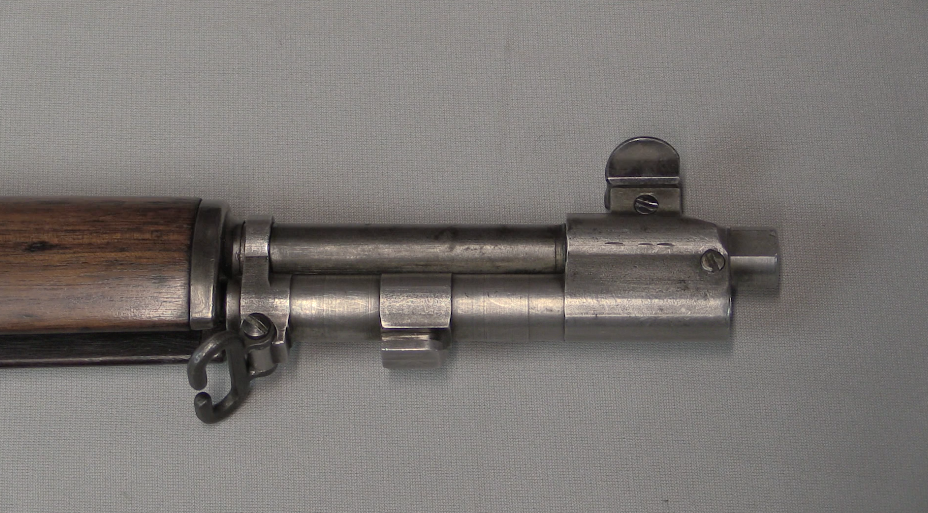
Gas Trap M1 Garand
The original design of the M1 Garand as adopted in 1936 used a “gas trap” system instead of a gas port drilled in the barrel. This system used a type of muzzle cap and false […]
Prototype
Bommarito: America’s First Toggle-Locked Battle Rifle
Designed by Giuseppe Bommarito, this was one of the many independent rifle designs submitted to the US War Department in the 1910s hoping for military adoption. It is a short recoil operated, toggle-locked system chambered […]
No more Eo-Tech for me. I once bought two expensive 577s, and both have issues with the glass.
EO-Tech’s response was that they are old now and I’m on my own.
Fair enough—now we know, and that’s the end of the road for them, given such poor service.
Eotech sucked ass for service/accountability.
For a short window after L3 bought them out? Much, much better. I had a claim in with Eotech; denied. Resubmitted after the L3 purchase, and for whatever reason, they did right by me. Got every dime I’d spent back; immediately bought an M68.
I think Eotech got shafted because they had a good product that was poorly designed/executed, and the money did not flow in order to be able to really stand behind them. With L3 resources, they apparently took a stab at fixing that issue, but since then? I don’t buy their products, so I have no idea.
If Aimpoint ever built a sight with an Eotech reticle pattern, I’d buy that in a heartbeat. If Eotech ever built a red dot, I’d stay far, far away from that.
Great video (along with your explanation of red dots). I had a decent handle on the operating mechanisms and pro/con compromises. But this did a wonderful job of re-iterating why holographics align so well with NV.
Please confirm or deny what I’ve heard:
1) Holographic sights are way more expensive than many red dots.
2) You don’t have to center the holographic red dot in your window to shoot accurately — if properly zeroed, wherever the dot is placed is both point of aim and point of impact. Resulting in quicker target acquisition?
Costs for a mil-spec red dot and a mil-spec holographic sight are going to run about the same.
My experience with both sights would indicate that the image is where the round is going to hit, if you’re doing your job. The difficulty comes in where you are running and gunning, never sure if it’s your sight picture or your lousy positioning when taking the shot.
The advantage is that your hit rate is exponentially higher under those questionable circumstances that it would ever be using iron sights. It’s one of those things where you’re unable to separate out all the factors of “miss” from the sight picture, like “I’m literally rolling around on the ground as I’m shooting, taking snap shots when the sights are momentarily lined up with where I want the bullets going…”
The red dots are subjectively superior. I do not know how the hell you’d establish “objectively superior” for a lot of the situations where they seem to be working as advertised. Too many other factors at play…
Every sight – be it Holographic or Red Dot or even rifle scope – places your reticle at some virtual distance. if you move left and right, the aim point and target will move accordingly, and if the target is not the same distance as your reticles virtual distance, you will experience a Parallax.
An adjustable objective on a scope does allow you to change the virtual distance of your reticle, to match the targets distance.
I guess what Ian meant with parallax was the distortions / additional parallax errors that a red dot may have when the dot is seen far at the edge.
One of the more common issues is the eye-box for a holo sight vs. a “red”-dot sight. For some applications it may be more practical to have a dot sight mounted further forward on the weapon since “relief” is not really an issue, while the holo sight has a tight eye-box and short relief. Can you cover the work being done to overcome those kinds of issues? Or is that impossible due to the optical physics involved.
My experience with Eotech sights would be as follows:
Had Lasik performed in June of the year we were redeploying to Iraq in November. Late August, we were handed the M68s we were authorized, and I discovered that I was one of a small percentage of people that had “blooming” around things like red dot sights afterwards; the dot was not clear for me, at all. Could not hit squat with the damn things.
Saw the opthalmic types there at Madigan, was told “Hey, yeah… We see this, sometimes… The SF guys who’ve run into it are why they have the Eotechs as part of SOPMOD…”
So, I try Eotech. Eotech works for me, and the reticle is actually better, with faster acquisition.
With that discovery, I go out and spend about $800.00 on the mil-spec night-vision compatible version of the Eotech that was fresh on the market. Take it to Iraq, and mid-way through the tour, it starts showing intermittent power issues that I surmise were due to contact issues in the design; frankly, the idea of mounting batteries longitudinal to the recoil impulse was always dumb as hell for the design.
By the time the sight started failing regularly, my eyes had “healed” sufficiently such that I actually could use an M68, so I took that one out of my footlocker and used it.
Returned to the US and tried exchanging the Eotech. No deal; they weren’t playing ball. Forgot about the whole thing, wrote it off as “Experience”.
L3 bought Eotech; word got out that they were settling the lawsuits over the sights they’d sold, and that you could apply for exchange/reimbursement. Sent the paperwork in, and got every single dime back that I’d spent, which was really kinda shocking; I’d paid way over market for the sight in the first place because “deployment timeline”, and they just nodded and took the very shady hand-written receipt (and, sight…) I’d gotten for my money.
I have no complaints about the financial end of that deal, but I am still rather pissed off that I was left in Iraq with a defective sight unit of questionable reliability.
And, yes… I’m now an M68 owner, one of the M4 versions on top of a Larue sight base. Much happier with that setup; even though I’d prefer the Eotech reticle in an ideal world, I can use a red dot these days, soooo… Reliability over “better sight picture” every day of the week, and Sunday, too.