
Colt originally developed the 901 as part of the US Army SCAR program, with the intention being to create a 7.62x51mm rifle that could also use unmodified 5.56x45mm upper assemblies. This would allow special operations units to customize a single weapon to a variety of different configurations for different mission profiles. Mechanically, the system Colt devised to do this was quite clever, and very effective. However, the rifle ultimately failed to win a military contract.
Moved to civilian sales, the system was unsuccessful fundamentally because the modular concept is just not very desirable. A single modular rifle like this inevitably sacrifices some capability in every specific configuration in exchange for the modular capability and most people would rather have two dedicated rifles in different configurations than one swappable one. It sounds appealing on paper, but almost always fails economically in practice.
This particular rifle is one of a small batch purchased by the San Bernardino County law enforcement and later traded in and sold commercially. Thanks to the viewer who loaned it to me for filming!
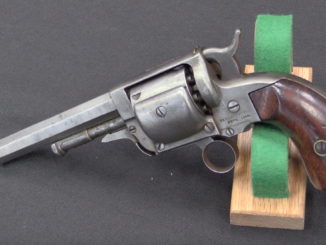
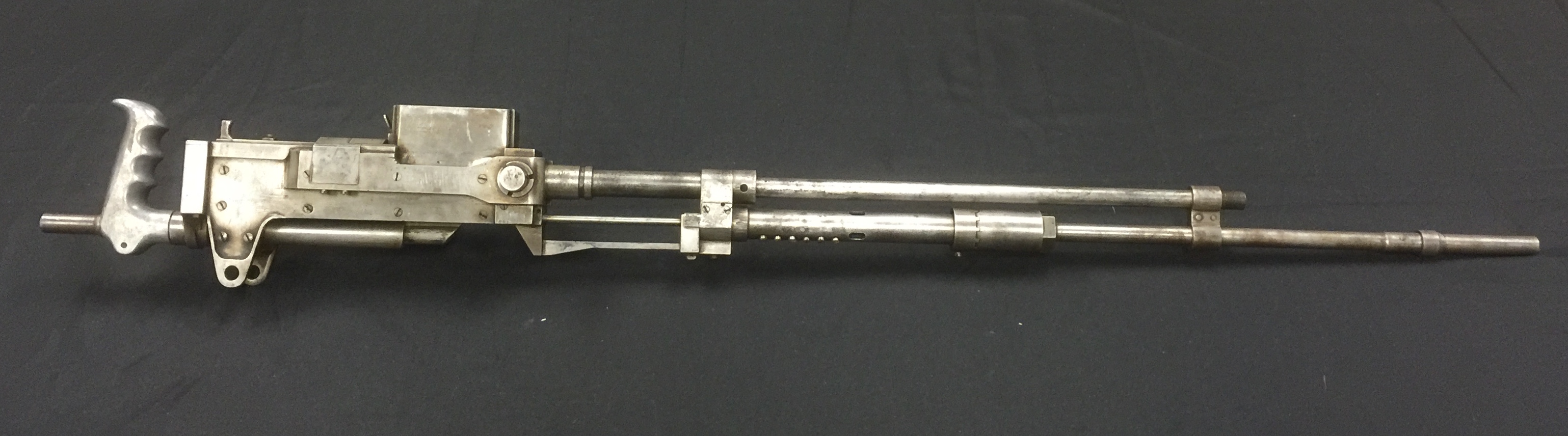

Look in any issue of Firearms News and you’ll see ads for Ar-15 upper receivers in all sorts of calibers from .17 Remington on up to .50 Beowulf , in every barrel length, weight, a rifling twist imaginable, and M1917 railed tops able to take any optical or electro-optical sight you lie. Or just plain old iron sights.
Mostly, since they are not legally defined as a “firearm” (unlike the serial-numbered lower receiver), you can order them online and have them delivered to your door, no FFL needed.
The problem wasn’t that Colt had a bad idea in this case (a rarity with them).
The problem was that, as with so many other instances, Colt was late to the game and all the seats in the arena were already full.
clear ether
eon
“(….)M1917 railed tops able to take any optical or electro-optical sight you lie(…)”
What do you mean by M1917 railed tops? What does mean to lie in context of sight system?
I’m gonna go out on a limb and interpolate from the eon…
I think that the “M1917” he’s referring to is a mis-remembering of the actual rail spec, which is “MIL-STD-1913”. Probably due to the way it sorta matches up with the M1917/Pattern 13/14 thing, and that might be why he expressed it that way. Easy enough mistake to make, on the fly and off-handedly.
English is like that.
I think that “lie” was meant to be “like”, but I’m guessing on that one.
You guessed correctly. I didn’t catch those errors until after I’d hit “post comment”.
As for the rail, I misremembered the number. I don’t like calling it a “Picatinny” rail because that’s not really correct. Like “battle rifle”, it’s one of those terms gun writers came up with based on the wrong assumption that it came out of Picatinny Arsenal.
Seriously, Hyvor needs an “Edit” button.
cheers
eon
Modularity is something that has come to serve as a marker of “clueless bastard” any time I hear of it.
The utility of this feature is nonexistent and anyone specifying it should automatically be kept far away from serious things and anything at all that really matters, to include the procurement of toilet paper.
I honestly don’t know where the hell this crap comes from, other than the fantasy-meme factory that was the “Man from Uncle” TV series, with its endlessly morphable P38 pistols.
For one damn thing, if you’re in a position to have all the bits and bobs with you to transformerize your CQB carbine into its ultra-long range instantiation, then you’re probably also in a position to actually, y’know… Have a real sniper rifle with you. The utility of being able to take the same basic rifle and do both roles with it is simply not there; too much has to change, and the transformation takes too long. It’s not like your SF bubbas are going to be wandering the Hindu Kush with their CQB weapons and a ruck full of accessory items to change them into sniper rifles at the drop of a tactical hat; that’s just not on.
Even when you do the transformation in the Arms Rooms, the problems then become more those of stock-keeping all the bits and bob, tracking them, and making sure you’ve got juuuuuuust the right configuration going out the door. The potential for confusion is near-infinite.
I think the idjit types that come up with this BS envision PFC Schmedlap walking up to the Arms Room issue window and specifying what he wants for that mission, as if the Arms Room were some sort of martial Burger King, and set up to issue weapons however the hell the individual soldier desires. Or, maybe his immediate supervisor…? Anyway, that simply ain’t on; it’s hard enough complying with the idiot security requirements during a mass-issue event, and then they want the armorer to somehow also issue out the damn weapons in some kind of custom mission-specific configuration?
Ain’t. Happening.
I can see absolutely zero scenarios where this is a good idea, in any sort of military or police situation that is not somehow artificially resource-constrained. Maybe for an embassy arms room, where you’re only allowed so many weapons? Maybe for some outlandish legal situation where you’re also limited?
This is something that only makes sense for countries where they limit you on the number of weapons you can own as a civilian; any other situation, it’s utterly stupid.
On the merits of it, I do have to acknowledge that the guys at Colt at least came up with something that’s a little more sensible than many other people have managed, but… It is very, very easy to see where and why this whole idea failed.
I do acknowledge that the general idea of “Same interface” on everything from CQB carbine to LMG is a great idea, and it really works when you’re talking about things like the Javelin and the Stinger, where the gripstock clips on and off the weapon-round package as you fire them, but… Outside of those things, this is a terrible, terrible idea.
Dear God in heaven above… I contemplate the level of complexity and sheer detail that adding systems like this to my Arms Rooms would have required, and I just sit here and twitch… As a leader and manager of the Arms Rooms, I’d have cheerfully slit the throats of each and every one of the idjit-class morons that saddled me with this crap.
I mean, it’s bad enough having all those additional accessory items like the lasers, the optics, the silencers… All of which are serialized, all of which are high-value and “sensitive item” status, all of which have to be tracked and inventoried… Now, you want to add multiple (*)$(&)*!* upper receivers to the mix?
All I can say is “Go $)(&*#)*%&** yourself” with that idea.
Quite likely Colt visualized the verbally susceptible (‘Ooooh, modularity. Makes me hot
‘n hard!’ ) getting together with the bean counters (‘So it’s like two rifles for the price of 1.43? Cool.’) It seems the hoped-for canal never was formed
‘Cabal,’ not canal
I think this was a classic example of the Good Idea Fairy ™ showing up and showering all and sundry with her pixie dust, resulting in the short-lived “modularity fad” coursing through the procurement system.
These things happen; it’s like contagion, a mind-virus. For other examples, see “SPIW/OICW/XM-25” or “bullpup”.
Like I said voluminously above, I simply cannot see the utility of “modular”, out in the “Really Real Army” I served in. The idea that you’re going to have a ruck load of spare bits to do “presto-change-o” with your individual weapon anywhere out in the field is ludicrous; the idea that anyone is going to do that even in an Arms Room setting is equally nutso, and the amount of drag this concept would levy on the entire system is mind-bogglingly huge.
I don’t think anyone ever really thinks at all about things like “Hey, how many man hours is it taking to track all of this BS we’re handing out, and what actual benefit does it provide?”
I think the actual numbers would numb the minds of most people who were paying the tax bills for it.
I mean, OK: Red Dot sight like the M68. Great idea; could be a game changer, yes?
However, ‘effing comma, let us look at how they were actually issued and used during our 2005 tour in Iraq. First point? They arrived in our unit almost literally as we were going out the door; if we were going to be able to train on them and get them zeroed for the deployment, that would have meant giving up the entire “Casing the colors” ceremony in front of the Post Commander, so… Yeah. We didn’t spend the time training on the new sights. And, when we did get the promised chance, in Kuwait, the ranges were seriously circumscribed ‘cos we weren’t special enough to get time on them.
Upshot? When we returned from Iraq in 2006, I ran a zero/qual range for the unit. Roughly 20-30% of the people we’d deployed with over there, many of whom went outside the wire regularly, still did not know how to zero or really use the M68 sight.
So, tell me: What was the point of even bothering to issue the ‘effing things? So far as a lot of my command went, they may as well have just left them in boxes back at home station. In fact, that would have been a superior course of action, because that would have saved the wear and tear on the sight units…
This modular crap would have wound up in the same sort of category, with the same stupid attached to it for most units.
The people who specified this stuff are fundamentally unserious, and total ignoramuses about what is needed or even necessary. As such, the fact that they’re making decisions on this stuff is ludicrous.
I blame the Stoner 63 “weapon system”.
https://www.modernforces.com/img/new_site/Stoner_1.jpg
https://www.reddit.com/media?url=https%3A%2F%2Fi.redd.it%2Fnp7cd4m7y7u61.png
Disregarding the top two in the second photo, the idea was that the grunt was supposed to carry all the bits to change his rifle to a carbine/sorta-SMG/ LMG/tripod-mounted MG/tank MG around with him in that canvas drag bag. Along with the ammunition, rations, and all the other s#!t he’d have to carry to be both combat-effective and, oh, yeah, stay alive.
I suppose we should be thankful that it was in 5.56x45mm and not 7.62x51mm.
Exactly who would actually need a gadget like the Stoner 63, and for what kind of mission, is apparently a question nobody ever got around to asking.
Having had some contact with the real deal way back when, I noticed that the basic rifle handled about like an FAL, but of course was a 5.56x45mm rather than a 7.62x51mm. So it was bigger and heavier than it needed to be, because the receiver was massively over-engineered to handle sustained automatic fire in the LMG/MMG/Tank MG role, the assumption being that all of the above would be belt-fed. Never mind the “assault pack” for the SAW role’.
About the best that can be said of the Stoner 63 system is that it was an ingenious solution to a nonexistent problem. Sort of like the double-action trigger on an automatic pistol.
clear ether
eon
There was earlier attempt at providing caliber-change in field in form of United Defense Model 1 https://guns.fandom.com/wiki/UD-1 from 1943. To avoid forgetting about different barrel it was also used as stock of said weapon.
loved that firearm.
Stoner designed it in 7.62X51. He despised the 5.56X45.
As usual, it had been Sullivan and Fremont that converted it in 5.56X45.
Many people get “modularity” wrong.
“Tactical modularity”. Modularity intended as “I have this platform, change those pieces and transform it in another thing on the run” have almost never worked in military environment. Almost always two different platforms would have costed less and worked better.
The modularity that works is the “logistical modularity”. “I have this item” (IE an engine, a chassis, a gun…) “and can use it in many applications”.
The RR Merlin XX “power egg”, for example, is an example of successful modularity. A modular engine installation, consisting of engine, cooling, all ancillary equipment and fairing, that could be rapidly mounted and dismounted on single, twin and four engine aircrafts.
I have to agree with you. There are really two sorts of “modularity”, and the ridiculous sort usually begins with some disconnected idjit, somewhere, saying “Wouldn’t it be cool, if…”, and then proceeds from there into the Twilight Zone of common sense. Stoner 63 was something along those lines, and like all such compromises, it didn’t work out in practice. At. All.
Stoner 63 offers an excellent cautionary example along these lines: As eon rightly points out, if you’re going to build a receiver capable of really handling sustained fully automatic fire, then that’s naturally going to be a very heavy affair… Which then flows into “Gee, everybody is carrying X amount of excess weight that will never, ever be really needed in the mode they use most…”
Which is why the only Stoner 63 bit that actually saw much use was the LMG. That’s what the system was designed around, so that’s the only one that really made sense.
Dogwalker’s second sort of “modularity” is really the only one that makes a lick of sense, and that’s really not “modularity” as the usual suspects define it; I’d propose that another term is needed, another phrase, something along the lines of “design commonality”.
If Stoner and the other designers had stuck to the idea of “Yeah, we’re going to design this Stoner 63 system around the idea of design commonality…”, then what they’d have done is create a system design wherein the interfacey bits were all the same across all platforms, like the stock, fire controls and all that jazz. Even some of the other stuff, like fasteners and pins might be the same, while the receivers and barrels were actually built for the job they’d do, like individual weapon and LMG. Nobody is going to be doing field swaps, out in the ruck of things, so that is entirely unnecessary. You could still get a hell of a lot of mileage out of having as much as possible interchange, but there’s no real point to being able to do the presto-changey-o BS like turn your LMG into a CQB carbine. As well, simplify training by making sure that the interface remains common, as appropriate, throughout the “system of small arms” that you’ve created.
Although, you have to apply some damn common sense: The control interface for a handgun that’s meant to do last-ditch final defense under exigency ought not reflect the one you put on an individual weapon, simply because the use case is so different; no need for a safety switch, for example. You could go for 100% commonality, but I think that you’d want to avoid that simply because what works in one case, does not necessarily work in another. However, if you’re looking at the dichotomy between “individual weapon” and “LMG”, I think you could make a most excellent case for saying “Yeah, aside from the added-on things like belt feed and barrel change, the interfacey bits can all be the same across both platforms…”, and that’d be a damn good thing.
I’d say that just having all the screw threads the same and all the retainer pins the same diameter would be an improvement.
For that matter, just having one pattern of safety/selector switch would be great.
clear ether
eon
Not to mention, the same damn detent pins across the fleet…
I looked at the fishing tackle box of spares I had, in order to keep everything running, and it occurred to me that if someone had applied some ‘effin common-ass sense, then that box could have been half the size it was. Even a quarter the size…
You should have the exact same detent on your M16 take-down pins that you have on your trigger-group pins for your MG; as well, that detent pin ought to fit the pistol you issue, and be used as many other places as possible.
If you’re sitting there in the depot, looking at all the different line items it takes to support the weapons fleet, you should be doing some judicious note-taking, and trying to figure out where you can standardize. I mean, why the hell is the pistol-grip screw for the M16 a unique item that gets used just about nowhere else? Wouldn’t it make a bunch more sense to mandate it be chosen from among a specific set of system-standardized fasteners?
Hell, why shouldn’t I be able to wander down to the motor pool and go digging for spares in the parts bins? Surely there are cross-compatible bolts already in the system that could work for that pistol grip…?
Lots and lots of this stuff just isn’t thought through. At. All.
Case in point: Look at the logistics effort it takes to get stuff into theater. Tons of packaging, tons of pallets and other dunnage. All of which has to be dealt with as waste once you arrive, and then which has to be shipped in again in order to redeploy. Stupid, stupid, stupid.
What they should be doing, and never do, is issue containerized gear that packs up such that you can just stick it into the 20 or 40 foot shipping container without having to stow it inside container inserts; the stuff you get that’s expendable, like MRE rations, ought to come packed inside boxes that you can just fill with dirt and then use as part of your field fortification plan, like over-sized bricks. The pallets ought to be able to be used as shoring and/or overhead cover, not just be something you’re forced to burn. And, if you are, then why the hell aren’t we deploying field incinerators that also, y’know… Produce power? I mean, we’re shipping all that crap in, we ought to be getting as much out of it as we can.
Not to mention, a field-deployable incinerator system for waste-burning would likely be a hell of a lot healthier than simply doing the open-air burn pits we were.
Every ounce that gets shipped in ought to be used at least three or four times, as an ideal. Hell, I’d go so far as to turn the food that gets eaten into biomass for conversion into methane gas, instead of burning it.
Nobody really looks at this stuff at all holistically. If you shipped everything in pre-manufactured field fortification components, included a field incinerator for supplementing your power generation needs, and also converted all that human waste into methane for the same purposes, I dare say you could probably decrease the amount of crap (literally…) that you had to deploy by a significant fraction.
This is a FRANKENSTEIN clusterfreak.
Who would ever commit to this perverted system?
What was Colt marketing thinking (or NOT THINKING?)
Would YOU want to have to deal with this nonsense?
No. I would buy two weapons, which I’d wager you could for the cost of this monstrosity.
Modular bast@#£’s. Generally. They do it with planes. Arrrrrggh!
I think I’m happy with my SCAR H.
Secretary of Defense Robert McNamara
Endorses this weapon system alongside the Tactical Fighter Experimental (TFX).
When I learned that Mr. McNamara’s middle name was really and truly “Strange”, I had a bit of a dark little giggle over how apropos that was. Fate has a way of making reality out of casual naming, oddly enough, and Mr. McNamara was surely one of the stranger idjit types to ever get to the top of any hierarchy.
I spent some time with a GM engineer, oncet upon a time. He had this contention, this theory that Mr. McNamara was the primary offender behind the fall of the US automobile industry, in that his ascension to the heights of the Ford Motor Company led to his mentality being templated out across every other automobile company, and that the effects were pernicious. I don’t know how true it is, but supposedly, Mr. McNamara was one of the leading lights in the way that W. Edwards Deming became a prophet without honor in his own land, and why Mr. Deming wound up going to Japan, where someone would listen to him. Apparently, Mr. McNamara and his fellow “whiz kids” ran the numbers, and they concluded that Deming was a crank.
No idea where that came from, in terms of providing actual citations for it, but it’s a bit of automotive engineering lore I found… Fascinating. Especially being a victim of the long-term pernicious effects of Mr. McNamara’s thinking in the US military. The man was a friggin’ menace.
I don’t doubt but that the original specification for the Stoner 63 likely came out of some of his “thinking”, because it would be totally consonant with it all: Pointless “modularity”, just like the F-111 and the F-35.
I still say that while we’ve plumbed the depths of “intelligence”, ain’t nobody managed to quantify or test for “wisdom”, which really ought to have been the first thing they did, before elevating pure “IQ” to the top of the virtue lists.
Smart is only as smart as smart does, and when smart starts churning out (and, worse yet, putting into production…) ideas like the Edsel, the F-111, or the Stoner 63, you begin to recognize the outline of why “smart” ain’t necessarily the same as “wise”.
As I recall McNamara was responsible for the Edsel.
Somewhat off-topic, yet still germane:
https://www.airforcetimes.com/news/your-air-force/2025/10/27/airman-found-dead-in-wyoming-was-under-investigation-in-fatal-shooting/
At the time that this incident happened, I remember thinking and predicting that the whole “M18 failed and killed an Airman…” would prove to have some component of lower-enlisted f*ckery. And, I’m sad to say that it apparently did…
This sort of thing is tragic, and I really don’t know how the hell you prevent it. Young people and firearms are often tragically casual acquaintances, and it isn’t until age and misadventure drives home some serious lessons on things regarding safety and not screwing around with firearms inappropriately.
Sadly, this represents two dead young men who really shouldn’t be.
How exactly is this modular approach going to work?
People stand up in the morning, vi to the armory and say “I feel like 7.62 today”?
Or the whole army would re-equip the rifles, once their primary caliber changes?
As all the expensive stuff is sitting inside the upper receiver, I really fail to see the advantages of having a “modular” lower receiver instead of several complete rifles of different caliber.
I suspect that somebody has imbibed too much G.I. Joe. (The toys and comics both.)
“Hey, let’s have a single platform that we can switch calibers on as needed. That way, when we send a covert team in somewhere they can use the guns they’re used to but in deniable calibers.”
Train on 5.56 x 45mm, but switch to 7.62 x 39mm for a mission in Somalia. Or 5.45 x 38.5mm for one in Myanmar. Etc.
Putting on my old CSI hat, I can tell you that one of the first things any investigator with an ounce of sense will look at on a recovered fired cartridge case is the primer and the rim. Firing pins, extractors, and ejectors all leave distinctive marks, that can not only tell you what type of weapon the case was fired and ejected from, the striations left on the case by those bits will tell you exactly which weapon it was. Just like rifling marks, only more so; the breeching bits don’t wear as fast as the bore does, so the striations remain unchanged for a longer period of time.
So, what you’ll really get is
“These 7.62 x 39mm cases were supposedly fired by some local in an AKM. But the breech-face end markings are consistent with an FN SCAR 20 7.62 x39mm. Only the American special operations forces use that rifle.”
Oops.
They might also sell it as a cost-cutting measure. One rifle per man but several caliber options.
Rather overlooking the fact that a rifle built for that kind of switcheroo will likely cost as much or more as three or four compete rifles, one in each caliber you want to use.
In short, you won’t be saving any money and you won’t be fooling anybody with at least two functioning brain cells.
So the two basic arguments in favor of this just don’t hold up.
Want to shoot 7.62K instead of 5.56 NATO? Get an AKM. There are certainly enough of them floating around the Second and Third Worlds.
There’s a reason SF used to put high emphasis on foreign weapon familiarity. This is pretty much it.
clear ether
eon
Told ya…
https://apnews.com/article/sig-sauer-m18-air-force-p320-death-7a063fc3039d311fd2dc5cdb6657b637
I would love to know the actual details here, as to motivation. I feel like there’s rather more to all this than just “Airman A jokingly points loaded weapon at Airman B”…
Hazing, maybe? Gang-related? Feels like there’s rather more going on here, is all.
I have always appreciated the AR platform for its modularity. At one time, I had a single 5.56 rifle and pistol calibers (9mm & 45 Aco) uppers with the appropriate magazines and/or mag blocks, a rimfire conversion as well as a 7.62×39 conversion kit. So, the Colt 901 was a natural choice for me. The knowledge of the platform, controls, and convenience of “the right tool for the right job” was a practical choice.