Given the influx of very inexpensive Beretta M1934 pistols into the US market – and the fact that I have a fine Carabinieri hat – it is a no-brainer to run the monthly Back Up Gun match with one. It’s chambered for .380 ACP (aka 9mm Corto) and holds 7 rounds in the magazine…a perfect “backup gun” candidate.
Submachine Guns
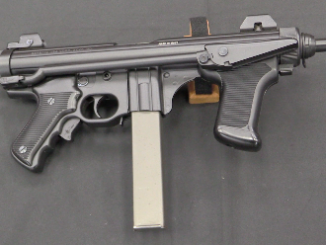
The Beretta PM-12S Submachine Gun
For several decades, the Beretta company’s handguns and submachine guns were nearly all designed by the very talented Tulio Marengoni…but nothing can last forever. After World War 2, Beretta engineer Domenico Salza began working on […]
Semiauto pistol
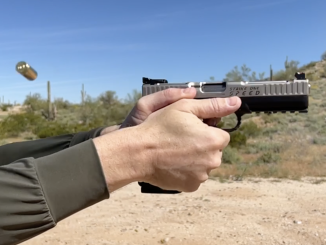
Arsenal Strike One: Russian Police Pistol Comes to the West
The Strike One pistol originated around 2011 as a collaboration between Nicola Bandini and Dimitry Streshinskiy as a pistol to replace the Makarov in Russian police use. By 2014 is was progressing very successfully through […]
Bolt Action Rifles
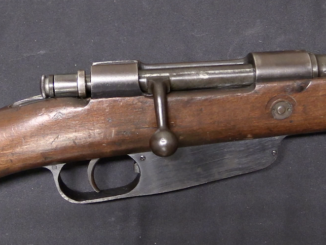
Krieghoff 8mm Mauser Carcano for the Volkssturm
When Italy surrendered in late 1943, German troops disarmed the Italian forces in areas under German control, and came away with nearly 400,000 Carcano rifles. These would form the core armaments of the Volkssturm forces […]
I am shocked. Ian actually took a real backup gun to a backup gun match.
The 934 was not a buckup gun, but regular military side arm – blowback in .380
But actually Makarov wasn’t much bigger and more powerful. For what officers’ side arms were meant for in European armies (being worn on the belt as a status symbol, used for occasional on-the-spot disciplinary action or for the honorable exit) a round like .380 was considrered more than enough
In Ordnance Went Up Front (Samworth 1948), Roy F. Dunlap spoke very highly of the Beretta M1934 in “9mm Corto”.
Having become acquainted with it in Egypt, he opined that it was accurate, reliable, pretty much “soldier-proof”, and that the .380 ACP hardball with about 200 FPE muzzle energy was at least as effective as the Webley MK IV, Enfield, and S&W Victory Model revolvers in 0.380in aka .38 S&W, which had about the same delivery.
He said that it shared the M1911A1 .45 automatic’s virtue that it was nearly indestructible in service and tended to work no matter what.
I’d say that you could do a lot worse than a clean, well-preserved M1934 .380 as a backup gun. Or for that matter one in your bedside table drawer.
clear ether
eon
Which, of course, opens up the never ending debate as to whether .380 is sufficient for self-defense.
The argument presented here is that if a major European country kept it in service, long after 9mm dominated the continent, then can the caliber be all that bad?
Studies going back to WW2 have shown that even the pipsqueak .25 ACP hardball achieves the semi-mythical “one-shot stop” at least half the time. And no pistol cartridge does any worse than that, statistically speaking.
Generally, anything which hits the heart, the aorta, or the brain, down they go.
As Lewis Winant pointed out in Firearms Curiosa, even the lowly .22 Short could put a man beyond aid in one tick of the clock with a single shot. He advised not sneering at “pocket-knife” guns in .22 Short for that exact reason.
People are no tougher now than they were a century or so ago. And small pieces of metal going just under the speed of sound are no less dangerous now than they were then.
clear ether
eon
Out of hundreds of career homicides I worked, the most amazing shot I saw was a .25 ACP from 56 yards into the eye. Instant stop of a running man.
And there is the story of a woman in Alaska dropping a grizzly bear with one shot from a .22 rifle. She know just right where to put the bullet. Which is a lesson in that it does not matter what the power of a firearm is if the shooter is not competent in handling the firearm and is well practiced in its use. So you all don’t sit on your butts staring at a computer screen. Go hit the range.
Out of 98 PMs, 34 of which were GSWs, I only saw three definable as “one-shot stops”.
One was a .38 Special 158-grain RNL that hit the heart, shutting the decedent off almost instantly.
The second was a .25 ACP FMJ 50-grain that penetrated the upper left ventricle of the decedent’s heart. Again, almost instantaneous cessation of aciton.
The third was a .25 ACP 50-grain FMJ that missed the heart and punched through the aorta just below it. It cut the side of the aorta, and heart action did the rest.
When the ME cracked the chest, most of the decedent’s five and a half liters of blood was pooled in the back of the torso (since the body was lying on its back on the table). the heart, still “pumping” for a minute or so after the event, had literally pumped the blood that should have gone to the legs and internal organs out through the ruptured aorta and into the body cavity.
Three more examples why nobody who understands forensic pathology wants to be shot, stabbed, etc., with anything.
Especially me.
clear ether
eon
That could just be because they so seldom fired one in combat. But yeah, as Eon points out, there is not a lot of difference between commonly used handgun calibers. I was looking at a piece online yesterday that presented stats that even between .25 ACP and .45 ACP, the gap between one-shot stops is about 10%. (40% vs 50%). If true, a .380 has s lot to reccomend it
Eon:
I agree, the .380 acp is much the same as the .38 S&W used in the Webley, Enfield and S&W Victory revolvers, but in a neater package.
The 1934 is a good little piece. Its main drawbacks are a safety which cannot be used by the thumb of the right hand, and the fact it locks open on the magazine follower, so the slide closes as soon as the magazine is withdrawn. Personally I preferred to use the half cock notch rather than the safety, though I appreciate this is frowned upon by some.
Josserand & Stevenson in Pistols, Revolvers and Ammunition (1972) stated;
I suspect the Beretta Model 70, with its wider, curved backstrap was more to J&S’s liking, also the Beretta Cheetah family (Model 81, 83, 84, 85, and 86) for the same reason.
Among them all, my choice would be the 84 with the double-stack magazine and 1911-style safety. That way I wouldn’t have to thumb-cock or put up with Walther-type DA nonsense unless I absolutely wanted to.
Cue the Mike Hammer theme.
cheers
eon
I could be wrong, but that looks like an Alpini hat rather than a carabinieri hat.
Definitely Alpini.
In 1972 they were actually still MILITARY guns in the Italian Army – though the Ethiopian export batches would probably be true commercial production, not Army surplus
The M1934 remained in service because its 9 x 19mm successor, the M1951 aka Model 951, proved to be somewhat less satisfactory than either Beretta or the Italian military had hoped.
The 951 was prone to cracking the slide at the locking block notches. Wartime production P.38s had similar problems, notably ones made by Spreewerke. The P.38 problems were due to poor metallurgy; the 951’s were mainly due to insufficient metal thickness in the sidewalls of the trademark “open-top” Beretta slide. A design fault rather than a manufacturing shortcoming.
The crossbolt “pushbutton” (shotgun type) safety on the 951 proved to be both clumsy and prone to slipping from “Safe” to “Fire” in the holster. It was replaced in late production by a 1911-type thumb lever safety. Most 951 users ignored the “shotgun” type safety anyway, carrying the pistol in Condition Two (hammer down on a loaded chamber) and thumb-cocking it on the way up. (Users of the French Mdl 1950 9mm pistol did it that way, too.)
The Israeli Defense Forces, the Egyptian Army, and the Iraqi Army all adopted the 951 in the 1950s, the latter two building themselves under license. Nobody seemed particularly pleased with the results.
clear ether
eon
Dear Ian
First of all, congratulations on the quality of your videos and the quality of your American English, which is understandable even to a foreigner.
A small clarification: the hat you used to test the M34 380 ACP at range is not a Carabinieri hat, but an Alpine one, a unit equivalent to your 10th Mountain Division.
Congratulations again for what you do.
Do it again with a Beretta 1935 .32 ACP just for side-by-side evaluation.
I have that Little Beretta in both .32 and .380. The shot just fine in both calibers, are accurate for a small gun, and fit your hand nicely. Complainers should just buy another gun.
Part of buying another gun is trash-talking the one you opted out of. Probably a reassurance thing
Aside from the fact that it’s an Alpine (soldier) hat, the 34 made a lot of people see green mice, just like the 1951.