In 1954 and 1955, the French company SOFAM (Société de Fabrication d’Armaments) in Paris marketed a system to convert bolt action rifles into submachine guns. The original design is reportedly Spanish, but was marketed through the French company. The design was pretty simple, using the stock and trigger guard of the rifle (in these examples a Mauser 98, but conceivably any type would do) and manufacturing a new receiver, bolt, barrel, and trigger system to go with them. The pitch was that production could be stood up in six months with minimal technological outlay, ideal for less-developed nations looking to upgrade their small arms. However, the cost calculations didn’t appear to make sense, as no buyers were found.
Many thanks to the IRCGN (Institut de Recherche Criminelle de la Gendarmerie Nationale) for allowing me access to film these two examples for you!

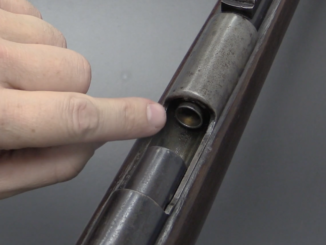
It doesn’t really make a bolt-action rifle into an SMG. It just recycles the back half of the stock and the trigger guard to put a completely new SMG mechanism on top of.
Which is basically what Erma did with a modified Mp28 stock and Mp38/40 action fifteen years earlier to create the Mp41.
clear ether
eon
Presented weapon looks similar to CZ 247 https://modernfirearms.net/en/submachine-guns/czech-republic-submachine-guns/cz-247-eng/ especially considering trigger behavior (short pull = single, long pull = full-auto). Considering Czechoslovak sub-machine gun was briefly manufactured during late 1940s as CZ 247 and sold in noticeable quantities to certain African and South American countries it seems plausible that ARAC was attempt to compete with them.
And Mr. M. made a video about it a while back. https://www.forgottenweapons.com/cz247-experimental-swivel-action-smg/ Fascinating weapon.
Different trigger group. Hugo designed the MP-41, and being its main purpose was a police gun, it was select fire. The MP-38/40s were full auto only. I got some good “Hands on” with a MP-41 a few years back and now understand where it fits in the German subgun story. My early Steyr MP-40 is so sweet to shoot, the 41 with the wood stock, even better.
“(…)pitch was that production could be stood up in six months with minimal technological outlay, ideal for less-developed nations looking to upgrade their small arms.(…)”
Now this sounds like person doing marketing and person doing design understand what they are doing exactly opposite. Observe that elements reused – wooden furniture and trigger guard – are easy to made even with limited industry.
This makes me think of the US Army making Trapdoor rifles from surplus Civil War rifled muskets, because it would be “cheap to do”.
Look at Snider- Enfield breech-loaders.
supposing you do set up your production line, then what do you do with your leftover K98 barrelled actions?
Sell them to even less developed countries
Blow them off to surplus dealers in the United States. At that time, custom gunsmiths here were begging for then modern-production ’98 actions to build custom rifles with.
The problem was that the actions varied from rock-solid to likely to blow up, and there was no way to tell in advance. In one case, a between-the-wars Mauser action used to build a .22-250 blew up in one writer’s face, and he spent a non-salubrious day at the ophthalmologist’s office getting brass fragments picked out of his left eye.
Being a friend of Philip Sharpe, he took the pieces of blown-up rifle to same, and Sharpe wrote a two-and-a-half page analysis of the incident. Short form; the custom smith who built the original rifle in 9 x 57 Mauser around 1930 had case-hardened the receiver but in the process had burned the steel in places. There was a crack on the inside of the receiver ring about even with the top edge of the right-hand rail, that was much older and duller than the rest of the fractures. It had finally failed due to the higher pressure of firing hundreds of .22-250 rounds over five years.
(“When A Rifle Blows”, Bob Bell, Gun Digest 1997 51st ed, p. 106.)
Most of the 98 actions that were transformed into custom rifles in the U.S. from the late 1940s to the mid-1970s probably arrived as barreled actions minus everything else. The interesting thing is that almost nobody in the custom rifle trade wanted anything other than a ’98 action.
The Japanese Arisaka Type 99 action, for instance, was not favored in spite of being better-designed, made of better steel with better heat treatment and more consistent QC, and having a standard safety that was far and away more easily operated while wearing gloves, not to mention requiring no modifications for scope mounting.
In fact, a 6.5 x 50SRmm Arisaka could be altered to .308 Winchester or 7 x 57 Mauser by a simple rebore and rechamber with no other modifications needed. A few minor alterations would be necessary to convert it to “standard” .257 Roberts, but converting it to .257 Akeley Improved Roberts was a simple rechambering job. (Both were popular deer cartridges at the time.)
Custom rifles on surplus Mauser-type actions are almost extinct today, mostly because custom smiths now generally start with “purpose-built” newly-manufactured actions. It’s probably the best way to do it- assuming whoever builds the action knows what he’s about.
clear ether
eon
Ream a bore to 9×19 and make submachine gun barrels out of them, heh
My uncle was recalled by the army to test weapons at Aberdeen during WW2. He told me the 6.5 Arasaka was the strongest bolt action of any tested there including the Mauser 98 action.
This gun re-purposes the cheapest part of a gun: stock while needing all new expensive parts: trigger-mechanism, barrel, bolt, etc.
This reminds us of the Cessna 160 airplane that first flew in 1962. The goal was to reduce purchase price by simplifying production of the fuselage (aka. “gunstock”) with a constant-chord wing, corrugated fuselage skins, etc. but all the bolt-in parts: engine, propeller, landing gear, instruments, radios, etc. still cost the same, so retail price ended up almost as much as the 4-seater 172 model that it was supposed to replace. Cessna only built a single 160 prototype and it never entered production.
Interesting info! I guess they couldnt cut the corners because all that bolt in gear was made by different companies