
Designed by Bartolomeo Girardoni the in the 1770s, the Girardoni is an air rifle that can fire 20 rounds as quickly as a modern bolt action rifle. It uses .46 caliber round lead balls, delivering 154 grains of lead per shot at about 1000 fps. This was a revolutionary weapon when it was created, and it was adopted by the Austrian army. However, its manufacturing was very difficult, and not enough were made before the inventor’s death to make a significant effect on and battles. Poor tactical use of the guns that did get into service didn’t help. It wasn’t until more than 60 years later that an equally effective military rifle was developed, that being the Spencer.

Semiauto pistol
Steyr GB
After World War II, the Austrian military used a mixture of Browning High Power and Walther P38 pistols – they were effective and available in large numbers so why not? However, by the early 1970s […]
Bolt Action Rifles
Steyr M95 Semiauto Conversion (Video)
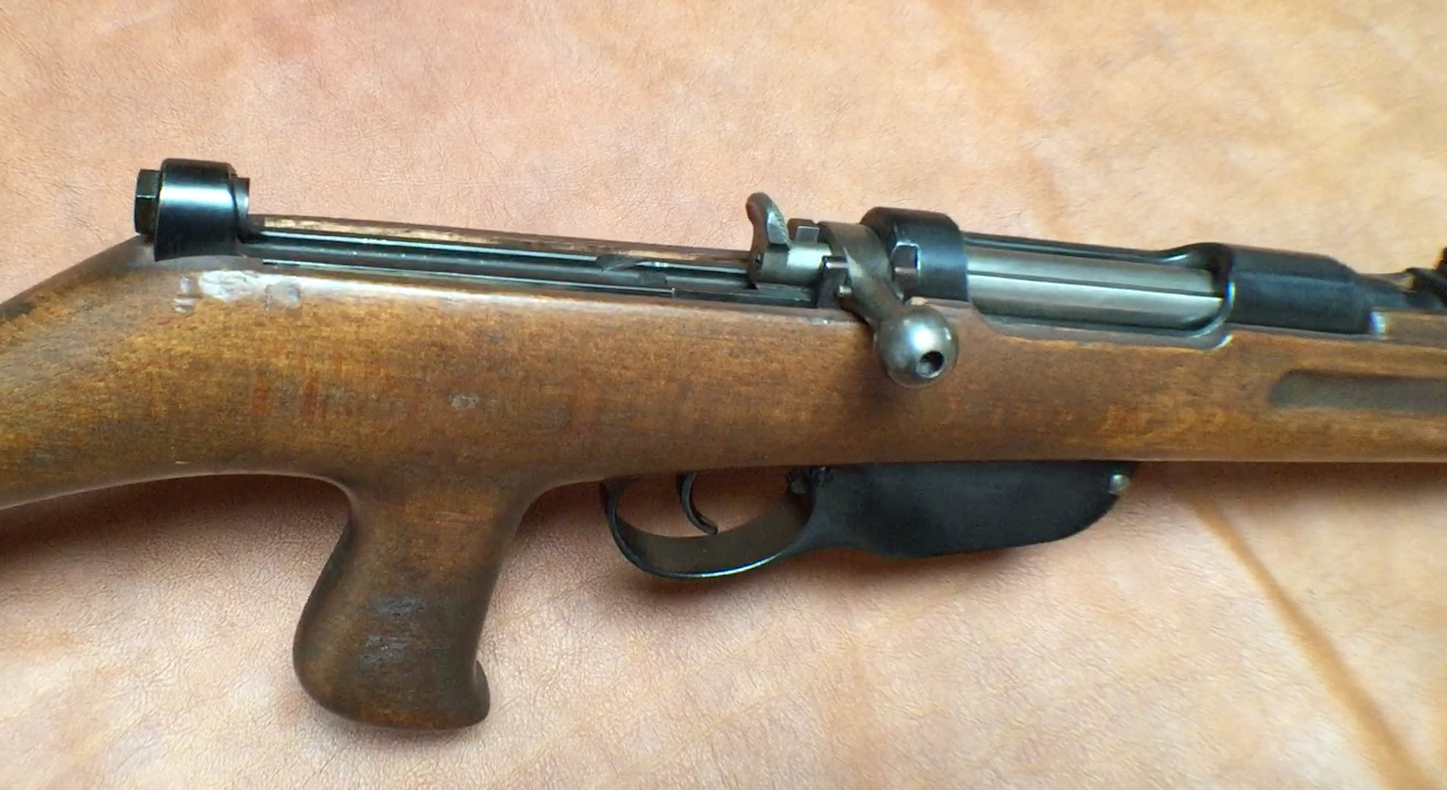
This rifle is a Steyr M95 straight-pull carbine that has been converted into a semiauto by adding a gas piston under the barrel connected to the bolt carrier, and an extension to the stock and […]
Semiauto pistol
Looking for Some 7.65mm Mannlicher Ammo…
Update! Thanks to some leads I got, I now have 200 rounds of ammo inbound; half Argentine surplus and half modern loads made from .32-20 brass (and some great resources for other odd calibers I’m sure […]
Pre-Charged Pneumatics (PCPs) are the most powerful air rifles in use even today. Most are between .30 and .45 caliber, although the Dragon Claw from China is a .50 caliber. Most of them are powerful enough for small game, some can take deer-sized game.
Generally, the .30 caliber class ones have the highest muzzle velocities, making them the most suitable for medium-sized game. The .45 to .50 caliber versions are roughly equivalent in velocity and etc. to a typical “”Kentucky” rifle, assuming an average load of 150 grain bullet and 60 grains of FFg black powder.
The Girardoni could easily have been redone for conical bullets, simply by making the “loading block” longer front-to-back and having a coil spring and a cylindrical follower in the magazine tube. This would have eliminated the need to elevate the muzzle to reload, as well.
In the first edition of Gun Collector’s Digest (DBI, 1977) an article about antique air rifles shows a centrifugal filler pump for the Girardoni air rifle. Mounted on a stand, it had a set of flywheel weights to keep it rotating, and the air tank “stock” was mounted valve-end-down on top inside a canister that was filled with water around it to keep it from overheating. Five minutes of cranking could pressurize the cylinder to roughly 1,200 PSI (82.73 bar). While probably handy for “military” operations, it was more likely intended for sporting users. Perhaps an “air gun club”?
cheers
eon
Definitely a gun for special forces. A concept not really developped at this time. And anyone who would have suggested such, would face push back from generals who only knew about putting soldiers in a line and slaughtering the enemy troops in their line. I can see cavalry with horses carrying a supply of pressurized air tanks. Also why did noone think about a larger airpump to fill tanks faster. Think about the fire engines of the day with seesaw pump handle. Overall, I get the impression that Girardoni had to pretty much hand inspect every rifle. When he died, there was noone smart enough to take up the work.
I thought the Austrians employed the guns with ‘Jaeger’units, light infantry troops that were assigned scouting and skirmishing duties. The closest thing that existed to ‘special forces’ then. One reads of troopers caught with the rifles being executed by the French during Napoleonic wars. Apparently shooting quietly from concealment was cintrary to the Gallic sense of ‘egalite’ being exported. That aside one questions whether industrial technique at the time would have made large scale issue of the complex weapon viable.
Funny how all that works, what with the Germans executing “francs-tireurs” in job lots a few generations later…
It’s only considered cheating when it’s the enemy, and it works, apparently.
All this work was for an equivalent of a big heavy .38 special rifle. Even using modern technology that’s pretty useless beyond a hundred yards or so. The much cheaper and simpler Jaeger and Baker rifles well outranged the ordinary musket, and that was the value the generals sought.
Armies then weren’t as vulnerable to modern “special forces” operations as ours are.
Also I’ve always though that a reproduction of these would sell a couple of thousand units or so.
Still 20 shots fast is pretty daunting to soldiers with slow loading smoothbores accurate out to only 50-75 meters
Now add rain.
Did Lewis and Clark have one of these on their expedition? Thanks, Nick
Yes.
Do I not remember a video on this very site or channel about this weapon or a similar air-driven weapon? Wherein a guest expert demonstrated its use with, I think, a modern reproduction? Here we are — 2014! Search for “air rifle” on the FW site. I’m not going to watch it again but if my memory is correct it is worth viewing.
Slightly off-topic, I recall Sherlock Holmes bagged an assailant armed with a single-shot air rifle. Was there any weapon for sale in late Victorian England that conformed to the tale. The gent who wrote thr Flashman novels has an elderly Harry present at the hilarious denouement of his version of that case
Indeed. “The Adventure of the Empty House”, where Sherlock Holmes finally gets the better of Colonel Sebastian Moran. This happens while Moran is busy trying to assassinate Holmes with a high-powered air rifle. Arthur Conan Doyle writes:
“Holmes had picked up the powerful air-gun from the floor, and was examining its mechanism.
‘An admirable and unique weapon,’ said he, ‘noiseless and of tremendous power. I knew Von Herder, the blind German mechanic, who constructed it to the order of the late Professor Moriarty.'”
I always suspected that Conan Doyle was inspired by the Girandoni air rifle, but I am not aware of any specific comparable weapons in Victorian England.
“(…)suspected that Conan Doyle was inspired by the Girandoni air rifle, but I am not aware of any specific comparable weapons in Victorian England.”
https://www.airgunexpert.com/what-is-an-airgun/airgun-history/ claims that
…1899 the sport of competitive air rifle shooting had grown so large that a
National Smallbore Rifle Association was founded. During this time, in excess of 4000 air rifle
clubs and associations existed across Great Britain, many of them located in Birmingham. Also
around this time, due to the airgun’s ability to fire a shot without a significant report, airguns
become associated with poaching (illegal game hunting)
I bet last fact was inspiration, but I am unable to provide direct evidence that Doyle know about that.
Thanks. I was unaware that air guns were this popular in late 1800s Great Britain. Regarding Conan Doyle, according to his Wikipedia page (caveat emptor), he founded the “Undershaw Rifle Club” in 1900, and was supposedly also a champion of “miniature” rifle clubs, where members could shoot small-calibre weapons at local ranges. It thus makes sense, I think, that Doyle would have been aware of the popularity of air guns, and of their possible “extra-legal” uses.
Looking it up last night, I found that Adrian Conan Doyle (his son) stated that the rifle described in the story was one his father owned. It was .45 caliber (11.25mm in Continental measurements) and could use the same bullets as the .450 Eley’s no. 2 cartridge for the Webley Metropolitan Police pocket revolver- which his father also owned an example of. It seems that “soft-nosed revolver bullets” in .32, .38, and .45 caliber were fairly common in Britain at the time.
Dr. Doyle apparently had a considerable number of firearms in his personal collection, some acquired in his travels and some gifts from friends and admirers of his work. Watson’s “old Army revolver”, an Adams .450, was in fact the one Dr. Doyle had carried as an army surgeon in the First Boer War (1880-81).
Watson’s pocket revolver, a .380 (.38 S&W) with a safety catch, described in “The Problem of Thor Bridge” was another in Dr. Doyle’s possession, a standard Webley MK II pocket revolver introduced in 1893 and yes, the same type used in .32 S&W caliber by Emma Peel (Diana Rigg) in The Avengers (1967-69).
The descriptions of rifles in Lord John Roxton’s arsenal in The Lost World (1912) were again based on ones Dr. Doyle owned.
As a side note, in England at the time, “rook rifles” , break-action single-shots using .32 and .38 caliber cartridge similar to the American .32 S&W Long and .38 Colt revolver cartridges, were commonly used to dispose of “rooks” (crows) that pestered farmers. This involved shooting them out of the trees they roosted in- by firing the rifle upward at about a 45-degree angle. Apparently nobody worried too much about where the bullet might land if they missed.
An air rifle such as a .38 or .45 Kurbelspanner or Bugelspanner would seems to be an entirely reasonable choice for this sort of thing, if you didn’t want to make a lot of noise doing it.
cheers
eon
They were German, actually.
https://www.cinedux.com/resources/bspanner.jpg.opt1375x709o0%2C0s1375x709.jpg
https://www.littlegun.info/arme%20allemande/artisan%20u-z/venus%20waffenwerk%20oskar%20will%20illustration-06.jpg
The Kurbelspanner (the one with the separate crank) used a rack-and-pinion to wind a piston in a syringe tube back against a volute spring.
The Bugelspanner used a lever built-in to the stock to haul the same sort of syringe back, or in some cases inflate a bellows-like air chamber. Some modern underlever air rifles still use this system, except with the lever under the barrel. Side-lever air rifles use almost exactly this system with the syringe inside.
Most in that era had bores of 9mm or 11mm, launching pistol-type bullets at velocities of around 300 m/s.
So, the air rifle in “The Adventure of the Empty House” was most likely based on an actual air gun, made in Germany, that was commercially available in England at the time.
Holmes’ description of it (“noiseless and of tremendous power”) would be correct in the era. With a MV under the speed of sound, there would be no ballistic “crack”, just that “strange, loud whiz” Watson described. That would be the piston slamming forward in the syringe and venting compressed air into the barrel. It would not be audible for more than a few yards from the shooter’s position.
As for “tremendous power”, a rifle like this would launch a “soft-nosed revolver bullet” at velocities equivalent to a medium-velocity Magnum revolver load of today. As in roughly 450 to 500 FPE at the muzzle. Compared to the .45 Colt (405 FPE) and .44 WCF (430 FPE) from revolver-length barrels, this would indeed be significantly more power than you’d expect from a revolver shot. No wonder it completely penetrated the Honourable Ronald Adair’s skull and expanded more than usual.
Incidentally, one sure sign that the bullet had not been fired by a conventional revolver would be the lack of powder-blackening and ablation on the base of the slug. We have almost forgotten that today, with smokeless powder, but with black-powder loads of that time any revolver bullet not fired with a gas-check behind it would be almost certain to be scorched and partly melted by the effects of black powder burning at roughly 3800 degrees Fahrenheit.
cheers
eon
eon,
You were in forensics, right? What would the effects be of patching on ball rounds? Sabots?
Friend of mine once discussed with me the difficulties in dealing with things like saboted projectiles for muzzle-loading rifles, and other weapons. He was saying that the main reason they went out of fashion back a few years ago was pressure from the authorities because the sabots basically made projectile comparisons impossible…
I never knew whether or not to take him seriously on that. I always thought it was accuracy at long range that did those in…
Check out the ammunition for the Dreyse needle rifle;
https://www.gunboards.com/attachments/dreyse-book_0005-jpg.3974483/
The bullet was enclosed in a papier-mache’ sabot and never actually touched the rifling.
Since the first model Dreyse was a muzzle-loader, using the same round, I would say that any muzzle-loader using a similar setup would perform about like the needle gun.
And yes, the sabot meant that the bullet was not in any way “engraved” by the rifling, just like “accelerator” rounds of today.
Ballistics evidence hadn’t really been invented yet at that time, but even if it had, the lack of rifling marks would have been either a major handicap to an investigator or a dead giveaway. (“Yes, Herr General, the fatal projectile was definitely fired from a Dreyse, but there are 200 in the armory at this moment.”)
As for accuracy, muzzle-loading rifle muskets and etc. were always over-rated. As Jack Coggins related in Arms and Equipment of the Civil War (1962), in official U.S. Army tests in 1859 the then-new .58 Springfield and Pattern 1853 .577 Enfield were shot side-by-side.
At 100 yards, both kept all of their bullets (20 rounds each) on a two-foot-wide by six-foot tall target board- 100%. At 400 yards, both could hit a four-foot-wide by eight-foot tall board with 12 out of 20 shots- 60% hits.
At 600 yards, on a sixteen-foot-wide by twelve-foot high board, neither one could obtain more that five hits out of 20 shots; 25% hits.
At 800 yards, in the words of the official report, “Both shot so wildly that no records could be kept.”
in actual service, volley fire tended to disguise this shortcoming. The Table of Fire for the (breechloading) Snider-Enfield is interesting to look at.
Sighted at 100 yards, highest point of trajectory was 4.5 ft (1.37m). Sighted at 300, it was 7 ft (2.13m). “First catch” on infantry was “Throughout” out to 200 yards (183m), but at 300 it was 220 yards (200m). Cavalry was “Throughout” at all ranges listed.
“Dangerous space” for both was “Throughout” to 200 yards, but for infantry when sighted at 300 it was only out to 135 yards (123m).
Sighted for 800 yards (highest setting on the slider), highest point of trajectory was 44 feet (13.4m) above line of sight. First catch for infantry was 790 yards, and 780 for cavalry (call it 715m either way).
Dangerous space for infantry ended at 20 yards, and for cavalry at 30 yards off the muzzle.
(Myatt, Fredrick C. Illustrated Encyclopedia of 19th Century Firearms. London; Salamander Books 1979, p. 84)
The Snider breechloader had almost exactly the trajectory of the .577 muzzle-loader and the American .58. As can be seen, none of the three were likely to hit a single chosen target much beyond 300 yards.
A smart officer ordered his men to set sights for 100 yards, and hold fire until the target was within 250 yards- a “dangerous space” going right up to the muzzles of his rifles.
Whether you’re talking about muzzle-loaders, M16s, or the English archers at Agincourt, except for volley fire “by the numbers, by ranks”, shooting much “beyond 300” isn’t much more than a waste of ammunition.
clear ether
eon
And, the point I keep making:
The machinegun is the modern-day equivalent of volley fire.
Unfortunately, the manic gravel-belly types seem to be unable to comprehend that shooting a precision point-target weapon at an area target is an exercise in stupidity.
I once met a guy who got really into the old Remington Accellerator sabot rounds (guy had been a tanker, I guess he was enamored with sabots generally), he said they regularly but unpredictably throw flyers, by his guess because the sabots weren’t made precisely enough
The entire story of the Girardoni just goes to show that there is a lot of meat to my theory about the “how” of weapons use being more interesting than the weapons themselves.
The Austrians had a potential paradigm-shifting device on their hands, same as the French later did with the mitrailleuse. They did not pay any particular attention to “How can we best use this…?”, and as a result, the same sort of thing that happened with the mitrailleuse ensued.
You can observe this syndrome just about every damn time something new and really improved comes along. The entrenched “experts” have no idea how to use the thing, they misuse them, and then they’re written off as “useless”.
It’s only when the devices are sufficiently successful in spite of the experts that you see true “revolutions in military affairs” enforced by reality: Things like the machinegun and barbed wire in WWI, and the drone in Ukraine.
You’ll see this situation repeat time after time, and mostly due to the “expert” class screwing things up again and again.
I suspect the biggest problem would simply have been producing them in worthwhile numbers. As Ian pointed out, the actual “lock’ mechanism was extremely difficult to manufacture back then, requiring tolerances in the range of mid-20th Century designs like the M1 Garand or Carbine. In the late 18th and early 19th century period gunsmiths and arms factories were doing well to work to sixteenths of an inch. And it was mostly piecework, as assembly-line methods hadn’t gotten out of the Royal Navy block works at Portsmouth at that point.
In short, the tech base required to mass-produce this sort of thing just didn’t exist yet. That by itself limits how it could be used on the battlefield. It was the problem of the Ferguson rifle taken to the next level.
The more I see of things like this, the more I respect designers and inventors like Christian Sharps and Christopher Spencer.
Sharps figured out how to design a relatively rapid-fire breechloading rifle that could be made to work with combustible linen or paper-cased cartridges, and be mass-producible with methods not much improved over what Girandoni had to cope with.
Spencer by comparison created a genuine rapid-fire repeating rifle which required several new technologies that were an actual bottleneck in getting it deployed, notably the need for metallic cartridges. He nevertheless got it to work with the help of among others the Union Metallic Cartridge company which manufactured the cartridges which he basically designed based on existing rimfire technology. (Just as Benjamin Tyler Henry did with the .44 Henry round.)
By 1865 there were almost as many Spencer rifles and carbines in Union Army service as there were Sharps single-shots. By comparison, the Confederacy couldn’t even manufacture cartridges for captured Spencers; they had enough trouble making enough percussion caps to go around.
As the old saying goes,if you want to know why an army does or doesn’t do something a certain way, the answer is almost always “logistics”.
cheers
eon
You make a most excellent point about the logistics of these “revolutions in military affairs”. You can see the same thing going on today with drones.
There’s a thing about all this focus on the technology, though. It misses a huge swathe of detail about the necessary tactical development that has to evolve alongside the new weapons, and how the involved military forces go through that process.
It’s not ever recorded very well, nor is it studied worth a damn, because I suspect that the sort of personality that does “academic study” isn’t the sort of personality to have ever been down on the pointy end of things, at all.
Vegetius, for example? Wrote copiously and admiringly of the Roman Legions, but did the halfwitted knucklehead actually leave us anything of real detailed value, like “What foot did the legions step off on, and how did they keep step…”
Y’know, little things like “What was the actual SOP for establishing a camp?”
He was great for broad strokes and hand-waving, but when you try to find out “Hey, which guy does what, and why does that go there, in the camp?”, you’re left with having to guess and extrapolate.
Same with the Japanese. Japan got the firearm from Portuguese traders sometime during the 1600s. Somehow, they managed to work out “Hey, we need drill and all the rest…” before the Europeans did, and put together forces that would likely have trounced anything Europe had at the time.
Nobody has a clue how they did that. We know they did, but we don’t know how. Was there some inspired von Stueben who came up with all that, on his own? Was there a noble who put together a brain trust and experimented until they got it right? What the hell happened?
All things nobody studies and which were probably not even recorded.
Look at the American Civil War. All these innovative weapons, yet about all they found to do with them was “Mo’ bettah of the same…” You don’t see anyone going “Hey, ya know… We got some serious firepower going here, if we concentrated it and tried doing new things, maybe we could cut down on the casualties and maybe win this thing…?”
I mean, OK: Yes, the Spencer and the Sharps weren’t light machineguns, but they were damn sure more firepower than the prevalent muzzle-loaders. Why did it never occur to anyone to think of better ways of using them…? Mass the breechloaders, and use that firepower in blocks the way an LMG would be a couple of generations later?
Didn’t occur to anyone. Just like with the mitrailleuse, it was all magical thinking: “Well, this new weapon is so effective that it’ll just change things…” and then not bothering to really work out how it would change things and what the best way to work it into combat operations would be.
You can see this going on right now, in a lot of military forces: “Oh, we need to get us some drones…”, and then they buy a bunch, but nobody is looking at the Ukrainian organizational innovations that are making these things so damned effective. The “entrepreneurial market” that the Ukrainian military is using to allocate resources and equipment? ‘Effing brilliant; not a sign of anyone else emulating them. And, we should be: This is the wave of the future. The sclerotic BS that you find in every traditional military is why those forces get their asses handed to them every single time they encounter more adaptive forces that are better at learning and extrapolating.
This is something I find far more interesting than the bare-bone discussion of weapons technology. The human component is far more important than the mere weaponry involved; witness the difference between German and Allied machinegun doctrine/employment that I love to harp on.
It’s there, it’s real, and it’s almost completely ignored and left undocumented, let alone studied.
Our present Army command structure’s main interest in drones is that they may be a credible threat to The Invincible Main Battle Tank by attacking its thinner and more vulnerable top armor with hollow charge warheads firing almost straight down. Never mind that the Bofors RBS 56 Bill ATGW has been designed to do exactly that for forty years.
Or that eight decades ago, my uncle the M4 troop commander watched British paras do the same basic trick with PIATs fired like mortars in the bocage country, over hedgerows and onto the roofs of German Panzers from Caen to the Meuse River. To say nothing of what “four-deuce” chemical company mortarmen could do with HE rounds.
The Powers That Be are more worried about what the threat of drones does to their existing force (and thus promotion) structure than they are about “How do we change the way we fight in this new situation?”
Which to be brutally frank is the main thing that they should be worried about. Because that’s what the Armed Forces are intended to do.
As Tom Clancy said, it’s not a jobs program or a social justice laboratory; it’s an entity designed to protect this country, its people, and in certain cases its allies from external threats by the systematic application of structured force.
Maybe the MBT is still viable with new technology. (Imagine something like the hovertanks in “Hammer’s Slammers”.)
Or maybe we will end up with something entirely other, like the one-man vehicles Dean Ing postulated. Or something entirely unmanned, like the “Battletank” in Gerry Anderson’s Terrahawks. (That show’s tech doesn’t look as far-fetched or child-friendly now as it did four decades ago.)
But we should be figuring it out now. While we have time.
Because the war that’s changing everything doesn’t involve us on the battlefield.
Yet.
clear ether
eon
“(…)forces get their asses handed to them every single time they encounter more adaptive forces that are better at learning and extrapolating.(…)”
If you need recent example of that see CODENAME COMBINED RESOLVE
https://www.thedefensenews.com/Ukrainian-Drone-Operators-Outperformed-US-Armored-Brigade-in-Germany-Exercise/
Elements of 3rd Armored Brigade Combat Team of the 1st Cavalry Division were attacking and …Ukrainian operators eliminated the attacking U.S. armored brigade so quickly that vehicles and troops marked as destroyed had to be returned to the exercise as reinforcements, or “re-spawned,” to keep the training going.
@Daweo,
As a layperson, you should exercise caution in trying to interpret the “results” of military exercises.
Hell, I did years as an observer/controller, and I still restrain my urge to “interpret”. After all, everyone who had the least familiarity with the performance of 3rd Infantry Division units at the various training centers were universally certain that the invasion of Iraq was going to be a disaster, with them being the main element. We had good cause, too; their piss-poor performance in all regards while at the National Training Center did not bode well for real-world performance.
I will freely admit that we got it wrong. No real idea why, but we did. Maybe it was all that time waiting in the deserts of Kuwait before the invasion, but they got their acts together somehow.
The other thing is that an exercise is an exercise; you don’t know what the intent of the designer actually was, and trying to work out likely real-world performance at this point, especially with regards to drones? It’s not actually possible. I’d want to sit down with the documentation, which likely filled more than a couple of thick 3-ring binders, before I said a damn thing about anything involving this exercise. Maybe it shows what you say it does, maybe it doesn’t. We don’t know, because all we have are biased press reports that are going to gleefully play up whatever they think will sell more copies of whatever rag they’re being paid by.
@ Kirk;
Looking at “exercises” from the POV of a lab geek, I often see what looks a lot like “confirmation bias”. That is, the exercise is structured to prove that whatever the exercise’s designer believes about The Way Things Are is in fact reality.
As Col. Tom Kratman has related (“Training for War”)
https://www.baen.com/readonline/index/read/sku/9781625793027
About the worst thing that the military does in “exercises” is appoint the theorists who want the exercise to prove they are Right as the referees. What usually happens is that when the results begin to go sideways relative to the point they want made, they begin changing the “parameters” (game rules) to force the exercise back toward the outcome they desire.
A similar phenomenon among computer game designers, in which the game program begins cheating when the human player gets too close to a win, is referred to as “Biggest Badass Gamer Syndrome” (BBGS). Some designers are narcissistic enough that if someone “beats” the game they created they regard it as that person defeating them personally, and their egos can’t tolerate it.
(The character of Grishenko, the “computer geek”, portrayed by Alan Cummings in the 007 movie Goldeneye[1995] was a nearly textbook example of this.)
Some SF writers noticed this a long time ago. Kimball Kinnison’s “winning” a war game as Capt. Traska Gannel in Second Stage Lensman by E.E. “Doc” Smith by “violating every rule” is one example.
Another is the early Royal Manticoran Navy CLAC exercises in Echoes of Honor by David Weber, which were specifically designed by officers opposed to the Light Attack Craft concept to make a “win” impossible. The LAC advocates “won by losing”, by letting the opponents cheat so shamelessly in writing the rules without objecting that when it was over, everybody from the Queen on down knew what they’d done, how, and why.
(Of course, they had to do it while Admiral Harrington was believed to be deceased. If Honor had been within fifty parsecs of Admiralty House at the time, the “opponents” would have been roasted over a slow fire at a court martial.)
Real-world examples exist. The pre-WW2 British Armoured Corps exercises on Salisbury Plain were structured to make tanks lose to “standard” units (foot infantry) because of fears that AFV advocates like Liddell-Hart wanted to replace “traditional” type units with an “All Tank Army”. The result was the British dichotomy of “infantry” tanks and “cruiser” tanks, that cost them dearly in the Western Desert until they began receiving American-made tanks under Lend-Lease.
Naval warfare abounds with examples too numerous to go into here. (see “Jutland” and “Tassafaronga” aka “Fourth Savo Island”.)
All this really shows is that an “exercise” can be folded, spindled, and etc. to “prove” whatever somebody in the chain of command wants to be The Doctrine.
The bill will inevitably called due the next time somebody is firing for effect with live ammunition.
clear ether
eon
The same article goes on to say that the US units improved markedly during the course of the exercise. That is why one trains. The whole point was to have the US learn from Ukranians who had been fighting for real. Chicken Little strikes again.
@eon,
The other point to be made again, here? Simulation fidelity.
You have to have it, you have to do everything you can to maintain it, and if you lose it, the training you do with that simulation is useless.
Fidelity drift is what happens in all too many sport disciplines that are supposedly rooted in actual combat disciplines. For really egregious examples, look at the course of the Pentathlon down the centuries. Once upon a time, that Olympic event was a simulation of war; by the time we see it today, it’s purely game.
Biathlon? Same deal: Where once the event was a rifleman on skis with his national military rifle, firing full-bore, and simulating a ski patrol? Today, pure game with .22 rifles that bear about as much resemblance to a combat rifle as a Chihuahua looks like a flock protection dog…
Simulation fidelity is why what was once PPC is pretty much now a gamified joke, and about as “police practical” as bullseye target shooting is.
The issue is rife in military training. It is my contention that the infamous 507th Maintenance Company debacle in Iraq happened because of a loss of simulation fidelity: Everyone involved in training did a triage, said that the only units that ought to have the money spent on them for trips to the National Training Center were maneuver units like the divisional brigades and separate cavalry regiments. Trouble with that was that it totally left off the “slice” elements that divisions would typically have attached to them, which was what 507th was. Because 507th never went to the NTC, they never learned the lessons of what it took to survive just moving around in the combat trains of a maneuver division. Also, the division never learned that the corps support slice elements didn’t know what they were doing in a combat environment, so they did not know that they needed to really wrap their arms around them and ensure they were doing the necessary.
Simulation fidelity is a problem at all levels of training and all educational pursuits. Education itself is a simulation; if it lacks fidelity to the real world, well… That’s when you hear things like “Yeah, forget all you were taught, we do it differently here…” and “I’ve never used a damn thing they taught me in college…”
I’d wager a barrel MUCH shorter than 32″ would be 1) more efficient for velocity, and 2) handier in the field.
Very likely. Like a black-powder rifle, the pressure peak in an air rifle like this is a sudden one, right at the breech. Beyond a certain point, the barrel’s rifling mainly exerts friction to reduce muzzle velocity.
Going back to the 1977 Gun Collector’s Digest, the article about antique air guns showed a photo of an Austrian military issue Girandoni air rifle and a sporting version together. The lock was the same, the air cylinder stock was pretty much the same, although the sporting version had a padded leather cover sewn around it. (Less for comfort than protection in event of a seam failure; rather the way the steel or composite prods on crossbows had sewn-on covers to catch the bits in event the prod fractured.)
The main difference was that the sporting version had a much shorter barrel; from the looks of it about 20″ vs 32″ on the military version. Most PCP air rifles today have 16″ to 18″ barrels in .38 or .45 caliber. And they average 1,150 F/S MV.
Generally, a long barrel is more of a handicap than a help on a PCP air rifle. But back then, ballistics theory as we understand the term was in its infancy.
cheers
eon
It occurs to me that a bit of combustion with the compressed air should either boost performance or allow far more shots per air flask. Obviously useless today, but an interesting mental exercise for the black powder era in question. While it would probably be propane today, alcohol would probably have been the fuel of choice back then. Power of combustion of a small drop of alcohol with 200 psi air vs 800 psi air rifle?
Tactically I see it as an ability (back then) to mass fire from concealed positions. Just an interesting thought for me, probably ridiculous to others.
I think one of the selling points of the air gun was relative quiet shooting and no muzzle flash.
For most civilian uses you’re right. I was thinking of military massed fire without the masses of black powder smoke. For two or three centuries back of course.
What if the container is loaded with some other gas, not air? And not co2 either.