
In the wake of the Civil War, the US Army recognized that many of its small arms were obsolete, and needed replacement. For handguns, the main user was the cavalry, for whom a handgun was still seen as a secondary weapon to a saber. While modern metallic cartridges were fairly well established by the time of the main Army handgun trial in 1869, the Rollin White patent on bored-through cylinders was still in force, and the only real option for breechloading revolvers were S&W’s .22 rimfire models. The Army tested these against the Remington rolling block single-shot pistol in .50CF (aka .50-25; 300 grain bullet over 25 grains black powder with a 600 fps muzzle velocity), found the rolling block to be the better option, and ordered 5,000 of them as the Model 1871.
The Army didn’t actually pay for the new pistols; they traded 5,000 unissued Remington New Model army revolvers that were still in storage for them. It does seem odd for the Army to be trading 6-shooters for single-shot pistols, but there you have it. The deal was great for Remington, as the market value of the revolvers was higher than the production cost of the rolling blocks, and they made a nice profit reselling the revolvers (which they had already been paid for once before) after retrofitting them for metallic cartridges after the Rollin White patent expires. The Army began issuing the pistols in 1872, but only about a quarter of them got into the field before the Army adopted the new Colt 1873 revolver and began using that instead.
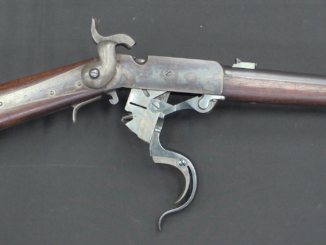


The single-shot Remingtons were the result of the delusions of senior officers.
The majority of same believed that the conditions of battle encountered in the Civil War were an aberration in tactics. And that “proper” warfare, in the style of European campaigns going back to the Napoleonic wars, would return. Conditions in which the saber, the arme blanc, would once more and forever be the way cavalry would dominate the battlefield.
They didn’t understand that the breechloading rifle (even the single-shot, let a lone the repeating rifle) had begun the death knell of horse cavalry. Or that fifty years later, the machine gun would finish it off once and for all.
The then commanding general, William T. Sherman, did state that while the single-shot pistol would be standard, revolvers would be retained for “Indian warfare” on the Western frontier. (Yes, even the “hometown hero” of my hometown, Lancaster OH, could be an idiot at times. Incidentally, the other Civil War general from Lancaster, Philip Sheridan, disagreed with Sherman on several subjects, including this one.)
In the end, the majority of those Remington single shots, chambering the .50 Short rimfire round, ended up with Francis Bannerman in New York. Where the actions were used as the basis for “cadet rifles” for military schools, which were short and light enough for ten and eleven year old boys to do rifle drill with, and were soft-kicking enough for them to use in range practice.
And PS; at the start of the Civil War, General Ripley, head of Ordnance, before anything else ordered 40,000 cavalry sabers with accoutrements (scabbards, etc.) from the Ames Cutlery Co. of Chicopee MA. They were delivered in April 1862.
In 1893, all 40,000 were sold off as surplus by the army. Bannerman bought them all for roughly twenty-eight cents each and put them in his catalog, complete with scabbards and etc. for $1 each.
The Army had never issued, or even uncrated them, after delivery three decades earlier.
clear ether
eon
It’s all a sad tale of woe, repeated endlessly.
You can find the roots of today’s NGSW debacle right there in this pistol, along with a lot of other things.
Sad truth is that the last vestiges of knightly chivalry died sometime during the Napoleonic Wars. During that war, the reality was that cavalry was gradually morphing over from knights on horseback to merely being mobile infantry on horses. The saber was on its way out, along with the knightly lance. Coming along nicely? Mobile firepower, and it held sway until it didn’t, in the face of machineguns and magazine-fed breech-loading rifles in the hands of the infantry.
The last dragoons were on the Eastern Front during WWII. Some small campaigns saw the utility of the horse still being a thing, notably in Afghanistan, but… Overall? It was all superseded whenever faced with a competent enemy.
The details of the syndrome are all the same, whether you’re talking horse cavalry or Airborne. The old noble classes hang on to their shibboleths and ideas, in the face of new reality worked out by the younger generation.
It’s kind of scary, when you think about it: Where the hell would we be if the old fogeys didn’t die off? Still doing horse-borne warfare? Imagine what they’d have gotten up to, if they were still around and in power…
Scary thought, that. Picture airborne cavalry with the horses being pushed out of aircraft with parachutes strapped on…
It’d give a whole new meaning to the term “Heavy Drop”.
“(…)old noble classes(…)”
Keep calm, United Kingdom already fields more horses than battle tanks, see https://www.newsbreak.com/combat-rated-361333999/4459468727895-britain-s-army-now-fields-more-horses-than-battle-tanks
Each horse likely comes with it’s own general officer, as well…
The UK has effectively demilitarized to a ridiculous degree. Next time the Argentines take a stab at the Falklands, odds are pretty good they’ll make the same case the US did with regards to Greenland: You aren’t actually securing it and defending it? It ain’t yours.
I recall an article on the net somewhere claiming the Royal Navy had more admirals than ships. Interesting if true
Argentina was making muted noises the other day about that. Roughly, why let them control the Falklands when they can’t secure the UK’s borders?
Martin;
As of Aug 2026, the Royal Navy has 102 flag officers of commodore rank or higher, 11 of them women.
They command the following;
Aircraft Carriers; 2
Destroyers; 5
Frigates; 7
Attack Submarines; 6
Missile Submarines; 4
Coastal Patrol; 26
Minelayers/ Mine Hunters; 11
Fleet Auxiliaries (repair ships, floating docks, oilers); 10
Total; 71 with an average operational availability of 43% (i.e., at any given time roughly 30-31 are OPAV)
Source; Ministry of Defense annual report to the Crown 2026
So yes, Parkinson’s Law is in full force at Admiralty Arch.
cheers
eon
My mother, who trained horses for the U.S. Cavalry in the 1920s and 1930s, told the senior officers that other than ceremonial duties, the horse had no place in military formations since the machine gun came along.
The exception in her opinion was the mule or donkey for use by mountain troops. She pointed out that there was really no other practical way to move mortars or etc. over that sort of terrain.
She also told them that as far as the “General Officers’ Riding Club” was concerned, if the generals wanted polo ponies they should damned well pay for their purchase and upkeep out of their own pockets.
Noncoms loved her. Generals, not so much.
Well, except for General Pershing.
clear ether
eon
Here is a link to the list of ships that the UK deployed to the Falklands. This was not the entire fleet. Compare this to the list of all ships in Royal Navy today. https://en.wikipedia.org/wiki/Falklands_War_order_of_battle:_British_naval_forces
Kirk:
The state of the UK armed forces is indeed dire. However, the Falklands are now quite well guarded. In 1982 a platoon of marines was stationed there. Now over 1000 troops are based there, with 4 Typhoons. Any Argentine invasion would face determined opposition. But that is not to be complacent. Argentina is buying used F16s from Denmark (thanks, Danish chums), and is looking at getting airborne refuelling, as well as a new submarine force. Who knows what the future holds?
Well not fields, really. More admirals than ships in the R.N, though.
While the old fogeys have died off, a fresh batch of young fogeys are still hard at work screwing up procurement.
Paratroops were a uniquely vulnerable way of delivering light forces behind the enemy’s FLOT. Probably the only thing more vulnerable to an enemy who was awake and knew what he was about were gliders.
Helicopter borne “Air Cavalry” superseded both, not in Vietnam but within five years, in Korea. The transition was underlined by the French in Algeria five years after that.
With the LHA-borne elements of the MEU (SOC)s, the Marines brought helicopter assault to its ultimate form, particularly with the Osprey giving the airborne Marines range and speed and the LCACs allowing the armor backup to arrive faster.
And then….
Five years ago, some clever bugger in Ukraine brought down a Russian Hind with a $400 drone, and the whole “air assault” thing became as obsolete- and suicidal- as the Charge of the Light Brigade at Balaclava.
What we need to do now is figure out what replaces it.
clear ether
eon
Every time someone mentions Bannerman, I weep for being born in the wrong century. Oh for a time machine to go on a grand shopping spree.
Who exactly were the generals advocating a return to Napoleonic tactics? Sherman and Sheridan were relatively young and aware war had changed. Officers like Emery Upton were even more advanced as to tactical innovation. The Army adopted cartridge revolvers hard on the heels of the rolling block fiasco. What I always heard hamstrung the late 19th century Army was a spirit of ‘save money regardless of cost.’ That’s what kept the trapdoor Springfield in service so long. That is part of why the Krag-Jorgensen’s rationale: it could be used as a de facto single-shot thanks to the magazine cut-off and thereby economize on ammo
It was actually the Navy, not the Army, which “lead the charge” to the adoption of the metallic-cartridge revolver. Simply put, the Navy understood the fundamental incompatibility of linen cartridges and high humidity.
Army officers in the field wanted metallic cartridge revolvers for the same reason- losing too much ammunition to rain, river crossings, etc.
Gen. Alexander Dyer, Chief of Ordnance after Lincoln fired Ripley, was on their side. He was opposed by Sherman, General of the Army under President Grant, and in the end it was Grant who basically told Sherman to STFD and STFU.
Among Sherman’s boo-boos was advocating the supposedly fake “Allin trapdoor” single-shot pistol for cavalry. Well, no, it wasn’t fake; exactly one was made, at Springfield, in 1866, from an Allin breech with an 1861 rifle-musket lock and a completely new everything else. It still exists in the Aberdeen Proving Ground Museum
The upper echelon was determined to return to “classical tactics” at all costs because that was what they had learned at West Point and etc.
That lasted until 1870-71, when they saw how badly “classical tactics” failed the French vs. the Prussians.
For the real story on the metallic-cartridge conversion revolver brouhaha, see;
Colt Conversions and Other Percussion Revolvers, R. Bruce McDowell
Remington Army and Navy Revolvers 1861-1888, Donald Ware
Guns of the Civil War, Dennis Adler
Guns of the American West, Dennis Adler
cheers
eon
“(…).50CF (aka .50-25; 300 grain bullet over 25 grains black powder with a 600 fps muzzle velocity)(…)”
https://naboje.org/node/4812# does show shot version of this cartridge (see table). Was it used by U.S. Army or it was made purely for civilian, if first what was its’ intended usage?
Like the .58 rimfire shot load, it was intended as a foraging round for use in the early converted Trapdoor Springfield.
Nominal bore size of the .58 (.578in) corresponds to 24-gauge. The .50 (.495 in) would be roughly a 38-gauge.
cheers
eon
Maybe a naive question: why didn’t the Army ask S&W to make a larger caliber revolver? The Russians did that with the .44’s they bought from S&W in 1872 wasn’t it?
The S&W Model 3 .45 revolver was Army standard from 1870 to 1873.
https://en.wikipedia.org/wiki/Smith_%26_Wesson_Model_3
It was superseded by the Colt Single Action Army Model 1873, which was actually type-classified in August 1872.
The Model 3 used the .45 S&W cartridge (11.5 x 27mmR), which is 27.9mm long vs the 32.6mm length of the .45 Colt cartridge, and has a larger rim (13.2mm vs 13mm). Thus the Colt revolver could chamber the S&W cartridge but not the other way around.
Modern reproductions of the S&W revolver have longer cylinders to accommodate the .45 Colt or .44 WCF cartridges. This also makes it easy to distinguish them from “original” Model 3 revolvers for purposes of detecting fakes created by unscrupulous sellers.
The Model 3 series was officially obsoleted by the U.S. Army in 1878 on grounds that it was less sturdy and more difficult for armorers to maintain than either the Colt 1873 or Colt 1860 or Remington New Model conversions from percussion to metallic cartridge.
clear ether
eon
That was kind of my poorly made point. The 1869 ‘trial’ featured two pistols clearly inferior to what was available and out there. If the Rollin-White patent really was such a stumbling block, issue leftover 1860 Colts, two to a cavalry trooper, as an interim measure. The Civil War should have been hard to write off as tactically aberrant.
You have to understand the “corporate culture” of the United States Army prior to Fort Sumter. All tactical doctrine was based on European writers like Jomini, and their theories were all based on the Napoleonic Wars.
Every war the United States Army had fought since the American Revolution had been against forces which fought in Napoleonic style, the Mexican War of 1846-48 being the classic example.
The only exceptions to this were campaigns against the “savage tribes”, such as the Seminole War in the former Spanish territory of Florida (the Army’s first experience of more-or-less actual “jungle warfare”) and the Black Hawk War (in which one of the tactical commanders was a militia captain by the name of Abraham Lincoln).
The War of 1812 (the “North American theater” of the Napoleonic Wars, which actually lasted into 1815) was fought mainly by “orthodox” European tactics. Which was how Washington D.C. ended up being torched by the British Army. The largest battle fought by “irregular” tactics, at New Orleans, was actually fought a month after the war officially ended. (It took a while for such news to “get around” when everything moved at the speed of sailing ships and horsedrawn mail delivery.)
There had been no changes in tactical doctrines in the intervening forty-five years, up to 1860-61, because nobody on either side of the Atlantic had seen any reason it needed to be changed.
The early major battles of the American Civil War (First and Second Manassas, Antietam, etc.) were fought by “Napoleonic” tactical doctrines. The casualties reflected that.
Later battles such as Shiloh, Cold Harbor, and etc. were fought by tactical methods that evolved from the casualties suffered in those early battles. Skirmishing instead of lines of musket firing volleys on command, etc.
Gettysburg was the largest battle ever fought by Napoleonic doctrines in North America, in fact the largest battle ever fought on North American soil, period. “Pickett’s Charge” (more properly “Pickett’s Advance on Pettigrew’s Flank”) was a nearly textbook example of a Napoleonic grand tactical maneuver. (Compare and contrast; French General Louis DeSaix’s flank attack on the Austrians under General Melas at San Giuliano, thereby saving Napoleon’s arse at Marengo.)
The difference is that Pickett was advancing on a rifle line armed with actual rifles, rather than muskets. Meaning, he began getting his force winnowed down before he was halfway to the objective.
All of this was seen by senior officers on both sides. But little of it was understood. The results were just too different from what the Great God Napoleon and his prophet Jomini said they should be.
And so, once the shooting was over with, the decision makers took the safe route back to the philosophy they were comfortable with.
Fifty years later, the armies in August-December 1914 made a similar error, in thinking the way the Prussians and Austrians had trounced Denmark in the Schleswig-Holstein War in 1864, and then curb-stomped France six years later, was the New and Improved version.
The machine gun and heavy artillery disabused them of that notion by mid-1915. Just as armor and air power would change the paradigm again from 1939 to 1945.
Tactics continue to evolve as military technology evolves. The thing is, after nearly three centuries of stasis from the Hussite Wars to Waterloo, military technology evolved more in the following century than it had in the previous half-millennium.
Today, it continues to evolve even faster. The “Air Cavalry” generals of the last three-quarters of a century are now as far behind the curve as the Jomini disciples of 1861-65.
And are just as oblivious to that fact as those old boys were then.
cheers
eon
@eon,
There’s a lot of validity to what you’re saying in this post.
I would submit, however, that there’s a bit of a disconnect in your thinking, when you blame the usual suspects for their failures to adapt.
This isn’t necessarily all the result of dimwits, much though all of us would like to blame them. Myself included.
This is, instead, a systemic set of interrelated issues/conceptual flaws in how we look at conflict and warfare.
The classical view is that the nature of war is whatever the last war showed us, and that nature is unchanging.
Which it is not. There are multiple levels to the enterprise, and while some only change very, very slowly, the rest are so mutable that it’s not even funny. The majority of the mistakes that you describe (and which I decry so often) are due to the mistaken belief that the actual changing bits of it all are the immutable ones, or that the immutables aren’t influenced by the changy parts.
Consider the “stack” of things influencing the conduct of war during the Civil War era: You had the logistics “grounds” that were shifting under everyone’s feet, things that totally obviated a lot of what Napoleon took advantage of. You had the technological improvements that enabled a lot of that, like improved communications. Those things alone, unconsidered in military instruction and terms, that would have changed everything about what Napoleon could have done or what he might have done. Imagine him invading Russia with railways, for example…
Then, there was the weapons pieces: Improved rifled arms in the hands of the individual soldier, with all the implications for range and lethal effect. Improved artillery; improved access to munitions from the factories and arsenals, due to the logistics pieces being improved. They did things in the Civil War that Napoleon would have found impossible.
So, you have all the underlying “stacks” of mission enablers changing all out of recognition, and the mental “software” of the military was still locked in on the old-school “best practices” as demonstrated by Napoleon.
The real flaw here was not that the “nature of war” had changed, but that all of the contributory stacks had, with the people who ran the enterprise not wrapping their heads around the implications. The Prussians saw the Civil War, they walked away with an understanding of railway logistics having changed, and then they glommed onto that in order to do more of the old things in the old ways. Same with breech-loading; they were like the old stories where the blind men examine the elephant, each taking away a totally different impression of the animal.
The fault in military technique is the mentality: You have to approach each and every instance of war with an attitude of open-mindedness, and be willing to let the situation instruct you. You have to be flexible; you cannot say “I am cavalry; all problems are soluble through the horse and horse-mounted shock action alone”, for down that path lies madness. It may well be that the horse is the solution, but that solution means that the horse and mule are the key logistics enablers up in the mountainous broken terrain you have to fight in… The inflexibility and dogmatism are what kill you and lead to defeat. You have to actually (shudder) run a true “learning organization”, and be willing to accept that many of those lessons will be both harsh and unpleasant to your prejudices.
Too much of the military depends on the sadly immature and childish. You love your horse-cavalry and brilliant charges across open terrain to saber down the enemy? Well, OK; odds are excellent that should the conditions shift beneath your hooves, the whole thing becomes an exercise in animal abuse and slaughter of your men.
You can’t be in love with anything. Me? I believe in the primacy of the machinegun and firepower in combat. However, I have to also acknowledge that the day of the machinegun may well have past, overtaken by mass FPV drone use at the front line. If I gave into my urge to “machinegun everything”, then I might well be setting my people up for a terrible comeuppance when the drone guys destroy their exquisitely planned machinegun-based defense.
The basis of war never really changes, at the roots. What does change is everything else, and where the rate of change was once generational, today it is exponentially higher than it was. You have to actually “plan to adapt” and adapt on the fly. Your systems have to adapt; everything does. You have to accept that what you were doing on day one of a war won’t be what you’re doing on day 27, or by the end of the whole thing.
I think that the key lesson coming out of Ukraine is that adaptability and systematically planned adaptation has to be an intrinsic part of operations, from the top to the bottom. You can’t adapt? Your systems won’t allow it? You’re going to die.
This requires a clarity of observation and thought that just isn’t all that common. You must recognize change, find ways to take advantage of that change, and at the same time, be able to withstand it all as your enemy uses change to bludgeon you with.
You cannot “marry” a way of war, and then expect to adapt when the underlying stacks supporting that all change. You have to maintain the balance while all the enablers and influencers on combat action have their way with the battlefield. You also have to be able to recognize the shifts, take advantage of them, and use them to work your way through to victory.
Classic example of this is there in the facts of France, 1940. The Germans managed to tap-dance their way through the hailstorm of shifting stacks of things, and overcame the sclerotic French leadership sitting at the top of it all in the French Army. The logistics pieces alone were gold; the command pieces that the Germans embraced changed everything, with the French left behind.
Ironically, I think it could be said that the German military only managed a very half-ass adaptation to the prevailing conditions of war. They lacked the adaptability to really recognize what was going on, and what they would need to move forward. If they had recognized the underlying reality, they’d have stopped with France, consolidated everything for a decade or so, then either moved on for more conquest or abandoned the effort entirely. Early asymmetrical success led to excess, hubris leading directly to nemesis.
I don’t think your mother knew what she was talking about, but that’s ok as long as she took good care of the horses.
https://www.semanticscholar.org/paper/The-South-African-Defence-Force-and-Horse-Mounted-Vries-Swart/13f61168f975679c5976b8ff3057cf00a0700cc9
https://youtu.be/OqlbJWLJqL0?is=QTZxPhQjZl5DMCCX
https://shs.cairn.info/journal-guerres-mondiales-et-conflits-contemporains-2007-1-page-81?lang=en