Dieudonne Saive at Fabrique Nationale began developing the FAL to submit for the British post-war program to adopt new small arms. He built the first example in the German 8x33mm Kurz cartridge, as this was of a lot of interest at the time, and offered the possibility of controllable automatic fire from the shoulder. The rifle was tested successfully, and led to a British request for two more guns for more substantial testing – but those next two were to use the .280 (7x49mm) cartridge. This example, serial number 1, is really the only intermediate-caliber FAL ever made.
Many thanks to the Ars Mechanica Foundation for giving me access to this unique rifle to film for you!
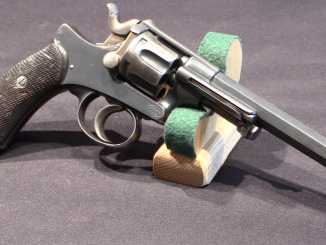
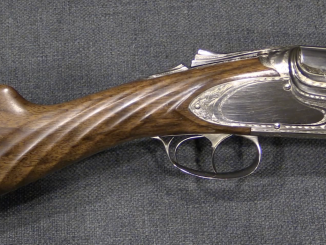
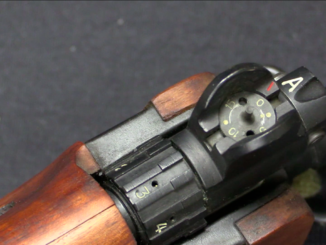
So many dead end features, but some that carried through unchanged. Thanks to all who respected the history of the piece.
I wonder if anyone ever tried just using a chamber adaptor in a full auto FN-49 to get it down to 7.9x33mm. They could’ve saved all the hassle of making a whole new rifle and FALs wouldn’t have been necessary.
Too much metal, too much weight, too much… Everything.
The reality is that as they were reaching towards the ideal “assault rifle”, a rechamber job on a misconceived big-bore rifle wasn’t going to do the job.
What they needed was a rationalized and product-improved StG44. The FAL in 7.92X33 Kurz came incrementally closer, but even it wasn’t there yet.
The thing that just yikes me about this era of small arms development was how all the information was there, and how a lot of the people around the “What shall we design/build/procure” question knew the reality, but… Somehow, none of those people were ever put into a position to make the decisions.
What should have happened after WWII was a long sit-down with the guys who actually did most of the fighting, some scientific survey/research on actual battlefields, and then some synergistic workflow between the two to establish the reality that a.) individual weapons are for close-in work within 300m, and b.) you need an actual MG or mortar for anything past that, if you want to be effective.
Didn’t happen. Can’t really tell you why. I spent years reading and researching it all, and the vague BS that flowed out of WWII kinda left me going “WTF?” while concluding that a lot of it simply flowed out of the misconception that nukes were going to make combat an actual non-event.
That didn’t happen, and here we are.
I don’t think that anyone has really synthesized a solid perspective of how combat really works, mostly because ain’t nobody bothered to really do the work you’d need to do in order to back up the conclusions I can infer from my personal experience and research in the archives. Hell, to be quite honest, before I ever had the testicular fortitude to pronounce on things really solidly, I’d preface everything with a huge caveat and tell you to go do your homework before believing anything I’m telling you. Why? Because there’s nothing hard-and-fast, really backed up with numbers behind what I believe, and that’s no way to run a railroad.
The FN49 wasn’t a bad weapon for 1947.
Certainly more advanced then a M1 Garand.
If you want a meta study of combat veterans on firearm design how do you factor in the fact that only 10% of soldiers actually fight in combat?
The other 90% refuse to actually fight. At best they shoot up in the air or down in the dirt hoping to seem scary enough to hopefully be left alone.
The depth of ignorance/stupidity coupled with the audacity it takes to come on a site frequented by actual combat veterans and post something like:
If you want a meta study of combat veterans on firearm design how do you factor in the fact that only 10% of soldiers actually fight in combat?
The other 90% refuse to actually fight. At best they shoot up in the air or down in the dirt hoping to seem scary enough to hopefully be left alone.
Well… It is awe-inspiring, in a train-wreck sort of way.
I keep wanting to ask the idiots who spout this sort of thing mindlessly just what the hell they thing NCOs in the military are for, what they do, and how they’d allow something like this to happen, if it were true. And, if it was, why the hell do we pay them?
On top of that, I have to wonder just what the hell they think the “10% that actually fight” are going to be doing about the other 90% that aren’t doing their damn jobs, forcing them to take all the risks and do the actual work in combat? I mean, if this is true, we could simply get rid of all that deadweight and do without their services under fire, right?
Right?
Yeah. No. This was dumb as hell when S.L.A. Marshall first started saying it, it’s stupid now, and the fact that so many believe it just goes to show how lies transmit bad information a lot more effectively and deeply than truth will ever manage disseminating reality.
I do have to admit that having been an avid reader of Marshall’s “work”, I believed for awhile myself. I then encountered reality in the form of actual, y’know… WWII veterans who set me straight. “Combat Non-participation” isn’t really an indicator of either cowardice or desire to “avoid combat”, it’s more a reality of the fact that in modern war, the battlefield is f*cking empty, it’s damn hard to find anything to shoot at, and the actual number of soldiers who manage to make out targets they can fire at is disturbingly low. The low numbers are more accurately a result of bad training, a desire to not “waste” ammunition, and the fact that actual combat is confusing as hell, so you hold fire more than you actually fire. The massive difference between WWII “combat participation” and that of Vietnam and later had rather more to do with realistic training on pop-up silhouette ranges that looked more like combat than the WWII-era known-distance bullseye target training. You train someone to reflexively (if somewhat subconsciously…) look for a nice, neat round black center on a white background, rather than a questionably visible human torso? He’s not going to be shooting at much in combat, because the enemy rarely consists of nice round black circles on white backgrounds…
Truly an awe-inspiring post, this one. And, not in a good way…
I am a combat veteran.
I have experienced real life combat.
The post 1980’s traing has not improved the real world outcomes.
As long as the 90% weren’t creating a danger to us we left them alone praying that should the enemy cross their path they might kill them or at least give us a warning.
PS
Your valted NCO’s are no different then the rest of the troops.10% vs 90% maybe a little higher but not by much.
Hope I haven’t crushed your Rambo fantasy.
I doubt that you’re a veteran of anything other than a movie theater.
If you were, which I doubt, you worked around some really piss-poor leadership, or were a piss-poor leader yourself.
Any post-combat inspection would result in unmasking the “combat non-participants” in short order, were the leaders doing their jobs, and said leadership had better take action or suffer the consequences. Namely, in your fantasy, suffering the mutiny of the “combat enthusiasts” who would, in that fantasy, actually represent the most dangerous people in the unit. I’m here to tell you that were I to have concluded that my leaders were allowing 90% of my peers to slough off their duties, while I took all the risks and did the fighting? LOL…
I’d have shot the lot of the 90%, starting with those “leaders”.
That’s reality. Your fantasies, fed by media, do not apply. If you think you observed this under fire, then odds are excellent you aren’t a very good observer, and actually haven’t seen much in the way of actual combat.
I know of zero actual combat veterans who buy this bullshit, myself included.
That 90% figure dates to WW2. And as I learned reading about the Quartermaster Corps and etc. as a kid, it actually means that for every infantry rifleman, artilleryman, machine gunner or whatever who is actually definable as a “Troop In Contact With The Enemy”, there are about nine personnel in rear-echelon support roles who are tasked with making sure said front-line trooper has food, ammunition, clothing, communications, medical support, and everything else in the “divisional train” required to allow him to continue inflicting damage on the enemy.
The people who parrot that “90%” BS today have obviously never RTFM. Or they’d know what it actually means.
Namely, that real war is a very f**king complex business, which is why it costs so damned much for an army to do it effectively.
As opposed to practicing the Casing the Colors ceremony until it satisfies some Flagpole Fobbit.
clear ether
eon
It does seem to come down to cartridge selection. The difference in what happened in the Soviet Union is very marked, where the AK as their ‘sub-machine gun’ in 7.62×39 ended up being a good enough infantry rifle to make the SKS unnecessary; in contrast to the US dominated NATO ending up with slightly shortened 30-06. Everybody blames Col. Studler, but was he following the preferences of his seniors in the military hierarchy? Has your research revealed any documents which show a preference for 7.62×51 at higher ranks than Col. Studler’s ordnance role?
It was “Marksmanship Tradition” in action.
One of the bedrock beliefs of the U.S. military has always been that accurate, precision rifle fire by individual soldiers wins wars.
It goes back to Berdan’s Sharpshooters in the American Civil War, and before that Timothy Murphy and his Kentucky Rifle in the American Revolution.
Targeting enemy officers was believed to be the winning strategy. The Revolutionary French army believed, too- see francs-tireurs.
In each case, what really won battles was firepower. Which the Sharpshooters demonstrated in no uncertain terms at Chickamauga- with the supposedly impractical Colt Revolving Rifle. 200 Sharpshooters with Colt Rifles + 80,000 rounds expended in 4 hours at a rate of roughly 100 rounds per hour or about three rounds every two minutes = “My God, we thought you had a division up there“.
Yes, soldiers with muzzle-loading rifle-muskets could achieve that rate of fire- but not in “burst fire”, which is how the Sharpshooters did it whenever a big enough group of Confederates presented themselves as a worthwhile target.
The Sharps rifle is inextricably linked to the legend of Berdan’s sharpshooters. But in fact only the very best shots in that unit used the single-shot Sharps, notably Truman Head aka “California Joe”. And the “designated marksmen” like him were always backed up by up to a dozen riflemen with repeaters, first Colts, and then Spencers and Henrys. While the Sharps rifleman was picking off officers, the dozen men with repeaters were protecting him from the Rebel infantry with a sustained firescreen.
Kirk’s “organic machine gun” carried to its logical conclusion, given the techne’ of the times.
The evidence was always there. But the U.S. Army’s upper ranks only wanted to see “California Joe”. And later, Alvin York.
The real story was Audie Murphy. Yes, just one man- with a machine gun.
But that wasn’t what the brass wanted to hear.
And it still isn’t.
clear ether
eon
@eon, who said:
Targeting enemy officers was believed to be the winning strategy. The Revolutionary French army believed, too- see francs-tireurs.
Having read extensively from that period, of what was available translated to English? I feel I have to point out that I think you’ve conflated francs-tireurs with the actual French light infantry, the Voltigeurs.
The francs-tireurs were more the irregular non-official guerilla-style “mob action” types. They did not generally participate in set-piece battles, and were more a late 19th Century thing than Napoleonic.
I would have to say that the actual impetus for Voltigeurs was more ideological in the sense that they weren’t necessarily targeting enemy officers so much as they were targeting enemy aristocrats. There was one source document that I saw which described the whole genesis of the Voltigeurs as coming out of the fact that a.) they had nothing in the way of actual disciplined troops (see American Revolution for parallels…) and were trying to overcome the issues of “lightly armed mob with bad crowd control” by having the guys who really, really hated the aristos get out in front and snipe them. This was an informal thing that gradually got more and more institutionalized, until the Voltigeurs were some of the most professional French infantry formations.
You have to remember that the typical French battle plan involved running columns into the enemy formations, with light screening forces (said Voltigeurs) doing the scouting and recon work, as well as softening up the enemy formations through highly selective and accurate fire. They were occasionally armed with rifles, and the British Army Rifle brigades were meant to counter them.
You could probably trace a direct line from the Seven Years War in North America through to the formation of those units and the development of their tactics. The 19th Century saw refinement of them, leading to the various light infantry “reform movements” that hardly anyone remembers these days. It’s a fascinating thing, just how the various “light infantry” contributed… A lot of the Stosstruppen tactics were developed originally by the various German Jager units, who also effectively foster-parented the entire Finnish Army by training their initial post-Imperial Russian cadre… Lots of things that are downstream of all that, which have been mis-attributed or ignored as being actual heritage items/practices.
“(…)saved all the hassle of making a whole new rifle and FALs wouldn’t have been necessary.(…)”
Actually FAL and FN-49 were being developed concurrently, according to https://modernfirearms.net/en/assault-rifles/belgium-assault-rifles/fn-fal-l1a1-c1-slr-eng/
The history of the FAL began circa 1946 when FN began to develop a new assault rifle, chambered for the German 7.92x33mm Kurz intermediate cartridge. The design team was led by Dieudonne Saive, who at the same time worked on a more traditional semi-automatic military rifle, chambered for the “old-time” full-power rifle cartridges. This rifle later emerged as the SAFN-49. It is thus not surprising that both rifles are mechanically quite similar…
While they were undergoing concurrent development, the deal was that the FN-49 was supposed to be the primary combat rifle for most infantrymen, and the FAL was supposed to be the intermediate-cartridge firing supplemental sort of affair that filled the same role/position as the StG44.
Only after the US munged everything up by forcing 7.62X51 down everyone’s throats did they basically look at the FAL and say “Y’know… If we’re gonna do this in the new NATO caliber, we may as well just toss that FN-49 thing…”
At least initially, I think the two FN weapons conceptually mirrored what the Soviets did with the SKS and the AK, there at the start of it all.
One does have to wonder what might have happened if the UK and others in NATO had simply placated the US by saying “Hey, ya know what, boys? Why don’t we do that 7.62X51 deal for your “real rifles”, and we’ll just have this nice little intermediate cartridge over here as a supplemental sort of thing, for all those folks who don’t really need one of those great big manly he-man rifles of yours…”
Could have kept the NATO standard, and eaten the cake of intermediate, as well. 7mm Liviano, anyone…?
Would have left the US still being stupid and trying to take the 7.62X51/M14 combo into Vietnam, but instead of the M16, they could have done an off-the-shelf procurement of something from NATO in that “supplemental caliber”.
Interesting counterfactual for an alternate-history universe, I guess. Too bad it didn’t happen…
This gets me thinking, (that’s always bad), what if the 7.92×33 kurtz was necked down to 6.5? How would that compare to the 6.5 Gendel?
Probably pretty close, maybe a little hotter.
“(…)what if the 7.92×33 kurtz was necked down to 6.5? How would that compare to the 6.5 Gendel?”
Unless intentional show of disdain: Kurz and Grendel. If you would to keep same pressure as progenitor, my bet proposed cartridge would be somewhat weaker as it would have more-or-less same volume, but less pressure (3400 bar vs 4050 bar)
https://apexload.pro/calibers/7-92-x-33-kurz
https://apexload.pro/calibers/6-5-grendel
Nonetheless III Reich did entertained lower-caliber-bullet for full-auto weapon, though it was 7 mm, namely 7 x 45 POLTE https://www.cartridgecollector.net/cartridge/7-x-45-polte/
“is really the only intermediate-caliber FAL ever made.”
I’m pretty sure Brazil made several.
Venezuela would like to have a word…
7mm Liviano strikes me as “intermediate”, but that’s me. Upper end of “intermediate”, but still there.
Overall, hell of a video. I did not think there were any of these left, anywhere. Kudos to Ian for bringing us one.
I do have to comment: WTF is with the 19″ barrel? That cannot be the “optimal length” for 7.92X33, can it? How much velocity are they gaining by those extra inches, and does that make a bit of difference?
“(…)19″ barrel?”
https://guns.fandom.com/wiki/FN_Universal_Carbine does claim that
The FN Automatic Carbine was developed in the mid-1940s by Belgian engineers from FN Herstal who had fled to Britain during World War II. Design work was completed at the Royal Small Arms Factory in Enfield and the original models were built for the German 7.92×33mm Kurz cartridge. The gun was produced in two versions; a standard configuration designated as the No.1 model and a bullpup configuration designated as the No.2…
So my guess is that they decided to have common barrel length for purposes of fair comparison.
Interestingly there are pictures of the No. 1 prototype with quite a different stock. Here you’ve got one.
https://imgur.com/a/EM5AHTk