When Switzerland decided to adopt a modern universal machine gun toe replace both the MG11 Maxim and the LMG25, both SIG and Waffenfabrik Bern used the German MG42 as a starting point. W+F Bern was the eventual winning of the trials with the MG51. This is basically a Swiss out-Germaning of the Germans. The stamped receiver was replaced by a milled one, the barrel made heavier for more sustained fire, and an effective anti-bounce system added to prevent the out-of-battery discharges that were a problem with the MG42. A number of other minor improvements were made as well.
Light MGs
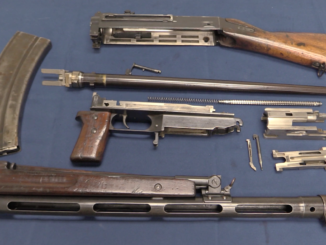
SIG KE7 Light Machine Gun
The KE-7 was the product of two Swiss designers, Pal Kiraly and Gotthard End, and was introduced in 1929 by the Swiss manufacturer SIG. It was a recoil operated design and fired from an open […]
Select-fire Rifles
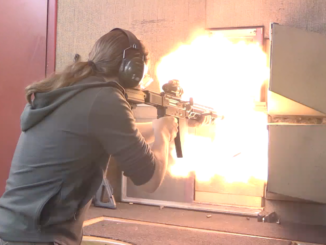
Holy Mother of Muzzle Flash, the Rico Special
Rico is a gunsmith at SIG Neuhausen who likes to tinker. He put together this SIG 510 (aka Stgw 57), with a modern collapsing stock, quad rail foreend, Aimpoint red dot, heavy barrel, and massive […]
Bolt Action Rifles
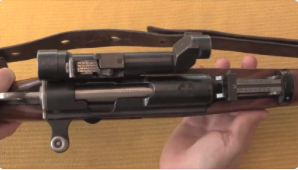
Transitional Swiss Sniper K31 Rifles (Video)
During World War II, the Swiss military experimented with two models of K31 carbine with integral optics (the K31/42 and K31/43). These were found to be not sufficient for military service, and after more experimentation […]
Outstanding
Great piece on this (somewhat) obscure weapon.
The thing you have to bear in mind, whenever looking at Swiss weapons is that they were designing, procuring, and building for a long-service conscripted force that was going to be using those weapons for their entire careers, and in many cases, taking them home with them for the duration of their active service.
Nobody else does this. Anywhere in the world.
The Germans designed the MG42 with the idea that it was going to be part of a semi-disposable Kleenex-style usage scenario. They did not bring back their troops to work the same weapons in the same way, year after year: You did your conscription, you went home, and only rarely got called up for periodic accountability checks. The Swiss, by way of contrast? You did your time conscripted, and then annual training events as well as being called up for emergencies. A Swiss weapon would see long service use, spanning decades, with the man it was issued to.
Which is why everyone looks at the Swiss as though they were quite mad, focusing on quality the way they do. They’re not mad, they’re Swiss.
MG51 is what it is because of that environment. The Swiss were not designing and procuring for hyper-hot war lasting a few years, the way the Germans who designed the MG42 were, but a military use case that meant long decades of service with minimal maintenance (in the sense of depot-level) and highly-trained soldiers. Thus, machined receiver rather than stamped, etc.
I wish Ian had spent some more time on the sighting arrangements and the tripod. I have seen several different telescopes for the MG51 setup, and I think the one he has there is one meant for fortress casements, because the normal infantry ones I’ve seen in use during training seem to include periscopic sights. There’s also the question of just how the tripod’s traverse and elevation mechanisms work, because I’ve never seen any laydown of their setup.
One of the things that most people fail to appreciate about machineguns is just how important the tripods are to everything; you have to have a good system build into them in order to correct fires at long range, and without that? You may as well be throwing most of your fires away.
With a machinegun team, the “infrastructure” matters rather more than the gun itself.
I am afraid the scope shown by Ian was the only one used by the Swiss army for MG 51 field use. The Swiss manuals I know of no MG51 manual, showing a scope different from the type shown in Ian’s video.
This is most surprising, because Germany, after experiencing head shots to machine gunners, adopted a periscope device which enabled the machine gunner to literally keep his head more down. The post WW2 optical scope for the MG1 was a periscope design from the start.
Interestingly, SIG in the 1970s produced two versions of its MG 710-3 machine gun flyer (both bearing the print identification Wf 50.119!!!). One shows the MG51 optic, plus an infrared night optic.
The other shows in the same place a rifle grenade mounted on the SIG 710-2 barrel and a persicope type optic similar to the German type.
It effectively is the normal sight for infantry use, although there exists a periscope for the mitr51. You have to mount it on top of the scope. See link for one that was on sale.
https://www.ricardo.ch/fr/a/periscope-militaire-suisse-wild-heerbrugg-1960-langnau-mg51-1279121926/
It is featured in “règlement 65.304 f, directives pour armuriers” on pages 23 & 24, if you manage to find it. Do not know the correct name in german, should be something like Anleitung für Waffenmechaniker
That’s more or less what I remember seeing, although I’d have to have a look at it mounted on the tripod to be sure…
You mean Ze Germans… Kleenex… Ok. I see. High rate of fire then, he he. Is this 43 onwards or, from the start? Using WW1 as a template…
WW1 get it… Verdun, death etc. Try and…
Sorry for my mistake. The second sentence should be:
Among the Swiss MG51 manuals I know, none shows a scope different from the type in Ian’s video.
@JPeelen,
All I can say is “Huh.”
I wish I remember where I saw the imagery, because I clearly remember looking at the Swiss soldiers shooting the MG51, and thinking “See? They get it… Periscopic sights…”
What I have to wonder is what the hell that dovetail below and behind the sight setup is for; if not periscope, then what? Night vision?
I would love to be able to get my hands on a Swiss MG field manual, one that showed everything relating to this weapon system.
@Kirk
I now found it in the Mg51 manual 53.122 of 1968.
It is a periscope that could be mounted behind the eyepiece of the standard scope and allowed an estimated 8″ lower position of the operator’s head.
Because no images are possible here, I will scan the 2 relevant pages and send them to you. It is nowhere else mentioned in that manual.
I wonder if they’d do that now, with drones… Would it survive now, long enough – In a defensive postion, to bother… Mini fecking Luftwaffe.
Does anyone think a BM21 Grad used, in the following way might work out of interest? For “Air defense” 10 across, 4 down tubes – Gives 4 full munitions of; 4 grad rockets “Modified so just propulsion” in a + pattern (One rocket at each apex of the cross) central – tube, filled with dummy “rocket” containing multiple continuous rod warheads from r60b missile – Should fit it 122mm tube’ish. Rockets – 4 have conical dome on top, and hinged mounting bracket that holds them as one for firing… Middle tube gets pulled out “Containing bombs” with other four via bracket – A slip bracket slides down… All five, on firing, catches on four tail fins, springs out new tail fins perhaps… Thus four become one, target approach, rear bracket splits – Allows central tube out, it deploys parachute gets pulled back thus “Containing warheads” body falls, it deploys parachute from nose cone. 4 BM21’s fire 1 combined 5 tube missile – Via different elevation/firings each land in sky sort of in area (Giving Audi type badge blast of continous rod warheads) now… The parachute on the central warhead tube, opens first… It floats on own, faster than rocket tubes – They fall away… Now it detonates only along with the other four that arrive – Soon… When something is detected, via remote control, or the warhead tubes and the rocket pack via parachute can be recovered… Resuable. To get anywhere near the potential target – Patriot type radar, is used. Point being; BLAM!!! 4 tubes each containing multiple continous rods go off on parachutes, that was one shot from 4 BM21’s, thus likeky “Audi badge sort of coverage” four more, can be released quick… Now… With that coverage, aided by remote control I.e. 2nd input to detonate, if you thought something might land thus – Radar. Could it hit…
1st question would be, could it fly, thus, but if so… Then hit.
Against drones, missiles even – Saturation; the not blowing up part, radio control – might be key to that… Re-use. Waste avoided like.
If you had some idea of a potential target, you float them down, type thing… Then detonate if anything, is confirmed.
I know that sounds sort of shit, but the prices of other stuff… Really add up – So just thinking; you all think, might help, us all, one day. Who knows.
The COULD it hit… Is the clincher, could…
I think so “Audi badge” A. 25m. B badge 25m, C 25m , D 25m. 100m sq… Shit, but other 3 and thus 400m sq… Something might, hit – Especially with the radio control; saturation, you press Bang!!! as appropriate. Primative. Everyone think cheap like that – But better, hee!
“And I mean cheap like, I it can be done for more money/complicated stuff. I know, but folk run out, etc.”
If I have accidently improvised a cluster munition delivery system as oppose air defence, that was, indeed an accident. S’meh.
https://youtu.be/Kzi8sL9P2ko?is=XP51NIwrN7oQCtC4