Steyr has just released its first new handgun since the M9. This new design is call the AT (Austria), with a competition model (AT-C) and a service/carry/defense model (AT-D). The gun is a Browning short recoil system that takes a lot of cues from the original Sig P226 handling and design. In fact, part of the concept is to fill the market gap left by the shuttering of European Sig production. The AT series is a modular system, but unlike most such new releases it actually comes with a number of different options available right from launch. There are three slide/barrel lengths (4″, 5″, 6″), both SA and DA triggers, and multiple hammer springs available. Several of the parts – including the grip and beavertail – are also publicly available as 3D models, so that DIY folks can make their own however they prefer.
Semiauto pistol
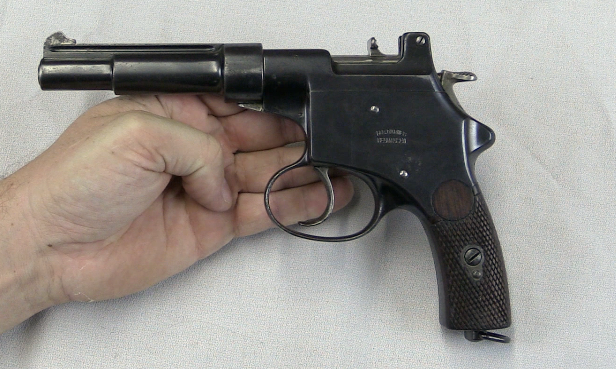
6.5mm Mannlicher 1894 at James D Julia
The Mannlicher 1894 is one of a small number of firearms designed with a blow-forward action, and also the first of these guns. It was the creation of Ferdinand Mannlicher, a brilliant and prolific Austria […]
Machine pistol
MP9 and TP9: A Complete History From Steyr to B&T
Steyr introduced their TMP (Tactical Machine Pistol) and its semiauto SPP counterpart in 1989, but it was never a very popular item. After the company was purchased, the new ownership decided to scrap the TMP […]
Manual Repeater
Passler Model 1887 Ring Trigger Pistol – Now With Mannlicher Clips!
Franz Passler and Ferdinand Seidl formed a partnership to make manually-operated pistols in Austria in the late 1880s, but the arrangement did not last. Their design was initially patented by Passler in Austria, and then […]
Have you made a video on the CZ550 variations
Does it take P226 parts or is it only “inspired”? As Ian noted, too many companies introduce “modular” guns and few/no modules. AT modules would be cool, but necessarily fewer and scarcer (at least at first) than the long-established pool of SIG mags, barrels, etc.
Watching this, it occurs to me that the use of the word “modular” is… Inadequate.
What makes a pistol modular? Changing the grip panels? changing the slide length?
I’d submit that there’s apparently “modular like the SIG P320” where there’s the ability to change out the grip assembly, working around an internal core of “working bits”, and then there’s “modular like the HK P4”, where the frame can take different slides.
So, the word “modular” is really too ambivalent to tell you much at all about the system. Is the Glock “modular” because you can trade out different bits to change the trigger pull? Would we laugh, were they to advertise that as a “feature”?
Like a lot of things related to weapons, the terminology and definition of the words used to describe them is inadequate. All respect to Steyr, but I don’t find these pistols particularly “modular”. All they’ve really done is made parts kits to modify them more easily available, while a bunch of stuff about the guns themselves is really quite fixed.
I’d say that the P320 is a lot closer to “modular” than a lot of the offerings other manufacturers have put on the market. I’d also submit that the “modularity” they espouse as being such a great thing isn’t really “all that” in the first damn place. I honestly don’t see people swapping their P320 “modules” around to reflect even seasonal changes in carry practice, let alone doing it on the daily like some hypothesize. I know one shooter who tried that crap, and he gave it up after a few weeks due to the sheer irritation factor.
I honestly don’t see a hell of a lot of benefit to “modularity”, mainly because of things like different requirements for each class of weapon. You’re not going to have your concealed carry piece set up with the same sights you have on your competition “race gun”, and while it’s nice to have the same controls on everything (a practice I highly encourage), the reality is that when you say “horses for courses”, they’re not really talking about slapping a dye job on your white horse in order to make it more useful for nighttime concealment. If you are changing the fundamentals, like going from 9mm Parabellum to .380 Auto, then being able to do that on the same frame is semi-redundant; if you’re going to change caliber like that, why not change to a lighter, smaller frame that is a simple blowback, rather than a locked one?
This is another one of those fads of questionable wisdom, which will result in a spate of people finding random miscellaneous parts in their grandfather’s gun cabinets decades from now, and then posting pictures up saying “WTF is this thing I found…?”
“Modular” is a corporate buzz word that pretty much means whatever the buyer is willing to imagine it means. One of those words corner by insecure professionals trying to make a pedestrian task sound arcane. In the case of firearms it seems to mean “capable of extra stuff being snapped bolted or duct-taped on”
It’s all marketing, all the way down.
Which is why when you go to learn about firearms, the required specialized terms and nomenclatures are so utterly ‘effed up. You say potato, I say potato… And, we’re talking two totally different things.
This is why things like the use of the term “battle rifle” just set me the f*ck off. There’s zero agreed-upon definitions of this term; we’re just supposed to pick up on things about these rifles by osmosis, and by way of “Well, I know pornography when I see it…”, which is utterly useless.
Go over into machinegun-land, where the international terminology for what is what is so confused that you could easily spend years trying to winkle out the various differences between what is considered a medium machinegun in the UK, Germany, and the US. All using the same words, NATO-approved.
The problem here is that there’s no real authoritative source for these things; it’s left up to users, and like most people, you never, ever find anyone using the correct noun-nomenclature out of the parts manuals for a given part. I swear to God, you try running a training class sometime, and find that all you get when you use the absolutely correct canonical term out of the manual, is a class full of confused looks because the term they’re used to using for that part is entirely different and totally senseless in terms of the parts manual.
All I can say is, f*ck the marketers and the usual suspects in the gunrag trade. It ain’t like it’s all that hard… Get the damn manual, look at the words, use them.
Maybe “configurable” in this case? Since the serialize part remains a major investment AFAICT.
It would be nice to have this all wrapped in a tidy package. But, also:
“Since English is a mess, it maps well onto the problem space…” –Larry Wall, inventor of the Perl programming language (which is also kind of a mess)
So I’ll give “modular” to any firearm with a fire control unit. The AR-15 as well. “Modular” as shorthand for enabling the end user to do significantly more for themselves with lower risk. Not exactly helping with the precision I know.
Being out 10s of dollars after screwing up a stippling job, instead of 100s and a trip to the FFL, for no downsides I can see so far, gives me options I didn’t practically have before. FCUs also enable Flux style chassis and who knows what else down the road. Seem like enough of a jump to give these kinds of systems the term.
Different Strokes for Different Folks. Steyr has a good reputation of making high quality reliable firearms.
Kirk, sorry for nitpicking. There was an HK4 pistol. There also was a [Walther] P4. I think you are mixing these up.
The HK4, basically using the Mauser HSc design, could be bought with a set of 4 barrels (plus recoil springs and magazines): .22 lr, 6.35 Browning, 7.65 Browning and 9 mm short. The slide was the same. By reversing the boltface, it could be changed from rimfire to center fire. I am not aware of any multiple slides. Mostly using a fluted chamber for .22 and the opposite (pockets in the chamber to cause case deformation) for 9 mm short.
The P4 was intended for the Police, fired 9 x 19, and looked like a P38 (P1) with a shorter barrel. But it had the advanced (compared to P38) automatic firing fin safety of the PP Super and the later P5.
It also eliminated the separate spring-fingered dust cover over the loaded-chamber indicator and firing pin. Thereby solving the infamous “Topless P.38” problem.
There were a lot of things about the P.38 that were obvious kludges, and and as such the pistol should probably have never been issued “as is” in 1940.
clear ether
eon
Not being a huge Walther fan, I’m at a loss at this description of yours.
Could you point to somewhere on the internet where there are pictures, for the uninitiated? Everything I see about “Topless Walther P.38” is very unclear on the concept, many of them talking about the takedown lever. Some of the others are definitely not worksafe, being examples of Rule 34 in real life…
The dust cover atop the slide is a stamping with two spring-fingers built in. They are what holds the cover on.
The cover retains both the loaded-chamber indicator pin and its spring, and the firing pin and its spring, along with the “mousetrap” type spring that ensures both pins remain in proper alignment inside the slide.
With age, those spring-fingers can weaken. When they do, at some point when the gun is fired, recoil force will cause the top cover to depart, taking loaded-chamber indicator pin, firing pin, and all three springs with it.
Then you have the fun of trying to find all six pieces, scattered from Hell to breakfast in the grass.
Most people who love the P.38 don’t realize just how carefully it had to be made, especially in the tempering and hardening of parts. It’s worth noting that it was Walther’s first locked-breech pistol, and a lot of the design was not copied by later manufacturers who thought that its double-action and locking systems were swell ideas. (I’m looking at you, Beretta.)
After years of thinking the P.38 was the second-best service pistol ever (after the 1911, and yes, I’ve owned and used both), I’ve come to the conclusion that it started everybody down a dead-end development road.
As you state, the Glock, even based on design concepts as old as the 1911, is better than the Beretta Model 92FS/XYZ. It’s probably better than the 1911 and P35.
All of the above other than the Beretta are better than the “legendary” P.38.
cheers
eon
“(…)P.38(…)was Walther’s first locked-breech pistol(…)”
Now I am extremely confused, as I always though it was predated by Walther Armee Pistole see 1st photo from top http://adamsguns.com/ap.htm AND Walther Armee Pistole does belong to locked-breech.
The Armee Pistol was the prototype for the P.38, not a separate type. That’s what Walther considers it to this day.
The exposed hammer superseded the concealed hammer because the Heerswaffenamt (Army Weapons Office, their version of Army Ordnance) wanted an exposed hammer for safety reasons.
Other than that change, the Armee Pistol and the final P.38 were essentially identical.
cheers
eon
I suddenly realize that I don’t know the P.38 anywhere near as well as I thought I did…
I’m guilty of going off of memory, and not verifying.
I should have verified what my memory was saying, and I did not take the time to do it. My bad…
My own memory is so compendious as to include a great many things that never happened.
Don’t feel bad. There are innumerable occasions where I’ve sat down at the computer, written a diatribe, and then thought “Maaaaaaaybe I ought to make sure that’s got citations to back it up…?”
Which action has saved my ass from looking like a dunce. The times when I’m so absolutely sure of myself and my facts, only to find I’m in error-mode? See this thread for examples thereof…
I do that all the time, mainly to check my spelling.
cheers
eon
I think these are relabelled Arex Zero (based) pistols from Slovenia. (Which very likely has Zastava CZ99 heritage.)