Available from Morphys here:
https://auctions.morphyauctions.com/_N__REMINGTON_ARMS_COMPANY_MODEL_17_SPECIAL_POLICE-LOT665717.aspx
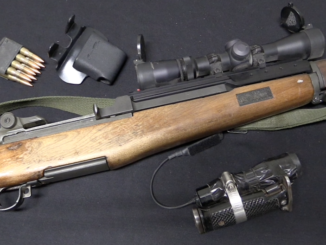
Remington introduced the Model 17 as a lightweight 20ga pump shotgun in 1921. In addition to a variant of sporting grades and a 20” barreled riot model, they also offered the “Police Special” configuration. This was a 14.5 inch barrel with a 4+1 capacity and a Shockwave-style pistol grip in place of a normal shoulder stock (although the guns were generally supplied with a spare stock as well). These were intended as a very compact option for special police requirements – stakeouts, undercover work, or a need to conceal a shotgun on an officer’s person. Only a few hundred were sold, and they are a very interesting side of fighting shotgun history.

These were often referred to a “whippet guns”; because when needed you could “whip it out”
Most “Whippits” I saw back in the day were confiscated from criminals. Your typical holdup artist back then would get an old pump shotgun from somewhere (one stole it from his grandfather’s barn) and applied a hacksaw to each end. Some of the more mentally-conscious ones used a file to dress down the muzzle afterward, and maybe a wood rasp on the attenuated butt.
They were seldom fired in holdups, as the appearance of such in the hands of an obviously not-too-tightly-wrapped suspect tended to make the victims circumspect about setting off said suspect’s Tasmanian Devil personality.
My take on them as that they made my wrists hurt and were pretty much useless beyond ten yards. However, for their intended purpose, that was probably good enough.
And yes, I had and still have a similar opinion of the High Standard 10.
clear ether
eon
Think of the popularity of Bond Arms derringers. Painful to shoot. Would not want to spend a whole day at the range shooting one. Not much good beyond a few yards.
But —- for the intended purpose, where a person would not fire it for real too often, and hopefully not be the sort of person that get lots of people mad at them all at the same time, they fit the bill.
“(…)Not much good beyond a few yards.”
Actually, these could be used effectively at greater distance, see https://www.youtube.com/watch?v=dzTO8aPDy6Y for example
This is weird. I guess the man was not faking this. Kind of blows up the dogma of accuracy vs. barrel length and velocity. People do confuse absolute accuracy vs. functional accuracy. Many guns and ammunition are disparaged because they would do terrible in a formal competition. But what accuracy is needed for the job at hand? The man was still hitting a torso sized target at distance. This is the accuracy needed for self-defense.
Note that barrel alteration by hacksaw might result in significant accuracy loss due to lack of barrel crown being even, see https://www.ssusa.org/content/will-damage-to-a-rifle-s-crown-hamper-accuracy/ for practical test. Bond Arms product are made this length at factory, thus not problems with uneven barrel crown.
I recall a feller with Z.Z. Topp got drunk, got forgetful, and taking his boots off shot hisself dropping his derringer on the floor. That always impressed me as the most likely use for a derringer. If you wear cowboy boots you can stick a Walther PP down there in even a half-assed holster and be better armed and safer. This incident was in 1984. Even better options abound now
I had a friend who had one of the model 10’s, I tried it and found that it work well mechanicaly or ergonomically. Having experimented with pistol grip only shotguns, they are difficult to use effectively beyond a vey few feet. A better close quarters shotgun would be an 870 with a standard buttstock and a 14 inch barrel with a scew in choke to adapt it to different loads and distances. This will work well from the hip provided you can keep your hand on the forearm during recoil. A corn cob forearm with a strap will take care of that. At bayonet distances shooting from the hip works better and faster than trying to get the gun up to you shoulder, especially in very confined spaces like machinery rooms and small house hallways.
did not work well mechanically or ergonomicly. I hate typing on a cell phone
A while back Ian did an episode on the WW I slam-fired shotguns. He mocked up a “trench” with open framework barricades. He did not find the slam-fire of any particular use. But he was firing from the shoulder and did not really simulate the confined space and low visibility of a real trench. My conclusion was that the test was useless. Just walking along dark hallways in my house showed that trying the fire from the shoulder would obscure what little visibility that was available. Firing from the hip would allow maximum use of available visibility and make for a quicker response when an enemy soldier pops out of a blind spot and a bayonet thrust is how you keep yourself alive.
So could a slightly longer grip be put on it to make not NFA restricted?
Only tangentially related, but I have another question for the chat: if you were tasked with designing a completely new replacement for the existing .12 gauge ammunition standard, how would you go about it? Would it be rimless? Would it be designed around higher operating pressures? Would it use solid brass or steel shells, or would it use entirely plastic shells? I realize that the installed base of .12 gauge firearms probably ensures that the standard will not be changed any time soon, but what if?
H&K approach in 1980s https://guns.fandom.com/wiki/Heckler_%26_Koch_CAWS was using belted case with high pressure and tungsten alloy buckshot.
Intrepid approach in beginning of 21th century https://modernfirearms.net/en/shotguns/u-s-a-shotguns/intrepid-ras-12-ar-12-eng/ was rimless polymer case (see 3rd image from top) though this was limited by intended already existing platform (AR-10).
sounds about right from H&K
just substitute a scarce and difficult to work strategic metal, that’s essential in many other areas of the economy (cutting tools, dies, gas turbine blades, EDM electrodes…)
and abandon a cartridge design that’s made by the billion, for a unicorn.
even the cuckoos in the black forest build clocks to lay their eggs in.
the current 12 gauge has survived since the middle of the nineteenth century because it just works so well
First question you need to answer is “Why?”, followed shortly thereafter by “What does this need to do that can’t be done by existing cartridges?”
Figure that out, and then the rest follows. Things like the “12 gauge paradigm” exist for good reasons. You don’t just arbitrarily abandon them, unless there’s something you need to accomplish. The installed base will murder you in your sleep for your temerity…
Sometimes you can get around the installed base problem. For instance, .50 Beowulf and .450 Bushmaster.
In his novelization of the 1981 movie Outland (from the script by writer/director Peter Hyams), SF author Alan Dean Foster postulated a short semiautomatic “riot gun” using caseless ammunition and electric ignition. The idea being that the propellant “burn” could be tailored to circumstances, i.e. keeping projectile velocity low enough to avoid puncturing a pressure bulkhead, or in vacuum going full-power to penetrate a spacesuit.
I’d say this sort of thing would probably work better with Plastic-Cased Telescoped Ammunition (PCTA), which a typical modern shotgun shell really is to begin with.
The major thing is to get rid of the projecting rim, especially in box-magazine or etc. designs. Rimless shotgun shells are overdue by about a century.
Tactically, the future of the shotgun is pretty much what was seen in Outland. Where you need maximum “stopping power” at very short range with minimal over-penetration potential.
Sometimes a pistol or rifle is just a bit too much. At least in non-military applications where you cannot automatically assume that everything in front of you is a valid target.
clear ether
eon