Available from Morphys here:
https://auctions.morphyauctions.com/_A__SPRINGFIELD_MODEL_1867_TRAPDOOR_CADET_STYLE_RI-LOT661752.aspx
When the US military academy at West Point opened in 1802, one of the things it did was train cadets in rifle drill. The cadets were as young as 14 at that time, and the standard US infantry rifle was quite long and heavy, and it was not well suited to cadet use. A series of shortened and converted rifles were used until 1830, when Springfield made its first model of rifle specifically for the cadets. From that year forward, each new service rifle was accompanied by a slightly smaller version for West Point. In 1867 the first Trapdoor Springfield (aka Allin conversion) cadet rifle was introduced.
The 1867 Cadet Trapdoor was unusual in that it was not a shortened version of the regular rifle. Instead, it used a whole bunch of unique parts, including a different lock plate, hammer, and breechblock. The barrel was reduced to 29 3/4 inches, it used the .50-55 cartridge, and it had no provision for sling swivels. Only 424 of these rifles were made before a new cadet model was introduced in 1869 which used standard parts. Two further Cadet models of the Trapdoor would follow in 1873 (the .45 caliber change) and 1884 (change to sights and other details), and these were the last cadet rifles made by Springfield. The next rifle after the 1884 Trapdoor was the Krag-Jorgenson, and by this time minimum age at West Point was up to 17 and the Krag was a much handier rifle to begin with – so a Cadet model was not necessary.
The American Society of Arms Collectors has an excellent paper on Cadet rifles written by David Hanes, which is publicly available here:
https://americansocietyofarmscollectors.org/wp-content/uploads/2019/08/Cadet-muskets-Hanes-vol-118.pdf
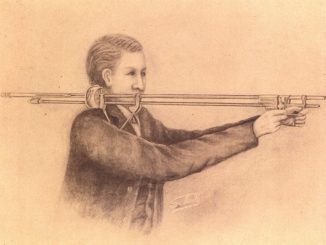

I have heard that when Cadet Edgar Allan Poe quit West Point he stuck his rifle bayonet down in the ground and hung his uniform on it, walking off the parade ground naked. So I guess the rifle must have been an early Springfield? I suppose that’s a trivia question for the bar, eh?
I recently saw a Remington Rolling block rifle in .50-45-400 carbine that was a reduced size and researched the history of the gun. Remington made approximately 500 guns for West Point and 500 guns for Annapolis and had the smaller model as a regular production item for sale to the civilian market. I could not find any total production numbers but there probably only a very few hundreds made compared to the full size. While researching the rifle history, I came across a video of Larry Potterfield from MidwayUSA loading for the carbine model. Also, evidently some of the rifles were chambered in regular .50-70-450.
The .50-45-400, bar-primed centerfire, had cartridge cases varying from 1.23″ to 1.34″ case length. Other than the shorter case length(s), they were identical to the .50-70-450 bar-primed centerfire, and like it they were made by Frankford Arsenal.
They were used in the Remington rolling block cadet rifle made for the U.S. Naval Academy at Annapolis. The West Point version used the standard-length .50-55 case.
Years later, Bannerman’s advertised Remington rolling block “cadet rifles” chambered for the .50 rimfire pistol cartridge. From all indications, these were in fact .50 Remington pistol actions from the 1866-67 Army contract, which after languishing in store for three decades (because anybody with an ounce of sense wanted a revolver instead of a single-shot) were bought for scrap price from Ordnance, and rebuilt with new rifle-length barrels, shoulder stocks and etc. into actual “shooting” rifles that were still short and light enough for 8-to-10-year-old boys to march and drill with.
My one uncle who brought back an assortment of “hardware” from the ETO in 1945 had what may have been one of these. The stock had about a foot of “pull length”, and the originally full-length forend had been shortened and tapered to what I would call typical Sharps Carbine “style”. It was definitely .50 caliber and definitely rimfire. He bought it in an antique store in WV in 1938 for $5.
clear ether
eon
In the course of my life, I have owned two reap doors. First was an 1884 ramrod bayonet model and currently own an 1873 rifle that has a cartouche that indicates that it was owned by the Detroit Board of Commerce. This was special to me since I live in Michigan. It has it’s original sling and bayonet. The scabbard is missing the belt attachment. It’s bore is perfect. I have alw@ys been interested in Cadet models. The one you showed on this video appears to be in very good condition which would make sense since it spent most of its life at West Point. It would be a good thing if you could announce the selling price. I’m betting that it will fetch a fair amount.