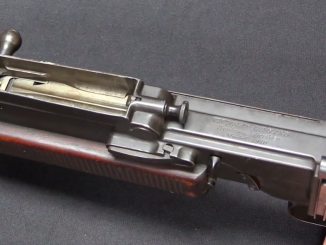
This is an example of a needle fire conversion of a French 1822 rifle based on the patent of L. Merckelbagh. The conversion was done in Paris, probably in the early 1870s. Other base rifles were converted as well (like this example), but like most upgrade conversion systems it does not appear to have been commercially successful. Unfortunately, there is virtually nothing I could find written about the man or design.
Prototype
Vickers-Berthier 1919 US Trials Rifle (Second Type)
This rifle sold for $31,625 at Rock Island on December 1, 2018. After designing the bolt action rifle that bears his name, Andre Berthier went on to experiment with self-loading designs. He developed a light […]

Handgun
Video: French Military Centerfire Revolvers
Today we’re look at the two main French military centerfire revolvers – the model 1873 and model 1892. These both served for many decades with French troop around the world, and they’re interesting designs. I […]
Semiauto Rifles
Mud testing: M1A, MAS 49/56, AR
I’m at the SHOT Show in Las Vegas today (and the rest of the week), and when you read this I will probably be desperately trying to wade through the sea of AR15s in search […]
17 mm equals what 62, or 68 caliber??
0.669 inch, so call it about .67 to .68. A muzzle-loaded original would have used a .664 to .665 Minie’ bullet; the breechloader would probably use a slightly larger solid-base slug.
cheers
eon
I have an original fired bullet in front of me. It came off an old french military rifle range. It is a single groove minie style. The groove is 3.4 mms wide and 1 mm deep. The bullet is 23 mms long and the diameter is 16.9 mms
The base cavity is 13 mms deep round and then square
The 1822 rifles are quite common over here. last year I picked up the wreck of one that had been converted by the tabatiere/snider system to a centerfire brass cartrige at the time of the francoprussian war
It was missing its breechblock but still is a fun piece of french military history for 20 euroes
Pretty nifty invention/patent/bréveté. I do believe the scooped out/dished-out cheek piece was found on most Mle. 1777 and onward French martial muskets, and also those patterns that copied them, including the so-called Potsdam Prussian muskets prior to the Dreyse system’s adoption in, what? 1842? And also the Swedish Flintlås m/1815 musket too.
Cool old gun. U.S. smoothbores in .69 used a .64 cal. ball for a good long while, later a .65 or a .65 plus three x .310″ buckshot. The Minié/Burton conical bullets for rifled .69 muskets was 730 grains of lead propelled by 70 grains of musket powder! “killed on one end, wounded on the other” indeed…
Absent any additional info, I’d think “Merckelbagh” might be an Alsatian surname? Ja?
French copy of the Dreyse needle rifle
Doch nein. Non.
Obturator? Chassepot.
Recall that Ian demonstrated that while the Dreyse needle/nädelgewehr has a long needle to punch through the paper combustible cartridge and powder charge to the percussion cap, this one has a short needle indicating the percussion cap was on the end of the cartridge. Also, the Dreyse bolt does not “tip up” after being turned through 90 degrees and then pulled back. Similar design, certainly “copy” not so much.
Also Belgian, n’est ce pas?
The design was invented by Louis Merckelbagh of Liege, Belgium, operating out of No.8 Southhampton Buildings, London, in January 1871. The particular model was built by Liege gunmaker Jules Bertrand, who was mainly associated with pistols and revolvers. This appears to be an attempted venture into the sporting market – but the idea evidently never took off, and why would it? Given that needle-fire had had its hayday. In Britain where Louis was based, one could buy the Needham or Wilson needle-gun. I can find you the patent if you are interested.
Sources:
https://www.thegazette.co.uk/London/issue/23705/page/502
J. Walter, Guns Dictionary (London, 2018)