Today we are considering two late World War Two rifles: the American M2 Carbine and the German MP-44 Sturmgewehr. Which would you take into combat? The Sturmgewehr is certainly iconic, with a more powerful cartridge, easy controllability, and a solid combat record. The M2 Carbine is much lighter and shorter, but often considered underpowered and difficult to control in full automatic fire. Which do you think is the better choice?
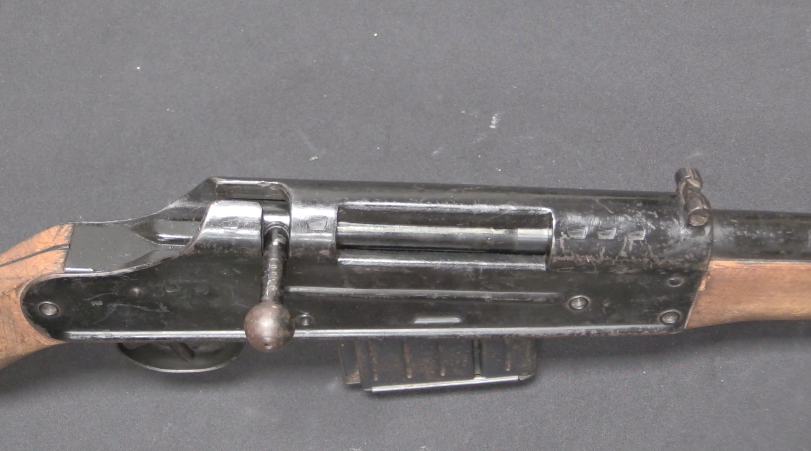
Bolt Action Rifles
RIA: Spreewerke VG-2
Five different companies in Germany produced designs for the last-ditch Volkssturm bolt action rifles, and they were designated VG-1 through VG-5. The VG-2 was developed by the Spreewerke company, and differed from the others in […]

Commentary
Ken Hackathorn on the M1 Carbine: Reputation vs Reality
The M1 Carbine has long been a bit of an enigma to me, because I have never had really good luck with the design, and yet they were extremely popular with Americna soldiers, German soldiers, […]

Bolt Action Rifles
A Rifle of Many Travels
I was visiting a friend recently (James, who runs Tombstone Territorial Firearms, which you should definitely visit if you are ever in Tombstone – it’s a remarkably well-stocked shop), and he had pulled out a […]
Having fired both multiple times, the M2 is a poor automatic weapon. Absolutely uncontrollable even with the compensator.
The mp44 is absolutely another league
Firing an M2 machine gun from the shoulder is indeed uncontrollable for most people. An M-2 carbine, on the other hand, is a sweet little pussycat of a gun that you can paint pictures with. They’re a lot of fun.
The M2 is more controllable than the MP5 and way more controllable than just about any WW2-era SMG, with the possible exception of the M1921/28 Thompson.
The MKb42 family is superior to all of the above, but it is in fact a true intermediate rifle, intended for a fundamentally different role than an SMG or the M2. The M2 is a Personal Defense Weapon, not an “assault rifle”, and its size, weight and capabilities reflect that.
That being said, the StG44 was one of the most shoddily-built PoS a soldier was ever stuck with. Manufacturing in Germany had by that time slipped to the point that the ’44 was being made from thinner-gauge stampings of lower-quality steel to at least get something built, and it shows.
As Ord reports show, just leaning it against something and letting it fall over could bend or break things, rendering it nonfunctional.
The MKb was a good design. The execution on the ’44’ left something to be desired.
The original MKb42 (H) or the Mp43 version were much better choices.
clear ether
eon
I would agree that the WWII German assault rifles were victims of their manufacturing constraints, but I’d also point out that the Germans were, by this point, doing “value engineering” and “engineering triage”, in that the individual weapons they were issuing to their troops really didn’t need to be exquisite pieces of machining art that would outlast their users by centuries…
What was, for example, the combat lifespan of the average Volksgrenadier issued an StG44? Was it really worth the money and effort to put something like a Swiss K31 in his hands…?
The calculus is there, it is ugly, and I have to acknowledge that the guys who were trying to churn out enough StG44 examples were probably right. You have to pick your battles, and while the StG44 was basically a cheap-n-cheerful solution, it was also appropriate to the situation the strategic dunces of Germany had put them all into.
I agree with the overall principle, but disagree regarding this particular application.
The StG is quite heavy, and most of that metal is in the machined parts (which are also better alloys, and heat treated, and made by processes that waste a lot more material than stamping). Using a too-thin gauge saves a ridiculously insignificant amount of mild steel, a less scarce and expensive material, at the cost of reliability rather than long-term service life. Also, these were among the best they had and generally went to trained troops rather than “volks”.
Agreed. Like it or not, the VGI-5 carbine was intended to be the true “Volksgrenadiers” rifle, and to judge from photographs at least some did see action.
Still, at least some “first-line” weaponry reached the volunteers.
One interesting photo I’ve run across is right at the top of this article;
https://militaryhistorynow.com/2020/09/28/weapons-of-last-resort-the-arms-and-equipment-of-the-nazi-volkssturm-2/
It shows an SS officer instructing two Volksturm volunteers on the MG42.
What’s really interesting is his sleeve band- “Charlemagne”.
Yes, the French “ethnic SS” division.
cheers
eon
Y’all really need to refresh your memories vis-a-vis the not-so-subtle distinctions between Volksgrenadier and Volkssturm.
The VG 1-5 was formally the “Volkssturmgewehr 1-5”, denoting that it was meant for the Volkssturm from the beginning.
Huge qualitative and doctrinal differences between the two sorts of units.
To quote Grok, just to save myself the time to type this out:
“The Volksgrenadiers and the Volkssturm were distinct military formations within Nazi Germany during the final stages of World War II, differing significantly in their composition, training, and role.
Volksgrenadiers were reorganized infantry divisions formed in Autumn 1944, primarily from surviving veterans, personnel from the Kriegsmarine and Luftwaffe, and other “jobless” Wehrmacht personnel, following major German defeats in Normandy and Operation Bagration.
They were considered a professional military formation, equipped with standardized uniforms and weapons, including the new StG44 assault rifle, and were organized into divisions that participated in major campaigns such as the Battle of the Bulge, the defense of the Siegfried Line, and the final battles in Germany.
Despite being lower in quality than earlier German infantry units, Volksgrenadier divisions often displayed high morale and cohesion, leading to surprisingly effective performance against Allied forces.
In contrast, the Volkssturm was a national militia established in October 1944, composed of conscripted civilians, including men too old or too young for regular military service, and those previously deemed unfit for combat.
It was not part of the Wehrmacht and was organized by the Nazi Party authorities rather than the military.
Volkssturm units lacked standardized uniforms, equipment, and formal training, with some members even receiving only basic instruction or no training at all.
They were typically issued minimal gear, with only a Volkssturm Wehrmacht sleeveband required to meet Geneva Convention standards for combatants.
The Volkssturm is often compared to the British Home Guard (Dad’s Army), serving as a last-ditch defense force rather than a conventional fighting unit.
While both units shared the ideological term “Volk” and were considered lower quality than earlier German formations, their operational roles and effectiveness were markedly different. Volksgrenadiers were a structured, combat-capable infantry force, whereas the Volkssturm was a poorly equipped and trained militia intended for home defense and static positions.”
The VG
I do not know what happened to that post, but it got whacked somehow…
I’ll leave it as an exercise for the reader to unwrap.
I hope Ian gets us the ability to edit these things for Christmas, some year…
Eon,
Amazing eye! I wouldn’t have picked that out in a hundred years.
Kirk,
Thank you for the correction. I read your previous comment as “quality didn’t matter, because they were just giving them out to hopeless hoboes who weren’t expected to accomplish anything”. I may have been wrong about the nomenclature, but – by clarifying that Volksgrenadier were not the hopeless-hobo units – you’re only reinforcing my point. They were good guns given to professional soldiers, therefore not a place to economize on 3oz of cheap mild steel.
@Mike,
I don’t know that I’d look at the issue of durability quite the way you are, TBH.
The Germans behind the StG44 program were feeling their way into a new paradigm, and we’re only seeing the result of what they came up with under extreme pressure and not a lot of time. Had they been able to do the iterative design process the way that it should be done, a la SpaceX and Elon Musk, odds are that they’d have hit on the idea of making the steel stampings somewhat thicker.
As it was, they were under a hell of a lot of pressure in terms of time and materials, so the German soldier of 1944 got what he got. That it worked as well as it did is something of a minor miracle, and I suspect that had they been in a different place in terms of where the Nazi idiocy put them, we’d have seen a different rifle entirely.
We might not have even seen anything remotely akin to the StG44, which only appeared in the first place due to extreme pressure on the German military, kinda like how they came up with the GPMG concept in order to compensate for the lack of trained reserves due to the Versailles stupidity of eliminating conscription for Germany, something that may well have been counterproductive for the Allies when you stop and contemplate what might have been in a WWII conducted along the lines of what the German military really wanted to do, which was emphatically not what won them the Battle of France in 1940.
It is very interesting reading, going back over the stuff that the German theorists were talking about, and what they really wanted to do. The stuff we associate with the German war machine of the late 1930s and early 1940s were things that the Germans were forced into as improvisations to compensate for the things they lacked, like the (comparatively…) highly trained manpower reserves they’d had during WWI. What they’d have fought WWII with, left to their own devices and having everything their way…? No real idea, but it’d have looked a lot different, and might not have worked as well as it did.
Which is an interesting counterfactual to consider, in terms of “alternate history”. Consider a Wehrmacht that had everything it wanted, and all the pre-WWII “experts” running it… With guys like Rommel and Guderian relegated to mid-ranks, no rapid promotions due to scant trained manpower.
WWII might have turned out quite differently, with the conventionally-minded German war machine trying to recapitulate the Schlieffen plan, just with trucks. The whole thing might well have just turned into WWI Redux, rather than the innovative and disruptive nightmare that it was for everyone else.
It’s really ‘effing humorous, when you think about it: France 1940 mostly happened because of Versailles, with the actual effect of the French reparations and restraint of German military might turning into the highly motivated and innovative Wehrmacht of 1939-40, possibly one of the more lethal military machines of modern history. If they’d have done the post-WWI peace differently, they’d have gotten a different, perhaps more easily-defeated German military out of it.
The irony is palpable.
Kirk,
My understanding is the same as Eon’s. They designed the MKb42 the right way, built it the right way, and then cheaped out later. They didn’t underengineer / underbuild the original in haste.
I agree that most of WW2’s horrors started with Versailles, but (while any fallible human system has its low points) the spirit of Rommel and Guderian is much older. It was there with von Moltke the Elder, and even as far back as Friedrich II when he led a country less populous than Metro San Diego against three great empires (although it required a rude reawakening in 1806).
@Mike,
For all the vaunted German military skill and acumen, the thing that you have to remember is that despite all of that…? They lost, after taking on the rest of the world.
How smart was that?
Germany historically reminds me of the Tae Kwon Do “experts” we had in Korea, the ones who’d make the mistake of trying to tackle a round half-dozen or so American corn-fed types who were easily two or three times their size; no matter the excellence of their technique, when you’re 120lbs soaking wet, you’re not going to leverage your bodyweight into a victory over someone who outmasses your stupid ass by a factor of two, minimum. Making the attempt is no doubt brave, but it is also monumentally stupid.
The German military was exponentially ahead of the game tactically and operationally. Strategically, they were dunces. Hitler’s early successes blinded them to reality, and the sad fact is that they really only got as far as they did due to two reasons: One, their own excellence at minor tactics and operations, and the fact that the Allied leadership were mind-bogglingly stupid at those levels. It is only by the grace of God that we won that war, because if our leadership had been as stupid and inept at strategy as they were at tactics and operational art, especially at the beginning? Yeesh…
You want a sobering read, go over the differentials in loss rates for the war. Until we wore them down, and engaged them with the full panoply of support weapons we built, the Germans were kicking our asses all over the battlefield. Which, logically, they should not have been able to do… Since war is way more than the mere numbers would indicate, however, they eventually got ground down and admitted defeat.
Excellence at the art of war is an illusory thing; if it isn’t backed up by resources, strategy, and good politics, about all it is going to get you is a lot of dead soldiers once everyone else gets into the game and learns from you…
Which was what did in the French and Napoleon in earlier generations. That, and all the dead Frenchmen…
Eon,
Despite the fact that French SS volunteers, alongside the Volkssturm, were among the last defenders of Berlin, the instructor in the photo is not one of them. Instead, this is a Wehrmacht non-commissioned officer from the ‘Grossdeutschland Division’ as indicated by the cuff title on his right sleeve. ‘Charlemagne’ and other SS cuff titles were worn on the left sleeve.
About the quality of the StG44: I have a Sturmgewehr, made in 1945 and stamped StG44. The quality is no different from MP43 and MP44 stamped examples that I have already seen and shot. Most manufacturers didn’t even bother to adjust their expensive dies to the new designation and continued to produce weapons marked MP44 until the end of the war.
Kirk,
I completely agree with your assessment. Tactical and operational brilliance, led by strategic lunacy (in not only goals, but also approach).
Regarding your other comment, I agree that .25Rem ballistics are near-ideal for an assault rifle cartridge – which makes me curious why you’re so often critical of 6.5 Grendel, offering similar or better performance out of a more compact cartridge (because it isn’t limited to LOL 9×19 chamber pressures).
@Mike,
I’m critical of the 6.5 Grendel because it’s basically an attempt to shoehorn something into a platform based on the M16/M4 family that has better ballistic potential. As such, they were faced with the size constraints forced on them by the magazine well dimensions, and that never works well.
Better to clean-sheet something that works, rather than try to adapt something. Examine the sordid history of where that “adapt to existing weapon” mentality led the French, with the Lebel: They wanted to “get something out”, and saddled their troops with the 8mm Lebel for the next forty-plus years, along with all the issues inherent to that (originally) black powder design.
There’s a lot to be said for the ballistics of the 6.5 Grendel. The case dimensions? Nope; too fat to get a decent magazine size out of, and the internal ballistics of propellant combustion are problematic per what my reloading guru tells me.
They really need something slightly longer than 5.56X45 that can drive something slightly bigger than 5.56 projectiles and still fit into something close to the 5.56 magazine dimensions, which are fairly optimal for handling. This militates towards a new platform with something longer than the M16/M4 magazine well.
Allowing the existing stuff to drive your design choices is always a mistake, and that’s effectively what the designers of the 6.5 Grendel did. Go clean-sheet, design a new cartridge taking everything into account, and then design something new as a platform that effectively uses that cartridge. Don’t saddle people with stupid compromises the way the idjit types behind the M4 did; that rifle was designed more by way of picking crap out of the Colt catalog that was “available”, and going from there. Had they actually wanted to do it right, the 14.5″ barrel would have been a less ballistically-compromised 16″ or so, with a mid-length gas system. They cheaped out, thinking that the M4 would only ever be used by support troops, and here we are.
That’s why I don’t like the 6.5 Grendel; it’s a compromise design, and they absolutely should not be doing that. Down that path lies things like the French being forced into compromise after compromise, and the US failing to comprehend that the already-marginal 5.56X45 was not likely to do all that well out of a much shorter barrel…
Kirk,
Most successful systems in history (and essentially all in weapons history) were “shoehorns” (evolutionary developments of proven-effective systems). The M4, while not perfect, is highly successful by your oft-stated criterion of suitability for stated purpose). Recent discussions highlighted how both Maxim recoil and Browning gas MGs – among the tiny handful of inventions that were anywhere close to worthwhile the first time around – were “shoehorns” of the Henry / Winchester system. What you described as “close to the ideal assault rifle cartridge” would have been a shoehorn, having not been designed for assault rifles.
Conversely, every major failure (e.g. NGSW or LCS1) has been a “clean-sheet” (attempt at revolutionary change). Allowing the Good Idea Fairy rather than the existing stuff to drive your design choices is always a mistake. Absent the ability and the necessity to deliver truly revolutionary results (which almost never happens), anyone submitting any clean-sheet system in a field as mature as small arms should be drawn and quartered.
Short and fat cases make ideal combustion conditions, and 1/4″ more protrusion than .25Rem or 5.56 allows more tapered, higher-BC projos. Grendel either delivers .308-beater range out of a full-length barrel, or full-length M16 performance out of an 11-12″ barrel. Four fewer rounds in each magazine are an insignificant price to pay. Admittedly, weight is also a factor, so I’d personally prefer 6mm ARC.
“(…)StG is quite heavy(…)”
III Reich was aware about that and this prompted development of lighter weapons for same cartridge, among them Gerät 06H https://modernfirearms.net/en/assault-rifles/germany-assault-rifles/stg-45m-eng/ which has empty weight of 3,7 kg, as opposed to 5,22 kg of discussed weapon and …required about 50% less raw materials to make
Daweo,
An excellent point. It’s ironic that a country building the lightweight (though not cheap or simple) FG-42 around 8×57 built such a heavy 8×33. Makes me wonder whether an FG updated for the much less demanding cartridge could have been made cheap and simple.
I have fired both extensively. I prefer the German weapon in all aspects. However, one must keep in mind that the STg. 44 was designed from the very beginning as a front line combat weapon. The M1/M2 carbine was designed to be issued to service troops in lieu of a pistol. So this is a bit of an apples and oranges comparison.
Comparing the M2 to the MP44 is not an even match. The carbine was designed in a hurry and delivered for mass production, versus developed and evolved. Not saying the Germans were doing things wrong, but their engineering philosophy was sound.
Someone else asked if the FG42 in a smaller cartridge would have been an improvement. No. I’ve fired a semi-auto BD42 in 8×57. The operating system is too particular and too jarring to be issued widely.
I carried three versions of the Canadian C7 in the Gulf War, Bosnia and Afghanistan. My preferred carry is slung on a single point sling, muzzle down. The rifle can be steadied with the right hand, but the weight is off the hands. So much less tiring – but I was not in contact and had the rifle as battle rattle gear for guard duty and low-risk travel.
As already noted Kurzpatrone has heavier bullet which was going faster, but there are other differences worth pointing: German bullet is more stream-lined making it retaining more velocity (and thus energy) at given distance and common bullet were mit Eisenkern denoting usage of iron core. Whilst this seems to be mainly provoked by material economy side effect of using material with greater hardness is improved penetration c.f. https://thegunzone.com/what-is-steel-core-ammo/
The M2 is just easier to live with. Firepower is adequate, and there are plenty of better guns in the squad if ranges get past 200. Don’t forget that you’re going to carry it all day, every day, then sleep with it every night.
I won’t pronounce on much, going forward into the “Age of the Drone”, but I will state that the small arms paradigm for the individual weapon during the 20th Century was very much a Goldilocks sort of affair…
And, the M1/M2 carbine was very much the “Baby Bear” solution, being just a little too little for the role as individual weapon. It did just fine as a quasi-PDW, but… As far as fitness for the actual role of an infantryman’s individual weapon? Nope, no, and no way.
It’s stablemate, the M1 Garand, was just too damn much Papa Bear’s weapon; too big, too powerful, and not capable of doing the last-resort bullet hose role that the individual weapon has to have. I’d wager that about 60-80% of the time, the .30-06 projectile wound up hitting nothing worthwhile, for all of its vaunted power. If they’d have dialed it back to about what the Soviet M43 cartridge was, stuck that into an M1/M2 Carbine-like platform, we’d have been sitting pretty. Very much the “Momma Bear” solution…
It was unfortunate that the people in charge of things in the US military small arms world were basically illiterates staring at the handwriting on the tactical/operational wall. If they’d have paid attention to the facts on display during the latter stages of WWI, we’d have had very different small arms going into WWII.
I still say that most of the US small arms efforts from about 1918 onwards to around 1958 were flatly delusional, with the focus on full-house individual rifle cartridges more appropriate to the linear volley fire tactics of the late 19th Century. The rounds they issued kinda-sorta worked for support MG roles, but as far as the individual weapons were concerned? Insanity on stilts, until the advent of the “interim” 5.56 and M16.
by the way,in that volksturm picture,the trainer is army,notSS,and from the Grossdeutschland division!
Read S.L.A. Marshall’s report on the carbine: https://thekwe.org/topics/reports/after_action/commentary_on_infantry_weapons_korea_1950_51.pdf
Soldiers and Marines are cited as almost unanimously rejecting the carbine after extensive combat experience with it in winter 1950-51. The Garand rifle, by contrast, receives high marks. Important reading on this subject.
Be careful relying on SLA Marshall too much. He embellished his research, and outright fabricated parts of his books.
There more credible primary documents are battalion and regimental QM reports which feed back on what personal equipment the soldiers preferred, how the companies and platoons organized themselves, and like your comment states, which small arms worked best in specific conditions.
Having extensively reviewed the various AAR documents coming back from early days of the Global War On (some) Terror, I would have to say that relying on the subjective reports of your average combatants is an exercise in mass insanity.
I talk a good deal about how people should have listened to the combat veterans, and that the foolishness of mid-century small arms procurement could have been avoided if they had, but… The key issue is “Who to listen to…?”
Just like with the utterly delusional GWO(s)T take that US forces were in an “overmatch” situation and the solution was NGSW, the unfortunate fact is that the average soldier in combat is no more an “expert witness” than your average citizen seeing a crime and reporting on it. Most of them have no idea what they’re looking at, no idea of what the actual issues are that lie behind what they’re describing in purely subjective terms.
Example: I had access to two Ranger Battalion veterans who were there in Mogadishu during the Black Hawk Down events. Both of them were what I’d happily term “small arms experts”, and both of them had experience with the weapons we used there. One came out of the experience swearing at the 5.56mm/M4 and the other did not; they’d had diametrically opposite experiences with the weapons. Who was right? In the event, it transpired that they both were, in that the combination of the early M4-alikes with the then-standard M855 was “less than ideal”, especially at range.
The problem with using “experts” for your decisions is that you’ve got to carefully vet them, and make sure that what you’re listening to is actually, y’know… Accurate. The purely subjective things you’re hearing from those guys are valuable things to know, because if nothing else, you’ll know what the guys on the ground are perceiving… Which is important, if only for morale purposes.
The problem is, as I say, those “experts” can get it wrong, wrong, wrong. What we were dealing with in Afghanistan and Iraq was not what they conceived of as “overmatch”, it was simply that our MG technique, supporting equipment, and training were unfit for task. You don’t answer long-range MG fires during a firefight with a bipod-mounted gun fired off of someone’s shoulder. You need to have either copious amounts of hot-n’-cold running support fires, or you need to have exquisitely trained MG teams firing off of good tripods, along with organic mortars that are similarly “weapons free” instead of restrained by lunatic ROE demands.
The whole GWO(s)T line of thought on small arms that resulted in the NGSW fielding was purely and epically delusional, something we will no doubt find when the real test of those new systems is made the next time we’re in a shooting war.
It’s wise to listen to “experts”, but for the love of God, pick out and vet those “experts” carefully, while also carefully testing what they tell you. PFC Joe Schmedlap may have valuable insights into your situation vis-a-vis small arms, but it’s a hell of a lot more likely that he’s passing on a bunch of extraneous crap that has zero relation to small arms reality.
Do remember that the M16A2 was foisted off on the US military by “experts”, just as the M14 was. Neither weapon answered the mail, and just as the M14 was done in by men following the “desire path” of actual combat development, so too was the M16A2 supplanted by the M4. Something works, listen to reality.
And, the M4 wasn’t the “perfect solution”, either. They never validated it for lethality at the ranges it needed to be until midway through the GWO(s)T, and they absolutely needed to. It was an afterthought weapon, meant to make life easier for support troops, never intended for front-line use by the direct-combat guys. They were supposed to stick with the M16A2 that they all abandoned as soon as the M4 started showing up, which ought to tell you something about “experts”…
Marshall got a lot of unjustified criticism after he was safely dead. His controversial 1948 assertions on low firefight participation are supported by independent Infantry School data from 1945 and earlier. (Citation on request.) Read the Korea report linked above, commissioned by the Army during a particularly trying campaign, and see if you detect any false notes.
Every historian has friends and enemies. I read Marshall a long time ago, and found his work was direct to the point. In my mind, he’d spoken to enough guys to get a clear picture of battle. I too was a fan. Then I started reading some of his critics, and got a different sense of how he reported AARs and Lessons Learned. I have no dog in this fight, just a historian’s skepticism for the one true answer.
@William A Befort,
I once made a project of trying to understand where the Army’s TRAINFIRE program came from, and what the actual antecedent studies and documents said about it.
Using Marshall’s claims about his role in it all, I used his work as a set of pointers as I began my research in DTIC and the military library system. Army Research Laboratories was also a valuable source.
Do you know what I found? Absolutely nothing to support Marshall’s assertions about his “key role” in developing that program. Zero. Not a damn thing, at all. I also found a bunch of stuff that made me question the actual stats about “firing in combat” that were commonly bruited about during that era, which was when Hackworth was publishing his big book.
The conclusion I reached after the fact was that Marshall was a self-promoting hack, and that virtually nothing of his was worth using in any serious historical context, other than to discuss the way that such hackery gains acceptance and credence. Marshall did not have adult supervision while he worked in WWII or Korea; he sure as hell didn’t have any during Vietnam.
I’ve actually talked to WWII participants in his post-combat sessions. They described leading questions and not seeing a damn thing that they discussed or brought forward about the engagements in anything that Marshall wrote. His basic methodology was to reach a conclusion, and then seek or create supporting “evidence” to support said conclusion.
Most telling comment I can remember about it all was from a guy who’d been a squad leader during WWII, and who’d been there/done that, as well as having been there when Marshall did his little post-action bull sessions. His main comment was “What the hell did Marshall think the NCOs were doing? That we weren’t checking things like ammo, and didn’t keep track of the soldiers we led? How, exactly, do you hide “avoiding combat” from your peers, and just how long do you think the supposed “10%” were going to put up with that bullshit before taking action?”
Virtually none of what Marshall wrote about WWII and Korea makes sense, once you stop and think about it. And, it is notable that once better research was actually done, and it didn’t match with his BS from earlier wars, he immediately claimed credit for having identified the problem and “fixed it”.
If you could provide some actual cites to verifiable sources, I’d appreciate it. I went into my TRAINFIRE research a Marshall “true believer”, and came out of it with a diametrically opposite view due to what I didn’t find in the actual military documentation. There are passing references to him and his work in some of the introductions to the papers I found, but the majority of them are dismissive, saying that while Marshall asserted both this and that, the actual research and data mostly refuted it.
If you are to believe Marshall, then you also have to believe that the US Army and Marines fielded formations without real junior leadership, and that the soldiers involved in these “combat avoidance” incidents were without either leadership or any kind of real supervision.
Which is an assertion I’d recommend highly against making to anyone who served in those capacities during the war. Feel free to make the attempt, though it may require a time machine to go back to when some of these guys were still alive and literally kicking. I had an educational experience when I made the mistake of doing just that to some WWII combat veterans from Europe. That was an enlightening experience, let me tell you…
I always enjoy reading your stuff. Gotta disagree on Marshall, though. What I saw as a rifle squad leader in Vietnam went far to confirm his major points on firefight participation, communication in battle, individual combat loads, soldier capabilities and morale. Since you mention Hackworth, I’ll add that the “Vietnam Primer” he and Marshall assembled, though badly edited, is on point in most respects. In particular their first chapter, “The Direct Assault”, describes exactly the kind of precipitate attack into a VC base camp that cost A/4/47 half its men on 19 June 67. My company helped pick up the pieces, and everything we saw and heard went to confirm the booklet’s description of the most typical small-unit blunder the authors observed in 1965-66.
Keep at it on machine gun tactics!
@William A Befort,
All respect to your Vietnam experience, but I have to ask: Did your reading of Marshall perhaps predispose you to seeing and interpreting things the way you did, to support his assertions?
Remember, Marshall claimed that his work had set the stage for TRAINFIRE “fixing” combat participation in Vietnam, and that his evidence showed greater participation there.
The guys from Army Research Laboratories, however, had a different take on it: The biggest reason that they saw for people “not participating” in combat was due to the marksmanship training environment classically used by the Army, in the form of the “Known Distance Range”, where you fired on bullseye targets hoisted for you at set ranges.
What they determined was that most men trained in that environment on those targets got to combat and had a very hard time transitioning to “man-sized silhouette fleetingly presented at random ranges”, and that was down to why the majority didn’t fire: They’d been conditioned to look for a bullseye target at predictable ranges, and lost the opportunity to shoot when the hard-to-see enemy went into cover.
This was what brought about TRAINFIRE, an attempt to more accurately replicate combat conditions in training. It must have worked, because the statisticians all concluded that they’d gone from low rates of firing at the enemy to much higher ones.
The basic thesis Marshall had was, to my eye, wishful thinking: He postulated an innate “reluctance to kill” that somehow magically got suppressed until recent times, because I sure as hell can’t identify any natural “reluctance to kill” in classical populations like the Romans or Persians. The Mongols, you would think, would have demonstrated this “reluctance”, but the actual fact is, they were entirely OK with putting entire cities to the sword and then searching the entrails of their victims for any swallowed valuables…
If Marshall had said something like “…well-brought up young men of Western nations have been conditioned not to kill gratuitously, and need to be deconditioned in order to make it easier for them…”, then I might agree with the assertion. Raw fact is, however, that in my observation? There’s vanishingly little “reluctance” once the bullets start flying towards you. My guys in Iraq were perfectly A-OK with killing, and were only ever bothered when they inadvertently hit civilians or their own. More than a few were enthusiastic about shooting at the enemy, and actively sought out opportunities to do so. Especially once they’d seen a few of the things that the enemy did, or got hit by an IED.
Based on my reading and experience, I think that Marshall was 9/10ths full of excrement. The only work of his I might still find useful is “The Soldier’s Load and the Mobility of a Nation”, where he restricts himself to actual historical fact and not his own delusional fantasies.
Frankly, I think there’s more to be worried about when it comes to “turning it off” over this supposed “reluctance to kill”. Once you’re used to that as a “go to” solution, the number of times intrusive thoughts will later pop up in totally inappropriate situations is actively disturbing.
I think that Marshall and his acolyte Dave Grossman have done immeasurable harm to people trying to cope with post-combat stress. I understand fully why Grossman got banned by SOCOM, and I just wish the rest of the Army had seen fit to do the same thing before his BS infected a lot of minds. Too many guys were primed for “issues”, and when they didn’t appear, they started obsessing over the fact that they’d had zero problems killing, when they were actually dealing with things in a perfectly normal and healthy way. Marshall’s role in that is something I find essentially unforgivable, and why the hell he felt the need to do that? No idea; I speculate some misguided sense of Christian morality, but I really don’t know.
“…you also have to believe that the US Army and Marines fielded formations without real junior leadership…”
Paul Fussell did, and he was one of them.
“(…)Soviet M43 cartridge was, stuck that into an M1/M2 Carbine-like platform(…)”
This actually was done, though much later and by private entrepreneur. Result is Ingram SAM-2. See middle third of 1st image from top at https://www.thefirearmblog.com/blog/2016/03/18/inside-ingram-sam-gunlab/
Just some clarification on the fragility of the StG44, and the comment: As Ord reports show, just leaning it against something and letting it fall over could bend or break things, rendering it nonfunctional.
Is this noted in formal Ord reports or just the statement to this effect made by Roy Dunlap in Ordnance Went up Front? After reading this in Dunlap’s book I asked some collectors who had original rifles if this rung true. All said it sounded like a serious exaggeration.
Dunlap apparently got it the same place I did, from the official British intelligence evaluations.
It must be said that to them, anything might have looked flimsy compared to a Rifle No. 4.
cheers
eon
Which is ironic as hell, because the SA80/L85 was the only issued military rifle I ever encountered where you could apply too much pressure to the sides of the receiver and have it jam…
The StG44 that I handled in Iraq was apparently in use for about 40-50 years, and was still perfectly functional. Beat up beyond belief, and the only reason we could figure out for it being abandoned in a cache was that the ammo was impossible to find, and that they only had the one magazine with it. How it got to Iraq? Oi… I so wish that rifle could have talked!
I think that the people saying you could render a StG44 inoperable by leaning it on a tree or dropping it were literally talking out their asses, the same way that they discussed the MG42, with a lot of sour grapes in their mouths.
The reality? The StG44 was a lot closer to what the soldier needed in that era than just about anything else that got fielded by any of the major powers, and anyone who’d been shot at during that war as an infantryman could have told them that. The various numpties and arseholes doing the technical intelligence and ordnance evaluations on these guns were likely more worried about protecting their own jobs and keeping the troops from making complaints to the media, so they talked all the German stuff down, which was sad because if they’d only have done honest evaluations, and tried to understand the whole tactical paradigm of the German military, they might have learnt a thing or two…
The Brits, at least, seemed to pull their heads out of their asses in the aftermath of WWII, and the EM-2 and the .270/.280 British cartridge it fired came out of it all. Too bad the dumbasses like Renee Studler ruled the roost here in the US…
Provided that the US could have developed a VASTLY better round withouth changing the fundamental charateristics of the M1/2 carbine (IE the 8mm Ribeyrolles, further necked down to .30 spitzer), I’m with Ian here.
Half the weight, can carry much more ammo, still gets the job done at realistic battle range. I’ll take the M2.
The US already had something close to the ideal assault rifle cartridge in the .25 Remington. All they needed was to put it in a select-fire platform with a larger magazine, and they’d have been set.
Friend of mine used to rave about his granddad’s old Remington Model 8, and I was allowed to fire it at a range with him. His handloads showed where that cartridge could have gone, with development: Flat-shooting, powerful enough to take game out to maybe 500m, and easily something that could have been a military cartridge, had someone seen the potential for it.
Picture a US military with the wit and wisdom to recognize that they needed something like what they actually did, and they put the .25 Remington into a decent modern platform for it… Might have looked like an M1 Carbine, or not, but it’d have answered for what the average soldier needed for a lot longer than the crapfest they wound up procuring.
You get down to it, the M1 Carbine and its cartridge were abject admissions that they’d fundamentally gotten things very, very wrong with the M1 Garand and its legacy .30-06 chambering. Too bad it took until early days in Vietnam to acknowledge that fact, and I have to wonder if they ever would have, absent that experience…
Anecdotes are often like fish stories, sometimes, but I’ve read too many of them to trust my life to the M2. Ten to fifteen percent better ballistics doesn’t sound like much until the bad guys are in the wire, then it matters a lot.
Trying to use what was really a superior handgun to do the role/mission of a combat rifle was what led to people’s dissatisfaction with the M1/M2 Carbine. Early SF and ARVN experience with the weapon indicated that so long as you worked within its “lethality envelope”, it did the job.
The problem is that once you take it outside that envelope, it doesn’t perform. I suspect that an awfu lot of the people making the complaints about it were also people who were trying to do a rifle’s job with a pistol-category weapon, similar to what you’d experience today trying to engage the enemy at assault rifle ranges and so forth with a PDW-class weapon like the MP7 or the P90.
Within its design limitations, the M1/M2 is a reasonably workable solution. The problem is that those design limitations were baked in due to an almost willful disregard of actual combat needs, and never should have been set in the first place. I mean, the M1/M2 is a really good substitute… For a pistol. Past that? Nope. Not in the least.
The M-1 carbine was designed as a replacement for a pistol, the M1911A1. It was not designed as a weapon for an infantryman. The M-1 was for someone who had another job on the battlefield such as field artillery or a staff officer.
It wouldn’t matter which of the two weapons was issued to my troops. The primary firepower of my infantry platoon would be the belt-fed general-purpose machine gun. The whole point of the riflemen in that case would not be to charge forward and hammer the enemy, but to support the machine gunners as to pry the enemy out of a defensible position. If said enemy refused to reasonably vacate, he would be captured, shot, or blown up with explosives (grenades or breaching charges). Did I mess up?
Big mess up: what weapon will your supporting troops be using? That was the question. Even if the machine gun is the heart of the effort, other weapons are not a matter of indifference
Honestly, I’d prefer the Sturmgewehr.
The recognition you’re describing here has been beyond the vision of most military forces during the 20th Century. Regrettably…
I would suspect that so long as the combat “system” were able to keep the enemy from close engagement, then the individual weapon wouldn’t matter much, at all. The MG and mortar teams would suffice to do the majority of the tactical work, properly employed and supplied.
The problems start to come in once the enemy figures out how to counter your MG and mortar teams, and once there, then you need excellent individual weapons to go along with them. Up until that point, well… Yeah, you can get by with things like a Kar98k and some MP40s. Once the enemy figures out how to negate your advantages, then it’s “Yeah, we need a lot more than we have, at all levels…”
You do the reading on how the Soviets countered the MG42 “problem”, and you’re left in awe at two things: One, that anyone would willingly expend men’s lives the way that they did, and two, that the men involved in the effort would go along with it.
I suspect that had the US or Britain tried similar measures, using raw numbers of infantrymen going up against fixed German positions with good supply? They’d have been facing mass mutinies of both troops and leadership; absent the copious amounts of support we had, I really don’t think the Western Front would have turned out the way it did in historical fact. The loss ratios on the Eastern Front, especially wherever the Soviets didn’t have a mass effort going, were truly, mind-bogglingly high.
It was so bad that it gave the German MG team members PTSD from all the killing they had to do. I remember one that I spoke with, and thing he remembered the most were the once-empty fields in front of his positions that would literally be carpeted with dead the mornings after a night attack. I went back and tried to find out which battle this had been, and about the closest I got was one of the “holding attacks” on the German line while the Soviets were trying to prevent the Germans from relieving a salient. Giving your enemy PTSD from all of your troops they had to kill is perhaps a path to victory, but it’s also one I would refuse to participate in. Utter madness, TBH.
If the ammo supply was not an issue, definitely the
German weapon.