
When Indonesia won its independence in 1949, its military had a real mess of different equipment. The SMLE was adopted as the first standard rifle, ut these were in short supply and a lot of Arisakas and Dutch Mannlichers were also in the country’s possession. Looking for a weapon for rural police using the now-standard .303 British cartridge, the Indonesian government decided to revisit a program to convert 6.5mm M95 rifles and carbines to .303 – something initially done with Australian in 1941.
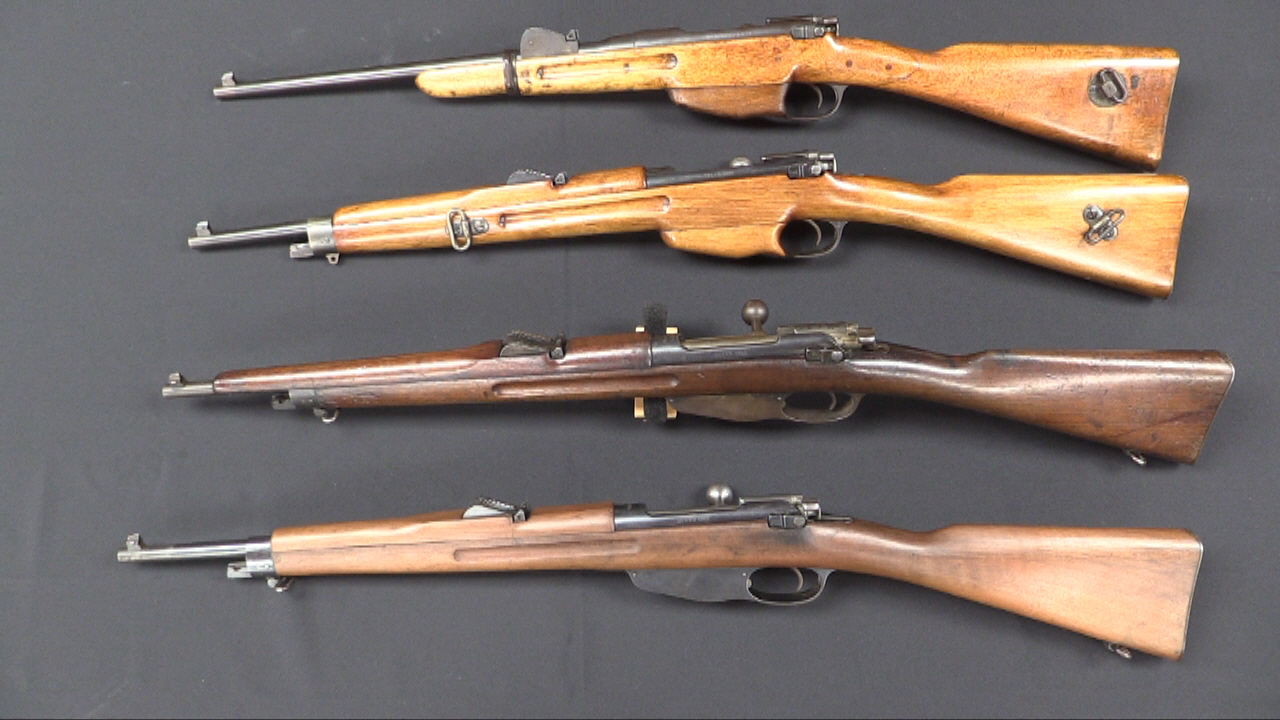
With Australian advisors from Lithgow, the Indonesian PSM factory gear conversions in 1951, and continued them into early 1955. In total, 13,999 M95/51 conversions were made, 9,904 of them carbines and 4,905 short rifles. They were made by reboring the original 6.5mm barrels to .303 and reaming the chambers out (although does result in a slight double shoulder to fired cases). The carbines (with 19″ barrels) were fitted with a variety of muzzle brakes, and made for an as-yet unidentified pattern of bayonet. The short rifles (with 26″ barrels) were given new 2-position rear notch sights, but left using standard Dutch M95 bayonets.
The guns were used in police and possibly military training roles until removed from service in 1961. A batch was sold as surplus in 1962 to InterArms, and another batch was found in the late 1970s and sold to Odin in the early 1980s. The InterArms guns tend to be in better condition, and have intact Indonesian markings, where the Odin guns are generally rougher and have the government property marks ground off.
it will be good put pictures of weapons if there’s no videos. Thanks and good work
The “double shoulder” problem could have been avoided by setting the barrel back about 1/8″ (call it three threads’ worth) in the receiver before boring out the chamber.
It’s the way the original M1903 Springfields in .30-03 (7.62 x 65mm) were converted to the definitive .30-06 (7.62 x 63mm) in 1906-07.
clear ether
eon
“(…)“double shoulder” problem(…)”
How severe problem this is? Does it result in anything other than odd shape of spent ·303 cases?
Case separation right at the “double” point could occur. Especially true with ammunition made in-country on originally Dutch machinery, or especially Japanese 7.7 x 58Rmm leftover from the wartime occupation. Both had noticeably “soft” brass.
cheers
eon
I knew a Dutch Maree Chausee veteran of the 1941/2 war who mentioned the 303 conversions who said the hand guards burst into flame after about ten rounds. Apparently, the boring out and re rifling made the barrels very thin. Good enough for police but not for any serious work.
If it burst into flames after ten rounds, I’d say the rifle was only good for the bandits who were facing the police. Did the guy say how common the mishap was?
It was forty years ago in a safari bar in Africa. His name was Van ERP and I made the mistake of speaking to him in Afrikaans. He corrected me quickly. •” I am ditch, not some Boer.”
Thinking about this… Your informer’s story has every hallmark of an “Old Soldier’s Story” that is probably a wild exaggeration of personal experience. I don’t doubt but that he told you that, and that maybe he even believed it himself, but…
It’s about like “And, there I was, with my Mattel M16, fighting off Viet Cong sappers…”, in that there’s a grain of truth in there somewhere, but after you’re done talking to the guy, you leave the conversation with a distinct sense of “Did that really happen…?”
I’ve been around “stock fires”, and even on the worst cases, it took a hell of a lot more than ten rounds on rapid fire to make it happen. You might burn your hand on the barrel; set normal wood aflame, solely through heat transmission? Not probable…
I’ve been trying to think about how such a thing could happen, and about all I can think of is “handguard soaked in highly flammable/volatile solvent” and that got set on fire from either a pinhole in the barrel venting into it, or maybe muzzle flash… Normal wood, just through the heat of ten rounds? That idea bothers me.
I like the rifle, which looks handy enough. Odd though, that it should have a simplified sight, when the carbine kept the fully adjustable sight.
I doubt the carbine was much fun to fire in .303 however. I don’t really like muzzle brakes, I imagine the blast would have been pretty obnoxious when it was fired. Luckily, since it was a police carbine, perhaps that was not very often.
I notice that the rimmed Dutch ammunition seems to have a very flat face to the back of the rim. On .303 it is gently rounded, so that a firm push on the bolt will force a cartridge over the one in front if it has been loaded wrongly. However, since the Dutch cartridges are held secure in a Mannlicher clip, that should not be a problem.
Interesting that they didn’t go down the British 303/410 route. I suppose that the Indonesians trusted their own police/security to a far greater extent than was the case in India.
As an odder note, I wonder if any suffered the same fate of some Siamese mausers in getting converted to .45-70 once on this side of the Pacific.
No question that Koen was there but I agree that ten roundsnsounds like an exaggeration, even with a barrel bored too thin.
Another episode that disgusted him was the Dutch governor giving a rounding speech one day and surrendering the next.