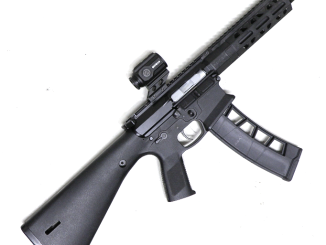
The very first iteration of the HK 33 roller-delayed rifle was included in early US rifle testing in Vietnam. H&K worked with Harrington & Richardson as their US representative, who did final assembly on a small number of trials rifles and marked them “H&R T223”. These went to Vietnam for testing and while the Army opted to stick with the M16, at least one of the test guns was kept by a member of Seal Team 2 and used in combat later (this is where the Vietnam photos of the T223 come from).
The T223 is most unusual for having an automatic bolt hold-open, a feature not seen in another 5.56mm H&K rifle until the trials G41 model. This hold open only functioned when the rifle was actually fired empty; it did not engage when the bolt was manually opened with the charging handle. While unique magazines are required for the hold open feature, regular HK33 magazines do function otherwise. The T223 includes a number of other very early features including a rib for a detachable bipod, a single-pin buttstock, cut-down G3 handguard, unique rear sight configuration, and lack of buffer in either the buttstock or bolt carrier.
Thanks to the Institute of Military Technology for allowing me to have access to these prototypes and bring them to you! Check them out at:

“H&R T223: In Vietnam Before the HK33”
Manual for said fire-arm already appeared at this site, see https://www.forgottenweapons.com/hnr-t223-manual/
I so wish we could trust the reports and outcomes from that era… I would really like to know if the T223 was a better performer than the M16, or if it was definite shiite.
From history, it’s obvious which system had more potential, but it’s also obvious that the distortions produced by all the favoritism created much of that “superiority”. Could the T223 have done as well as the M16, with the same sort of development…? What would the system look like, by now? Would we have fielded the whole range of HK products across the needs of the infantry, from LMG to carbine?
It’d be an interesting counterfactual history, if we could somehow “know” what would have happened, had we gone down that path.
I know from experience that;
1. 5.56 x 45mm cartridge cases do not react well to HK fluted chambers.
2. The HK53 (basically an MP5 in 5.56mm) is prone to cookoff after about two magazines on auto.
So, I’d be sort of dubious about this one. And I understand that similar “issues” were part of the reason for the demise of the G41.
clear ether
eon
Oh, don’t get me wrong: I’m highly dubious of the entire proposition of high-pressure cartridges in a roller-delay system myself.
I just wish we had accurate, reliable, and honest reports from those years of testing. I think we’d find some very interesting things, if we had them.
One of the things that stood out to me, back when I was digging through all the DTIC archives and such, was that the initial “tearing off of limbs” reports on the M16 were a little less than well-documented. I mean, yeah, OK, you went and did the post-contact assessments, but what measures were taken to connect said “torn-off limbs” with the M16, other than your own suppositions? They weren’t recovering cadavers to dissect, nor were they doing much more than looking things over, taking pictures (maybe) and moving on.
I mean, seriously… You go looking for some actual, y’know… Science? Real research, reproducible or at least well-documented? There’s nothing there but a bunch of damn fairy tales.
I still think that the M16 was adopted and fielded in a haze of fantasy and wishful thinking, which makes it even more miraculous that it even worked a little bit, let alone managing to be the most successful “interim” weapon, ever.
The M16 was an example of what happens when engineers are given a request to come up with a better product that’s outside of their usual line of work.
People forget that the Armalite group began as aeronautical engineers. Meaning, they looked at the problem (“How do we design a better infantry rifle?”) as a purely engineering concept, not on the basis of “How is it done traditionally?”
Compare the AR15 to the competing Winchester Light Rifle and the Harrington and Richardson prototype. The WLR was basically a beefed-up M1 Carbine, the H&R was basically a scaled-down T47/M14. Both were entirely reasonable lightweight rifles, but neither one was controllable in full-auto, and neither one reacted well to tropical conditions.
(Considering that throughout the Pacific war, the M1 Carbine was along with the M3 SMG the only U.S. weapon that did not suffer extreme reliability problems in the PTO, I have always found this odd. What did they change on the WLR that caused this?)
There have been few other examples of this sort of innovation “coming out of left field”. The Glock pistol design being the most obvious.
John Moses Browning’s designs were more along the line that he knew how a gun needed to be designed to actually work, and he didn’t much care what anybody else thought on the subject. The Colt and FN automatics, and the Winchester Model 1886, 1892, and 1894 lever-actions rather proved his point.
I think it all comes down to the old engineer’s joke;
“Tell us what you want, and go away until we call you, and nobody will get hurt.”
cheers
eon
with due respect
apart from materials, the Glocks did draw very heavily on older precedents
Browning for the combined breech block and slide, along with tilting barrel locking
and the Roth Steyr for the partially cocked striker and long trigger pull to take the striker right back.
I’ll give Gaston Glock his dues for the use of moulded polymer for the grip frame, and realising that the flexibility and crack resistance of polymer allowed him to reduce the frame slideways to simple little little tabs.
Stoner’s brilliance with the AR10 (and Sullivan’s translation of the AR10 to .223 size) was realising that using the bolt and bolt carrier as the gas piston and cylinder, allowed a true straight line design eliminating the bending moments of a none concentric gas system
just look at slow mo of an AK being fired…
without the bending moment, the AR receiver could be made much lighter and with a view to ease of manufacture rather than strength
with the gas system in the bolt, parts count could be reduced
and with a straight line, it was much easier to achieve a straight line stock for better controllability in full auto
beyond that gas system in the bolt and straight line philosophy, I don’t think there’s anything particularly new in armalite’s designs
their titanium and composite Barrels didn’t do very well and were dropped
moulded plastics had been advancing in use in guns for decades
multi lug bolts were already well known (Fosberry and Johnson had used them)
light alloys had been used in guns for decades, eg the Bretton shotguns.
coming back to H&K roller delay. That also came from within traditional gun making Vorgrimmler at the Mauser Werke
“(…)5.56 x 45mm cartridge cases do not react well to HK fluted chambers.(…)”
Regarding cartridge: how well did 40-round magazine for T223 work, especially compared to one used with M16 in that era?
The M16 magazine situation was a Charlie Fox of monumental proportions.
The original AR15 aluminum magazine was designed for 15 rounds. Because it was intended to duplicate the capacity of the M1 Carbine 15-round magazine.
Then they went to the steel magazine, still the same size. And some overenthusiastic Mother’s Son at Army Ordnance found out he could force 20 cartridges into it. Presto- the 20-round magazine was born, Hallelujah.
In service, soldiers and Marines quickly learned that the “20-round” magazine worked best with no more than…15 rounds. Even 18 was pushing it. The magazine feed habitually hung up after 16 rounds.
When the M16A1 came along, the longer magazine came with it. Designed at the behest of the United States Air Force for their Air Police guarding SAC bomber bases, it was designed to hold 25 cartridges.
Again, some overenthusiastic In-DUH-Vidual at Army Ordnance discovered he could cram thirty cartridges into it. Thereby matching the capacity of the Kalashnikov magazine.
And again, troops in the field quickly learned not to put more than twenty-five cartridges into it.
As for a forty-round magazine, other than civilian aftermarket magazines, the only ones I’m aware of are for the Stoner 63 weapon system, which had a forty-round for the top-feed LMG configuration, and the Israeli Galil 5.56mm, which was a copy of the Stoner magazine.
Speaking for myself, I’ve never put more than 15 rounds in the “20-round” AR magazine or more than 25 rounds in the “30-round” magazine.
And it works perfectly well that way. Just as it was designed to do.
Read the F**king Manual isn’t just a good idea. Under certain circumstances, it can save your ass.
clear ether
eon
“(…)Could the T223 have done as well as the M16, with the same sort of development…? What would the system look like(…)”
This is what happened in reality to sibling of T223, namely Type 11 https://guns.fandom.com/wiki/Type_11_assault_rifle which was and apparently is used by some units of the Royal Thai Armed Forces. It did manage to spawn bull-pup derivative (see images in article).
I remember reading an interview with Rudy, the ex-Navy SEAL that was on the tv show Survivor, where he said that he liked the HR223 that he used when he was in Vietnam because of its ease of disassembly.
I don’t want to denigrate the SEAL community, but as a whole, all the ones I’ve encountered were raging egotists, prone to doing things because “cool”.
I mean, in an environment where they were supposed to blend in? They couldn’t stop themselves by doing things that made them stand out as “special”. I mean, OK guys, you’re supposed to be looking like the troops you’re using as tactical/strategic cover, yes? So, why do you insist on wearing all the typical Gucci SEAL gear there is, making it very obvious that you’re something other than plain ol’ line troops?
There’s something about the entire SEAL program that encourages an awful lot of them to develop terminal “cooler-than-thou” complexes that they can’t quite forget about. And, sadly? Sometimes, those complexes are failure points for them.
I still marvel at the fact that the initial FUBAR on Operation Red Wings (Marcus Luttrell’s “Lone Survivor” incident) involved the 4-man team walking into a tribal farming area with zero plan for dealing with locals finding them. I mean, OK… Yeah, I could see that if that was the first time anyone in the US military had ever been on the ground in the Middle East, but for f*cks sake, that identical scenario is what blew things up for Bravo Two Zero during Desert Storm. How could you blithely set off to do a recon and not be prepared to deal with the implications of that sort of thing…?
I’m still shaking my head over that one, and I’m a mere line-doggie my damn self. One who was integrating civilians-on-the-battlefield into training as early as the very early 1990s. I’d also point out that my paranoia saved a couple of lives when the vic… Err… Subjects of my training rotations deployed to Bosnia. The real world ain’t an isolated training area inside the continental US, folks. Plan accordingly.
Very few SpecOps training syllabi even consider “role camouflage” or just basic “blending in”.
Army Special Forces used to make a big thing about their A Team troops being multilingual. All well and good, but speaking West African Hausa like a native doesn’t cut much ice in “blending” when you look like Rutger Hauer. Doubled when you’re tricked out in “All-American” kit.
(And we can’t even cover them as “East German advisors” any more.)
SpecOps is IMPO one of the few places in the military that desperately needs “diversity” in the “racial” sense. Dammit, we need troops who don’t stick out like a sore thumb no matter how well they sling the local lingo.
That’s just my take, your mileage may vary.
clear ether
eon
Army Special Forces has had an historical problem with outright racism in some of its components.
While I was in Germany, we got a highly unusual NCO assigned to us: A Special Forces-tabbed Sergeant. What was unusual about it was that he was anything but a dirtbag; everyone was looking at him like “WTF are YOU doing here?”
Couple of oddities: He should have been a Staff Sergeant, because at the time, while SF was accepting Specialist ranks for the schooling (this was before they established Selection), the deal was that if they took you, automatic Sergeant promotion during training, and then promotion to Staff Sergeant on graduation. He was still a Sergeant, so that opened up a whole “WTF? Did he get reduced in rank…?”
Also, at that time, SF was not a separate branch. You remained “property” of your home branch, with an SF qualifier on your MOS code.
So, nobody could figure this guy out, and he was a very private sort of person with a bit of a chip on his shoulder. Very obvious he’d been through some hard times with his leadership, because he basically trusted nobody.
Here’s the thing: Black.
I took the time to get to know him, because he knew his stuff. I picked up a lot of improvised explosive knowledge from him, and it was pretty damn clear he was a consummate expert at our field, way more knowledgeable than half our senior NCOs.
As I got to know him better, and he came out of his shell, what had happened to him was this: He’d signed up for SF, made the school gates, passed as the honor graduate for his class. Did everything right. Absolutely stellar SF soldier, at that point.
Where he ‘effed up, as he put it, was when they asked him where he wanted to go, he said “Who focuses on Africa? Send me there…”, because he already spoke a little Swahili and something else.
Trouble was, the outfit focused on Africa at that time was basically run by a bunch of unreconstructed racists. He got there, they didn’t put him on a team, they made him the Group Repair & Utilities NCO, which meant that he was basically doing all the building maintenance for them. That’s it; they took the honor graduate from his training cycle, and made him the R&U NCO. Wouldn’t let him train, wouldn’t let him do anything else. Didn’t harass him, but wouldn’t let him do anything but repair screens on windows, fix doorknobs, and manage all the repairs on their dilapidated buildings. They wouldn’t send him to schools, and it wasn’t until the Engineer Branch said “Yeah, this guy’s overdue for his Basic NCO Course, send him…” that he got to go to that. At the time, SF NCOs were trained side-by-side with line soldiers in their home MOS, soooo… You can imagine it was a bit of a bitch trying to compete with those guys.
He goes off to BNCOC, and did as you would expect: Exceeded expectations, to the point where the NCO Academy wanted to keep him on as an instructor.
Goes back to his unit, having achieved that, and instead of even promoting him to Staff Sergeant as he was supposed to be, they put him back in as R&U NCO. He was a little nonplussed by that point, as you might imagine.
What opened his eyes to the reality of things in that unit was when he turned on his TV one night, where he found a local access channel up on the UHF band (you might remember those…) and saw his unit’s Command Sergeant Major being interviewed and basically acknowledging that he was fairly high up in the local KKK hierarchy.
Right after that, he dropped his airborne status, which triggered a “Buh-bye…” from SF, and was then reassigned to Germany with us.
At that time, he had been one of, I think, three other black SF NCOs in his MOS.
He made Staff Sergeant the minute we boarded him and the time passed; he had so many damn points on the promotion board that it was ridiculous.
And, again, I would point out that this was the SF Group that had a focus on Africa. And, that he was black, with some African language.
Funny moment came later on, when some of his SF class guys ran into us on a training area, and mistook him for still being SF. They had no clue what was going on at that Group headquarters, and were shocked, shocked I tell you, when he told them why he’d dropped status. All of them were Sergeant First Class by that time, and they’d actually been outranked by him before SF training, so seeing him as a line-dog Staff Sergeant was surprising to them. Three years as an R&U NCO will do that to you, though…
Dunno if it’s still like that, today, but SF had some serious racial issues in some pockets of it, back in the day. Talking to him was what convinced me to remain on the line, and not drop paper to go SF, myself. It was pretty disillusioning, for me.
Can we say “ look at me I’m special”, the trope of US Spooks in Vietnam wearing tiger stripe and having a Swedish K hanging around their neck.
Some of that was performative, and some of it wasn’t.
The utilitarian aspects were that the SF guys needed better camouflage to blend in. The SF quartermasters went international across Asia, looking for stuff, and I think the Tiger Stripe came out of either Taiwan or Japan. Same with a lot of other gear, like the stuff they handed out to the Montagnard Mike Force troops. Strict necessity dictated it all…
And, of course, the pogues in the rear all thought the gear was oh-so-cool, and they snaffled it all up. Guy I talked to was one of the rubber-on-road types with the Montagnards, and he described his boss going back to the headquarters and literally stripping the field gear off the pogues, leaving them naked, while he gathered up the stuff he needed for their indigenous troops.
Combat zones are notorious for poseurs, but the problem is, some of that gear is critical and if you ain’t got it, you’re risking your ass. Case in point: I carried a strobe with me at all times for any potential signaling-in of MEDEVAC aircraft. At the time, the IR filter was seriously hard to find legally in the system, so I “tactically acquired” mine from a source which shall remain nameless. He owed me a few favors, see…?
So, I looked like a poseur, geared up like the SF guys. Normally, that’d have bothered me, but the real issue was, could I call a MEDEVAC in without highlighting for the world where I was and where the bird was coming in?
Lots of stuff like that, and it’s hard to judge without having been there and a part of it.
The Swedish “K” was indeed a highly-prized weapon, but there were reasons for it. Close-in, it was very effective, and if you were someone like an RTO, you were better off with it than about anything else.
@Kirk
And when Sweden decided they were going to do as Japan did and no longer supply arms to us for VN, the result was the S&W M76.
Which arrived just in time to be sold off to PDs and Hollywood after “Vietnamization”.
There’s a story that the M76 would have stoppages if not held perfectly upright and level when firing. In my experience, the usual cause of stoppages was holding it by the magazine with the off hand. Backward pressure on the mag, which was slightly loose in the (short) housing, caused the round on top to nose down.
The solution was to hold higher, as on the MP40. A better solution would have been an MAT49 style magazine housing, or one like the “1911 grip” styled one on the Argentine Halcon, but nobody thought of that.
We really don’t have many good SMG designs, in any pistol caliber.
Then trying to make them “carbines” in 5.56 x 45mm because “hey, we don’t have to change the bolt head” just exacerbates the problems.
clear ether
eon
@eon,
There were plenty of good SMG designs the US could have had for a pittance; namely the UZI, among others. I’m sure the Israelis would have licensed them to us, and after a little more development money thrown at them, they’d have been perfect for issue for a lot of roles in Vietnam.
Problem was, the SMG was never a “bread-and-butter” US weapon that we thought worth developing. It should have been different, and it could have, but… Powers-that-were just didn’t care. The M3 was just “good enough”, and the perceived benefits of having a good 9mm SMG just weren’t there.
I still don’t understand why the Swedish “K” and the M76 got all the love they did. For the size and bulk involved, when compared to the UZI? To me, it’s a no brainer: Buy the UZI. In job lots…
@Kirk 2
Notice how many 9mm SMGs that were set up like Uzis (or Czech vz 23-26 clan) popped up in the Seventies and Eighties?
The Italian Socimi and Austrian MpI 69 immediately come to mind, along with the Spanish Star Z84.
It seems like everybody “got” the fundamental logic behind the “Uzi/Vz23” overhung bolt system- but us.
We ended up with an AR bastardized into a 9mm blowback. Too big and heavy for the job and believe me, I speak from experience.
My personal favorite 9mm SMG? The Sterling, on the basis of rock-solid, no-matter-what reliability it inherited from its father, the Lanchester, and grand-daddy, the Mp28. But the Uzi will fit in places it won’t.
cheers
eon
“(…)Czech vz 23-26(…)Vz23(…)”
Again: this name is hoax. Said fire-arm was not developed in interwar period and true name is vz. 48
“(…)namely the UZI, among others. I’m sure the Israelis would have licensed them to us, and after a little more development money thrown at them(…)”
This actually was done, but somewhat later and by private company, result is known as Ruger MP9 https://modernfirearms.net/en/submachine-guns/u-s-a-submachine-guns/ruger-mp9-eng/
Kirk, it speaks a lot about SEAL guys that they retire in fairly low ranks, meaning probably that they are not a “material” having sufficient intelectual capability and scholar prowess to go to higher ranks and through the whole process.
But maybe thats somewhat the point, to have no brainer musclebrain types that could be thrown in any fire the command desire, with no opposition from them, when classic army types would maybe object and hold some reservations about the missions.
@Storm,
You have to be really, really careful about things like looking at rank with regards to “where they are” in terms of intelligence and all that.
The Army has, since WWII, generally slotted everything a pay grade above everyone else. Marines? They run squads with Sergeants; the Army has that as a Staff Sergeant position.
The low rank of the SEALs more-or-less reflects the structure of the SEAL teams, and how the Navy decided to pay those guys. Army has a lot more scope for promotion because much bigger units in SF and Rangers, plus that “one grade up” thing.
The SEALs get paid about the same as the Army SF guys, maybe a bit more, as individuals. They get that pay through various special pays and so forth that the Army guys just don’t have access to, so the SEAL is usually happy being a lower pay grade. Plus, nearly everything they do is going to be TDY with a truly unGodly per diem… From what I could work out, talking to the ones I ran into, a typical SEAL E-6 made about what an Army SF E-8 would be making.
So far as raw intelligence? I dunno; I have my doubts about the utility thereof, and I think that the SEAL community is probably about the same range of ASVAB scores as Army SF or whatever. The issues you have are really cultural; the Navy just does things differently, and the SEALs reflect that. Also, there are massive cultural differences that even insiders don’t really appreciate.
I got to be friends with the guy who ran the 1st SF Group boathouse, and once when I was talking to him about it all (I was over there picking up some gear when a SEAL element came in to do the same thing…) and he gave me his perspective on it. He’d been through the Navy salvage diver course, and had run around SOCOM with the SEALs doing stuff on joint exercises a lot, and he said that what he saw was that the SEAL teams did what they did really, really well, but anything outside that very narrow lane? Best get someone else… If it ain’t maritime or littoral ops, you ask the SEALs to do it, they’re gonna go do it, but they’re probably going to f*ck it up by the numbers, as he put it.
It was funny as sh*t, being there when the SEALs came in. When they thought I was SF, they were all like one of the guys, but the minute that they twigged to me being a leg line dog, the egos all came out, and it was, as my friend put it, all “Hooah-er than thou”.
I have a lot of respect for some elements of every SOCOM component, but that’s also tempered by knowing that a lot of them are more “hat than cattle”, if you catch my drift.
Eon, Socimi was/is very popular in web searches when pointing to Uzi copies, yet detailed information is extremely scarce, I think they never were made in any significant quantity, it failed to gain market traction, maybe it was too well/expensive made?
Even our proverbial Ian in decades long career has still not made a video about it.
As for Uzi, its great but suffers from being relatively heavy, I wonder if there is a space to tweak down the weight, using thinner stamping (but being heat treated) and/or aluminium, maybe even plastic.
You just described the Steyr Mp69. Basically an Uzi with a one-piece aluminum casting outer shell.
It evolved into the Steyr TMP aka Brugger & Thomet MP9. Same basic concept with an outer shell/chassis of polymer. In the process, it ended up as often being mistaken for a “product improved” MAC-10. It’s closer to being a Ruger MP-9 minus the folding stock.
What the TMP, Ruger, etc. all seriously need are rate reducers. None of them should be running more than about 400-450 R/M. None of them actually runs less than 900, never mind what’s in the manuals.
clear ether
eon
Steyr is plastic lower receiver with fairly simple square tube steel upper. It looks (much) simpler to produce then Uzi, aside the lower r. injection molding setup. Fcg is also simplified, stock is a wire! Idk the ergonomics comparison.
Every one of that small smg would benefit greatly with rate reducer, akin to vz.61 Skorpion.
Its true that manuals often downplay the rof
Daweo, its true for Ruger MP9,
however end result was good on paper but in practice somewhat buggy and not that great; its a type of weapon that first exerts unwarranted nostalgia for not gaining traction and market fame, until you see that it is not by accident, and that it has some big flaws, like Hk VP70 with stock in burst that cant hit sh.t, like Ian shown on video, now almost many years ago.