
Yesterday we looked at where the Hogue Avenger came from and how it works; today I’m out at the range to test it out against a nicely customized M1911…

Single Shot Rifles
Sharps-Borchardt M1878 at RIA (Video)
The M1878 was the last new rifle produced by the Sharps company before it went out of business in 1881. It was the invention of none other than German gun designer Hugo Borchardt, better known […]
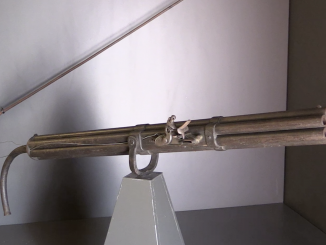
Flintlock
Chambers Flintlock Machine Gun from the 1700s
Joseph Chambers invented a repeating flintlock weapon in the 1790s, and I think it is appropriate to consider it a “machine gun”. The design used a series of superposed charges in one or more barrels, […]
Artillery
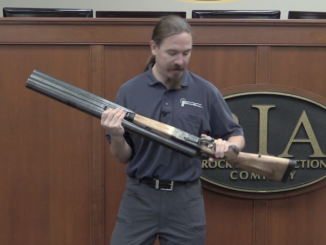
“Double Deuce” 2-Bore Rifle: A Gunsmithing Spectacle
Double Deuce rifle Lil’ Deuce pistol The largest sporting rifles ever actually used in the field as more than an exhibition were 4-bore stopping rifles, firing roughly 1″ in diameter (25mm) projectiles. These were intended […]
If this was a systemic issue how could they possibly have missed it during testing and development?
We should always be careful to draw conclusions about the reliability of a model from a single, used, sample.
Even more in this case, since that’s a slide assembly destined to be mounted on a “standard” frame. Does every 1911 slide assembly work flawlessly on every frame?
@Matisse Enzer,
Too many variables to say. This failure might be due to the ammo Ian was using, could be the magazines, could be a lot of things.
Designing guns is hard. Converting existing guns to new calibers and/or modifying them to use different sorts of operating principles ain’t easy, and the amount of development you’re looking at is massive.
Take a look at the process by which the M1911 came about in the first place… Over on C&Rsenal, they go in-depth on every one of the design waypoints from concept to issue, and then there’s the M1911A1 plus all the civilian development that went into that platform. Wringing all the oddities out of a semi-auto design isn’t easy, and it takes a full-blown developmental fielding and testing cycle to even begin to make something worthwhile. M16 ring any bells, for that…?
I’m not surprised there were problems feeding, which I kinda went “Uh-oh…” at yesterday when Ian described how they’d changed the barrel placement and feed ramp. First thing went through my mind? “How’d they do that with the standard magazines…?”
M1911 design is a well-known beast, by this point. Most good gunsmiths know exactly how to wring the most out of them, and one of the things they’ll tell you about tuning one for feeding is just how critical that feed ramp angle and magazine are to proper reliability. I’ve seen friend’s with “Race Guns” who went through hell getting them to work right, and had to resort to a custom selection of fitted magazines to feed even ball ammo reliably.
Firearms design ain’t easy. Modify existing ones at your peril…
I was a bit shocked when Ian disassembled the pistol and a little piece dropped out that acted as the feed ramp. Then I got to wondering if there were different pieces to work with different lowers. The setup Ian had may have to wrong configuration of the piece.
How very true. Does anyone remember a kit that was created in the 1970’s to allow multiple top ends and calibers on the basic 1911 frames. I don’t recall all the calibers, but there was a .22 lr, 7.63 Luger, 9mm Luger, .38 Super, and several wild cat options based on the .45 ACP case as well as the .45 Auto. I read about it in one of the gun magazines and never heard anything more. The Hogue shows the difficulty of any changes to the basic design being extremely problematic. Imagine the engineering nightmare of the multi caliber kit.
Guns & Ammo, had a piece about 1982 or 1983, putting different colt slides, barrels and magazines onto a 1911 frame.
Nice try, though complex-impractical. A short piston might work. Doubt if I can get a prototype. Perhaps I’ll try. Appreciate your evaluations.