GIGN – the “Group d’Intervention de la Gendarmerie Nationale” (Intervention Group of the National Gendarmerie) is the tip of the spear for French counterterrorism and major crime response. They are a relatively small (a few hundred operators) unit that deploys anywhere in France any often around the world. They curate a wide range of individual specialties from parachuting to diving and everything in between, backed up by a strong supporting contingent of technical specialists supplying them with robotics, drones, surveillance technologies, and whatever else they need.
Not surprisingly, the men at the front of an organization like this have a wide variety of small arms at their disposal from their iconic Manurhin MR73 revolvers to .50 BMG precision rifles – but they need to have *something* as the general standard rifle. And that rifle is the CZ Bren 2 chambered for 7.62x39mm. This rifle was chosen in 2017 as a way to maximize stopping power, to ensure the most effect for every round fired while also minimizing over penetration to prevent collateral damages. GIGN’s goal is to resolve every callout without anyone losing their life – but if they need shoot, they need that shot to be effective. After experimenting with many options, they chose the Nosler V-Armageddon expanding projectile loaded into 7.62x39mm for this objective. The caliber choice also allows maximum ammunition availability when deploying to the far parts of the globe with partner forces and without their own logistics tail.
The clean choice for a modern rifle in 7.62x39mm was the CZ Bren 2, which had been developed initially as the Bren 807 for sale to countries with legacy use of that caliber. That development involved the rigorous multi-environment testing necessary for a proper military firearm, which has been rare in things like AR conversions to 7.62×39. When GIGN made their choice, CZ made a few changes to the rifle to better suit them including a titanium firing pin and a gas system adjustment for reliable fully automatic use with the requested 9″ barrel and using subsonic ammunition as well as supersonic by way of a multi-position gas port. That said, suppressed use has not been a major element for GIGN. They often use suppressors to militate blast to other members of their own teams, but do not typically use subsonic ammunition – terminal ballistics are more important than maximum noise reduction.
The accessories used on these rifles vary significantly, as each individual operator is free to configure his rifle as he sees fit. The original procurement included ACOGs with stacked Trijicon RMR dots and MAWL IR laser modules. These are still regularly seen, but many rifles also sport Holoson lasers, EOTech and Aimpoint optics along with a variety of weapon lights and tape switches. The guns were originally Cerakoted OD green, but some have been overpainted by their users – as you see in the video. These are absolutely not safe queens, they are guns that used used day in and day out for training and deployments.
Many thanks to GIGN for inviting me in to film, and to the two operators who let me use their personal rifles in this video!
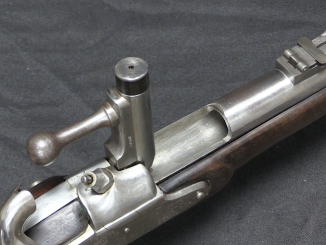
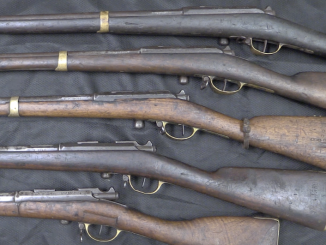
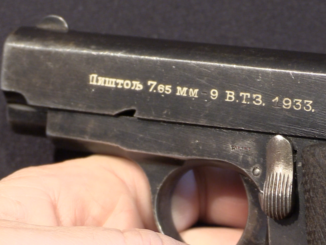
The force that recaptured Air France 8969. Tip of the hat to these brave Frenchies!
I so wish Ian could do “user interviews” on some of these more modern weapons…
It’s also very interesting that the French have apparently resigned themselves to irrelevance as a small arms manufacturer. Sad to observe, but I suppose iconoclasm and uniqueness doesn’t pay the bills in the end.
Their small arms manufacture always struggled, their airspace industry did not, so they put money where they made profits.
Because for every country it is better to make planes and import rifles that make rifles and import planes.
If you can’t build the small stuff, then building the big stuff is gradually going to become less and less viable.
It’s also a point of strategic weakness, no matter how you look at it. Right now, from what I understand, the only small arms production available in France is boutique-level stuff. They can’t even manufacture their own copies of the HK416 or its accessories, so… What happens if HK suddenly becomes “unavailable” for some reason?
It’s about like formerly-Great Britain: They shut down their small arms industry, and what happened with the L85…? Where the hell are they even going to get the replacement, when most of the L85 “stuff” isn’t even manufactured there, any more?
I mean, OK… MagPul makes a great product. What are you going to do when you can’t get them, any more?
Indigenous small arms production is a capability you should try and keep going, no matter what. That these countries haven’t is a testimony to short-sightedness, sloth, and stupidity.
Pure speculation, but possibly related to less people in the world hunting. And general anti-gun zeitgeist. Britain having handguns taken away, media making negative gun-use stories readily available to everyone. In the future, to make America safer, built-in AI monitoring of all vehicles to prevent murderers from mowing down groups of pedestrians.
Fewer folks hunting with firearms maybe. Last time I was in Rome, there were plenty of the ‘diverse ‘n vibrant’ crowd out hunting with bottles and blades
I would bet lack of civilian sales of firearms has a lot to do with the poor showing on the manufacturing of firearms ..
Uhhh… I don’t think so.
Glock is not the most successfull pistol in the world because Austrians are avid weapon buyers. Nor FN sells the MAG and Minimi to half the militaries in the world, while France shuts down MAS, because Belgians are avid firearm collectors, and the French aren’t.
The most successful small weapons manufacturers are simply legacy manufacturers (Glock being the exception, a knife manufacturer that own its success to a good idea) that sought international sales BEFORE the state-owned arsenals begun to shut down due to economic and manufacturing considerations, leaving them with a even greater competitive advantage. Belgians can quit buying firearms at once, and that would mean nothing to FN.
The secret of the success of a firearm manufacturer is simply to keep on manufacturing, so to not lose the know-how. It doesn’t count that much if it sells internally, externally, or to armed forces. It relatively counts even WHAT it manufactures. Pietta, IE, uses the same tooling to build, one week a batch of its black powder revolvers, another week a batch of its modern semiauto rifles. They started doing the rifles because, why not? There already was the tooling, and a lot of people at Pietta that knew how to build firearms.
Finland stopped making military small-arms with the Rk-95 TP supplemented by cheap Chi-com Kalashnikovs and the old MPiKMs from the ex-DDR… Now that the nation is in Nato, SAKO has been resuscitated as a branch of the stolid old Beretta group of companies… So sometimes arms manufacture can be restarted if there is the political will to do so and economic decisions.
@ Dave
It’s not that much the political will. The political will was to get rid of Sako.
Sako never stopped to make firearms, and Beretta acquired it from the Finnish government 25 years ago, well before the country even thought of replacing the Soviet-derived stuff, only because the Beretta-guys thought it would have been a good idea to acquire a manufacturer of precision rifles (also with Tikka).
Now, since the brand still exists, mantained the know-how of manufacturing firearms, and has some new tooling, courtesy of Beretta, it can manufacture ARs or any other thing. As said, the “secret” is to keep on manufacturing.It relatively counts even WHAT it manufactures. To pass from a genre of firearm to another is relatively easy.
Kirk:
Agreed. It is a poor show when two major states, permanent members of the Security Council, can now longer make their own small arms.
The SA80 debacle seems finally to have killed off major firearms manufacturing in Britain. After the government orders were fulfilled, exports might have kept it going, but no-one wanted it.
The deliberate government destruction of civilian firearms ownership in Britain hardly helps. When only 0.5% of the population owns a gun (legally), and those guns must not be of any modern design, there is no community which could support a gun industry. If civilians cannot try out the military rifle, there are no witnesses to how poor it is.
When the L85A3 iteration of the SA80 is finally retired, I expect an AR type will be adopted, there is no need to reinvent the wheel, and we could not even if we wished to. I imagine HK will get the order.
Britain can’t make tanks any more either. The last factories closed years ago. The capability has been lost. It’s Rheinmetall’s gain.
Chieftain! Leyland L60 multifuel engine…
France has a remarkably indipendent defense sector. There’s really not a great connection between small arms and the big stuff. Not even talking about military grade jet engine, all the electronics, armor, etc. But really, not even artillery pieces and shells really require the designers to have any experience in designing or using ARs and pistols.
Yeah, the lack of a domestic small arms industry is a dent in France’s military indipendence, but state arsenals are not more viable. Quality and innovation – wise they can’t compete with private manufacturers, and France didn’t really have a private firm in that business. They count on the fact that, if things get dire, the 100.000 rifles they bought from HK are not going to evaporate, and there stil are 400.000 FAMAS stored in arsenals. More than enough to have time to start building something else from scratch.
More than enough to have time to start building something else from scratch.
I think this statement is, shall we say… Overly optimistic?
As proven by Royal Ordnance and the SA80/L85 fiasco, small arms engineering/production is a definite “thing” in terms of whether or not it exists… It’s also highly perishable, in terms of “Did these guys actually do this, for real, at any point in their careers…?”
There’s a lot of fallacy in the idea that a given sub-discipline is at all transferable; you don’t find a lot of transference between civil engineering skillsets and automotive production, for example. Nations that don’t “do things” in an area are left trying to recoup their earlier successes without a hell of a lot of success, in general. Look at Sweden, and its production of submarines as a salutary cautionary example.
My take on the whole thing is that small arms design/engineering and production are things you want to keep going, as a precautionary thing. You shut down your ability to do that, and sure as hell, you’re going to be hating life when the necessity arises for it.
This seems to be something that a pragmatic person can infer, yet still a “thing” that nation-states seem to find difficult to understand.
Oh, well… It will be entertaining to watch.
Fact is that this is exactly why state arsenals had been shut down. Because their saltuary production of a pair of models was not enough to compete with private manufacturers in term of quality and innovation and, if a country doesn’t have a successful private manufacturer of small weapons, it can’t invent one.
The alternative is what Brazil did, or Romania will likely do. Adopt a Beretta weapon, ask the firm to build a factory in the country to manufacture it and, at the end of the contract, sell the plant to a domestic firm, hoping it remains in business.
Fortunately, almost any nation in the world can and does make a blow-back SMG, no?
I suppose that when the UK rolls around to a replacement service rifle, they’ll buy something from Brother Jonathan or ze Germans like les Français, oui ou non?
L403A1 AIW from Knights’ armament
L129A2 USA
Glock 19 Austria/USA
Police: Glocks, SIGs, HKs…
On the issue of “small arms production” in nations that let their production bases lapse… This is interesting:
https://www-tvmidtvest-dk.translate.goog/herning/midt-og-vestjyske-virksomheder-vil-producere-rifler-til-forsvaret-8d97b?_x_tr_sl=ru&_x_tr_tl=en&_x_tr_hl=en&_x_tr_pto=wapp
I wonder where Denmark is getting the Technical Data Package from, and who they’re paying for the monolithic upper, which I believe is still under LMT patents…
LMT introduced their monolithic upper in 2005, a patent lasts 20 years max, so it’s out of patent now.
No one in western Europe acts as though they believe there will ever be a mass army war again. Thus the Dane saying “We can deliver the first rifles in three months” from the order.
I particularly liked
“And if we are to defend ourselves, weapons are unfortunately a necessary evil…”
WRONG. If you are to defend yourselves, weapons are essential, and a jolly good to have and plenty of laying around to pick up.
Yeah, I rather think they’ve missed the entire point of “a nation in arms”.
Sad reality is that about the only nations in Europe with any real sense of reality when it comes to defense are Finland and Switzerland, and I have my doubts about the whole top-down issue with regards to the way the Finns do it.
I remember talking to a Finn who was a mid-level officer, back around the time the Wall fell down. I made comment that I really admired their system, and got an earful as to how it had “issues”, and that he thought it was entirely too easy to effectively “game” things as an opponent and completely screw up the mobilization effort. The way he described it, all you’d need to do is take out a few key decision-makers and some supply points, and then the whole thing would come to a screeching halt before they got troops out to do anything. He was a big advocate of getting the weapons, right down to crew-served and man-portable AT/AA weapons, out into the hands and personal storage of the reservists. Anything short of that, he was morally certain could be pretty effectively “jammed” by the Soviets/Russians through their Fifth Columnists and Spetsnatz.
I think he was probably giving them a little too much credit, but he did seem to know what he was talking about and had a pretty solid grip on how everything went together.
The way he wanted it, you’d basically hear the defense alert, maybe see a Russian tank coming down the street, go into your basement, and come out swinging with your home-stored Dragon missile system while your neighbors opened up with the squad machinegun from their basement…
One shudders to think what he’d have been up for, these days.