
Join the Forged in Snow launch here:
https://www.kickstarter.com/projects/headstamp/forged-in-snow?ref=2sw39d
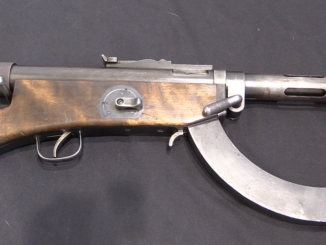
After the Finnish Defense Forces adopted the LS26 light machine gun, Aimo Lahti and the Tikkakoski factory continued to work on further developing it. They designed a 75-round drum for antiaircraft use, and built 50 trials examples in 1931. The design used a specially cut receiver of fit the drums, but also had an adapter to allow use of the original LS26 box magazines.
The Finnish military turned down the new design, but there was export interest from Lithuania and China. China actually placed an order for 30,000, chambered for the 8mm Mauser cartridge. Only about 1,200 were shipped before the Japanese government persuaded the Finnish government to cut off exports, as Japan was fighting in China at the time.
There was actually some use of the LS26/31 in the Winter War. About 30 of the trials guns remained at Tikkakoski in 1939, and they were pressed into service following the Soviet invasion. They were used until the available drum magazines were all lost or destroyed, and then had their box magazine adapters permanently attached and continued in service as standard LS26 guns.
Base weapon was used in conjunction with 2 different devices for filling magazines https://www.jaegerplatoon.net/LMG1.htm Typically Finnish light machine gunner and/or his assistant usually carried two magazine pouches which each contained five magazines, while other soldiers of their squad carried magazine bags, which contained ten magazines each. Finnish military had two loading tool versions for Lahti-Saloranta magazines. The larger version had bulk and needed to be attached to tree trunk for using it, but it was also very effective. The smaller version was small enough to fit palm of a hand, but it was not quite as fast to use as the larger version.
Was similar device provided for said high-capacity magazines or they were always filled manually?
OK… Trying to work out something here: Is this the only example of a (admittedly, only barely…) undermount pan magazine MG?
I can’t think of any. Lots of drum magazines, lots of stuff mounted on top… Zero that I can think of ever having seen which were mounted beneath the weapon, like this one.
Note that I said “production”, not prototype or patented. Something that actually made it into serial manufacture…
Honestly can’t think of or find anything on a search.
Theoretically, any LMG designed to feed from an underside-mounted box magazine (BAR, RPK) could use a pan magazine in that position.
Generally, though, pan magazines were mounted on top for the same reason that LMGs like the Zb26/Bren, Chatellerault M24/29, Nambu, and etc. mounted their box magazines that way, feeding downward rather than up, sideways or widdershins. To keep the “environment” out of the magazine and let gravity help in feeding and ejecting.
So far, I’ve only found a couple with sideways-mounted vertical “pan” magazines. The French MAC Mde 1931 being one;
https://en.wikipedia.org/wiki/Reibel_machine_gun
And the German WW 1 Gast MG being the other one;
https://en.wikipedia.org/wiki/Gast_gun
In each case, the arrangement was intended to make the gun and feed system fit into a restricted space; the MAC in French tanks (which were determinedly small; see Hotchkiss H35) or the Gast in the rear observer’s cockpit of twin-seat scout aircraft (Roland Wal, for example).
The Russians seemed to be perfectly satisfied with their DT28 tank MG with the “pan” on top, just as the British were content with the Lewis gun. Pans were more easily and compactly stored inside the tank, and changing them was faster than changing a feed belt, even one in a box.
Top feed also allowed bottom ejection and a brass catcher being mounted, eliminating the whole problem of ending up with empty cartridges rolling around the floor.
clear ether
eon
“(…)Russians seemed to be perfectly satisfied with their DT28 tank MG with the “pan” on top(…)”
No. There were attempts to develop tank version of DS-39 see 5th image from top in https://war-time.ru/item/pulemet-ds-39-stankovyj-pulemet-degtyareva-obzor-foto-kharaktirstiki-video which would be belt-feed, but solving problems DS-39 proved too hard.
And. They. Failed.
The British attempted to develop belt-fed versions of the Lewis in the 1920s, the VGO in the 1930s, and the Bren in the 1950s.
They failed for the same reason the DS-39 project did. Insufficient power in the system for belt pull-through.
Belt-fed MGs pretty much have to be designed as such from the ground up. Converting a magazine-fed design to belt-feed rarely works.
Colt found this out with their Colt Machine Gun project;
https://en.wikipedia.org/wiki/Colt_Machine_Gun
Even with 7.62 x 51mm Nato in the CMG-3, belt-feed just didn’t work well in the AR-type platform.
The Stoner 63 “did it right”. First develop your MG as a belt-fed, make sure it’s reliable that way, then modify it for magazine feed.
And accept that it’s going to be heavier than a magazine-fed rifle to deal with the stresses of sustained fire in belt-fed mode.
That’s really the only way to make it work.
cheers
eon
Belt-fed MGs pretty much have to be designed as such from the ground up. Converting a magazine-fed design to belt-feed rarely works.
And, yet… If you do it right, the mechanism works. Case in point: BAR to MAG58. It isn’t the basic mechanism that’s the problem, it’s the amount of energy you put into it. With the BAR, you just had to open up the gas system a bit more, add some weight to the bolt/bolt carrier group, and its Hey! Presto!!, a belt-fed for the ages. Same mechanism, different energy. You’re not necessarily designing from the ground up so much as you’re optimizing for each type of feed; the basic PKM is essentially an AK writ large and upside-down.
The issue is the energy; if you’re doing a slapdash and halfass conversion, yes… There will be inadequate energy to run the belt feed. Open things up, add some mass for more inertia when closing it all up again, and you’re golden. The mechanism ain’t the problem; it’s the energy equation going into the design parameters.
The feeding mechanism of the Enfield X11 was simply done wrong. That of the BSA X16 was done right, and the weapon was reportedly very reliable, but the BREN was simply an expensive gun to build in respect to the other competitors, and so was the BSA conversion.
Also the RP46, despite being an apparently “crude” conversion of the DP28, worked without problems.
As for belt fed conversions of mag-fed guns, mind the HK21 also.
The problem in converting mag-fed guns to belt feeding is not power. Recoil always provides excess power for that job. The problem is that the recoiling bolt has to power the belt pull system someway, and the belt pull system has to be placed somewhere. Since the gun had been originally designed without that bit, it’s geometry can easily prevent an easy actuation and placement.
“(…)And. They. Failed.(…)”
Whilst tank version of DS-39 never made it to production, Soviet Union did get production belt-fed tank machine gun in form of SGMT.
“(…)failed for the same reason the DS-39 project did. Insufficient power in the system for belt pull-through.(…)”
Are you sure about that? https://modernfirearms.net/en/machineguns/russia-machineguns/ds-39-eng/ claims that (the most common and frequent being torn empty cases, and bullet separation when pulling rounds with heavy bullets from the belt) which suggest feeding system was actually too emphatic in its’ action.
“(…)belt-feed just didn’t work well in the AR-type platform.(…)”
Turning said weapon to belt-fed version need work, but ARES SHRIKE https://modernfirearms.net/en/machineguns/u-s-a-machineguns/ares-shrike-eng/ suggesting it is possible due to peculiar design of AR-15 (ability to switch “upper” and claiming this is same weapon as long as “lower” is kept unaltered)
“(…)RP46, despite being an apparently “crude” conversion of the DP28, worked without problems.(…)”
There is also bigger machine gun, which is belt-fed conversion. Namely DShK which is derivative of DK, see 1st photo from top https://modernfirearms.net/en/machineguns/russia-machineguns/dshk-i-dshkm-12-7-eng/ where Sh denotes Shpagin (designer of feed module).
The Spanish also converted some ZB vz. 26 (Fusil Ametrallador Oviedo) to 7.62 NATO belt feeding, as the FAO Modelo 59.
I have a vague memory of seeing something like that for the BAR, I think maybe from some kind of AA setup, but I expect it’s one of those prototypes that went nowhere
There existed production pan-magazine-feed grandchild of BAR.
BAR spawned ręczny karabin maszynowy wz. 28. Ręczny karabin maszynowy wz. 28 spawned karabin obserwatora wz.37, which was used in some 1930s Polish aeroplanes and feed from pan magazines with capacity of 96. Some images: https://www.dws-xip.com/wojna/bron/polska/p25.html
I can’t think of any other bottom-mount pans that I’ve ever seen.
I wonder what Daweo can find? Surely, someone patented something with this layout? Yes?
Early version of MAC 1934 aviation machine gun (France) https://en.topwar.ru/157902-oruzhie-vtoroj-mirovoj-aviacionnye-pulemety.html According to the designers, the MAS 1934A (wing) was supposed to feed ammunition from… magazines! For this purpose, huge drum magazines for 300 or 500 rounds were designed. So far, these monsters confidently hold (they will soon celebrate 100 years) first place among all magazines of all times and peoples. No one has yet surpassed them in volume.
“(…)something with this layout? Yes?”
Not sure if it resulted in patent, but such idea resulted in МК200–РВ–98 sub-machine gun (Ukraine), see 4th image from top https://zbroya.com.ua/article/view/96
“(…)bottom-mount pans(…)”
М-100 magazine was prototype of such magazine for already existing weapon (RPK-74). See 2nd image from top https://weaponland.ru/publ/pulemety_s_unificirovannoj_podachej_patronov_izhevskogo_mashinostroitelnogo_zavoda/4-1-0-2474 weight of said magazine was 0,85…0,9 kg capacity was 95…98. They also developed drum (similar to RPK magazine) for RPK-74 with mass of 1.03 kg and capacity of 90…95.
Kirk:
There was the Hefah machine gun, but it was not exactly a success. Our host has covered it:
https://www.forgottenweapons.com/hefah-machine-gun/
This circular 250 rounds magazine was proposed by MBT (Brixia) for aviation FIAT/Revelli 1914 (recognizable from the lack of the water jacket) in 1917.
https://www.forgottenweapons.com/experimental-fiat-revelli-magazine/
https://archive.aeroscale.net/www.armigeridelpiave.it/SELEZIONI/La—mitragliatrice—FIAT—da—aviazione.pdf
Unrelated but, in the same PDF, you can see a 1917 conversion made by the same FIAT to belt-feeding (it will become standard in the FIAT/Revelli 14/35 conversion, in 8mm Breda, but that image clearly has a belt in 6.5 Carcano).
What happened between 1914 and 1917? Simply, in 1916, the Hotchkiss patent on metallic belts, that forced FIAT to adopt the weird “mousetrap magazine” in 1914, expired.
30.000 of these would have given a headache to the Japanese.
Well, it seems my last comment got sent to the void, so I’ll repost it
Sadly Ian has gotten the China part almost completely wrong.
Firstly the warlord period was practically over by 1937, and the order for 30000 was by the KMT, not any warlord
Secondly, that order for 30000 was for normal LS-26s, not 26/31s. This can be proven with some period photos and a surviving gun in the Beijing Military Museum (see https://imgur.com/gallery/4kob5RX/)
I believe where Ian got confused is because where he read of the order for 30000 LS-26s{The second book of Sotilaskäsiaseet Suomessa 1918-1988 (Military small arms in Finland 1918-1988)} it is placed directly after the book talks about the 26/31, thus he inferred that the order was for 26/31s, when it wasn’t.
I really hope Ian changes the title of the video and this page to correct the error.
We can see the evidence of where you can go wrong on pure scholarship… Also, the difficulty of researching when the source documentation isn’t easily accessible to the researcher.
Although, for your critique to be correct, we’d have to account for all the pan-fed articles that the Finns converted. Were they something other than what Ian has researched, here? Limited factory run that wasn’t actually meant for the Chinese contracts?
I think he is saying the KMT/Guo Min Dang Army ordered the guns, not warlords. So the order was still Chinese and still for 30,000 guns. It was not intended for warlords, though.
Shanghai Xueliang ‘the Young Marshall’ was still in business in the Northeast, though, and had and had a considerable army. He was also active against the Japanese. Given the priceless relations with Change Kai Shek, I doubt the Nationalists were planning to supply him with gifted MG’s though
Zhang Xueliang. I didn’t check my phone’s editing
‘Prickly’ relations
The order was also for normal LS-26s in 8mm Mauser, using special 20 round box magazines of a slightly different shape. Not LS-26/31s with the Pan magazines and adapters.
Jaeger Platoon says that only 50 LS-26/31s were ever made. I highly doubt any made it out of Finland.
Imgur was a pain, and wouldn’t let me add more images saying they violated one of their rules, but refused to tell me which, anyways I had to create a new imgur gallery
https://imgur.com/gallery/ls-26-chinese-service-CZaAqFD
According to my Chinese friend, the 167th Division of Tongguan, and a Guangxi unit were the ones who got nearly the complete allocation of LS-26 in China
Oh lord, I just remembered Ian’s making a Finnish firearms book, really hope he doesn’t put the false info about the LS-26/31 in said book, cause then people will take it at face value as fact(I’ve already seen some people online repeat it).