“From Hartford to Vietnam” is available here for preorder:
Or you can find it bundled with “Tiger Stripe: The Vietnam Camouflage Story” on Kickstarter:
https://www.kickstarter.com/projects/headstamp/tiger-stripe?ref=3b3v8y
The Model 703 was an experimental project at Colt which they envisioned being adopted as the M16A2 – although that clearly did not happen. It was essentially an adaptation of an AK-style long stroke gas piston to an AR lower, in response to complaints that the AK was more reliable in Vietnam than the M16. The first prototypes were made circa 1967/68, at the height of doubt over the M16’s viability. At least three were made, but it never did go into serial production. Before Colt was able to get the design to the point of submitting it to the Army, the issues with the M16 had been mostly solved.
Thanks to the Institute of Military Technology for allowing me to have access to these prototypes and bring them to you! Check them out at:
http://www.instmiltech.com
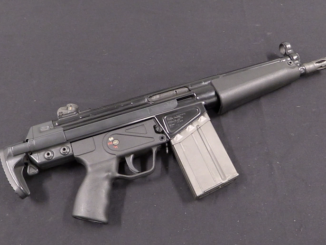
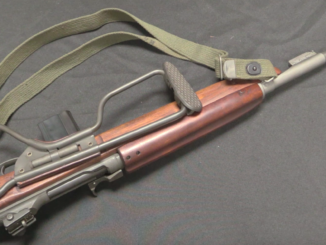

It mostly looks like an AK piston assembly, but that rotating gas port up front is more FAL style.
I notice it has the forward bolt assist, which first showed up in late 1963 on AR15s exported to ARVN and the Royal Thai Army under MAP. They had problems with the M193 Ball from Lake City just like everybody else, due to Lake City ammo case specs in every caliber crowding the upper limit of allowable dimensions, a problem going back to its opening in 1940. M193 being loaded with ball powder didn’t help either; the gas piston setup here was likely intended to deal with that problem.
I’m seeing this less as an “AK clone” and more as a forerunner of the HK416. What was really needed was to go to Lake City, scrap all their gauges and fire 90% of their QC inspectors.
The 703 would have been an expensive “fix” for a problem in ammunition production that nobody ever got around to dealing with from 1940 on.
clear ether
eon
@eon,
To a degree, I think you’ve got a point about Lake City.
On the other hand…? Military-scale mass production is more a question of “What is possible?” than “What is ideal…?”
It would be my take on things that if Lake City had issues producing 5.56X45, then the question ought to be backed up and asked “Did anyone bother to see if they could actually produce the ammo before going with the SCHV solution…?”
If you note, we’re kinda right back here with today’s NGSW program, where they’re not able, apparently, to mass-produce the high-end ammo that goes through the armor. Something about tungsten, and the projectile, I believe…?
This is an ongoing endemic failure in our military procurement system. Nobody actually checked, thoroughly, if the (then) high-tech 5.56X45 was really economically feasible to do mass production with, and thus we had the failures in Vietnam. Same-same with NGSW, and I’ll lay that out again as a similar problem indicating similar arrogance and overweening confidence about things that the idjit class has no business being involved in.
Basically, both programs were all blue-skys and delusional about the realities of production. NGSW is notable for not being able to produce the actual sight systems the whole thing was sold as being key and critical to the capability, along with the ammo.
Turns out, actually making the stuff isn’t so easy. Which, seems to me, is sort of a critical design failure that someone should have caught a lot further back in the program than they did, in both cases.
Personally, this just strikes me as more of the usual procurement incompetence around the details that I’ve come to know and expect from the US military. EMALS? The ACU crotch? Unable to actually make the key components of new weapons…? All of a piece; the idjits have really distorted ideas about their own competencies, which I would suggest are mostly non-existent.
Before anyone signed off on 5.56X45, someone should have done the background check on “Can Lake City Army Ammunition Plant actually make this stuff, at scale? Can we get the right propellants?”
Frankly, given that they could not, the entire design should have been sh*tcanned, and they should have then gone to something that they could produce, at scale and economically. If your ammunition production is predicated on hypotheticals, you done screwed the pooch, boys…
As far back as WW2, Lake City-made ammo in .45 ACP, .30-06, .30 USC, and .50 BMG was infamous for being so close to the upper allowable case dimensions that when you racked the bolt or slide it would stop just short of lock. The SOP for the Garand or Carbine was to whack the back of the bolt retraction handle with your boot sole. Everybody in the PTO (where most of the Lake City product went) blamed the climate. No, it was the case specs from the factory.
In 1962, when the first model (601/602) ARs were going to ARVN and RTA under MAP, the same problem resurfaced. And again, the reason was the case specs, which were even more critical in 5.56 x 45mm than in previous calibers. And there was no way to force the bolt shut on the 601/602 because of the non-reciprocating bolt-retractor.
Then some bright engineer (no, I’m not being sarcastic) at Colt thought of the bumper jack in his car trunk. Basically a metal tube with a ratchet.
Yes. The AR “Forward Bolt Assist” was copied from a standard 1960s American bumper jack. And like it or not, it worked. It got the bolt forward that last quarter of an inch to rotate into lock.
It showed up on the export 603 model in late 1963-early 1964. Four years before it appeared on the M16A1 (607) in U.S. service.
You can easily “spot” the export version in early Vietnam photos. It has the FBA upper receiver but still has the lower receiver without the “ridge” around the magazine release, plus the barrel still has the open-ended “bird-beak” flash suppressor. Quite a few ended up in the hands of Marines in-country in 1965-66.
In the Senate hearings, one Ordnance type said the FBA was added because “Soldiers like to have something to push against”. No, it was added because Ord didn’t bother to do due diligence on 5.56 x 45mm ammunition QC at their sole source, Lake City.
As I’ve stated previously, I never used the FBA because I always used commercial Remington-made .223 55-grain JHP, never M193. The Hague Accords never applied to me.
Like McNamara, whoever was in charge at Lake City should BIH forever.
clear ether
eon
@eon,
My point remains… Just like with the multiple iterations of the “blow-out crotch” on the OG-107, the Hot Weather BDU, and the ACU, the vaunted “system” produced multiple iterations of design failure, and in the exact same places.
The stupid felching f-wits can’t learn. Won’t learn; are apparently incapable of it.
With Lake City, they obviously knew from the WWII iteration that that particular plant had issues, and instead of taking any steps to ensure that history did not repeat itself or to design something that they could reliably produce, they just fecklessly went full steam ahead, and repeated history.
Entirely unsurprisingly.
I honestly don’t think this crap is going to stop until we start summary executions for this sort of entirely avoidable stupidity. You’re right to say that Lake City ammo production was an issue, but I think the problem is several layers deeper and further up the chain than just that.
It’s like they knew, and went ahead anyway. And, if they didn’t know? WTF? Isn’t it their job to know what happened, historically?
Most of our military “professional” caste could do with a large-scale culling. I’d start with the ahistorical ones, who seem to think that they’re the first people to ever encounter anything, ever, in the history of everything.
Seriously… I mean it. You have three successive failures like the “blow-out crotch”, and you really have to marvel at how they’re recruiting, selecting, and training the people in charge. There are ‘effing museum exhibits out there that talk about the early OG-107 failures, and they went and re-iterated the entire experience twice during my career. How? I ask you, just how can you do that and have the temerity to claim “World’s Greatest Military”?
I’ve long maintained that we need a SecDef who starts by “retiring” every officer rank O-6 and above. No exceptions.
I’d replace them with E-6s through E-9s promoted from the field units. “Congratulations, Master Sergeant, you are now a Colonel.” “Hey Gunny, guess what? You’re now a one-star.” “You’re a Rear Admiral Lower Half, now, Senior Chief. Go to work.”
And oh yes, ditch that “Lower Half” crap in Navy and Coast Guard ranks. “Commodore” was good enough back in Dahlgren’s day.
Although I will say that as a rolling Charlie Fox, our armed forces’ bureaucracy isn’t even a tenth as effed up as the British.
The Royal Navy now has more admirals than actual operational vessels.
The RAF is flying realair defense missions with thirty-year-old Hawk trainers armed with remanufactured forty-year-old Sidewinders.
And the Army is still issuing the SA80 “rifle”.
It says a lot that the SAS, Paras and etc. all clung to the Colt 603s they first acquired during the Troubles in Belfast circa 1970. In fact, they still do.
As my mother said, you can always look over your shoulder and see somebody else who’s worse off than you are.
And nine times out of ten, it’s due to somebody with a large desk and no actual qualifications for whatever “job” they’re supposed to be doing.
cheers
eon
“(…)Royal Navy now has more admirals than actual operational vessels.”
Nonetheless they managed to https://metro.co.uk/2026/05/11/navy-spend-200-000-fixing-female-sailors-jacket-buttons-placed-like-nipples-28320149/
Wu Qi吴起, a strategist of China’s Warring States period (c.400 BC), had noble families in Chu stripped of their privileges after three generations. His idea was if you really are ‘noble’ go out and prove it some more.
“(…)Like McNamara, whoever was in charge at Lake City should BIH forever.(…)”
Now I am confused. Why are you proposing sending said characters to Bosnia and Herzegovina?
BIH:Burn in Hell. At least that’s what it meant among the genteel folk I grew up among.
Trust me, his comparison and yours, its actually not so far off.
Is there any documentation on the difference in weight between these 703s and the contemporary M16s?
Bosnia as hell? I thought hell was Shreveport.
You’ve never been to Cleveland, I take it.
clear ether
eon
Polyticks aside, looks like Colt tried to build a much more expensive version of the AR-180.
I’m not so sure it would have been more expensive. The main difference would have been that at the time, the AR15 concentric piston system was not necessarily well understood by a lot of production personnel. (Even today, some people call it a “direct gas-impingement on bolt” system, which it isn’t.)
By comparison, by the early 1960s various manufacturers here and abroad had been making “straight” gas-piston type rifle actions, open or otherwise, since before World War One. There frankly wasn’t much they didn’t know about that sort of setup.
So a gas-piston “upper” variant of the AR15 could have been defined as the “economy” version.
Even today, the ROK Army would probably agree with that assessment.
https://en.wikipedia.org/wiki/Daewoo_Precision_Industries_K2
cheers
eon
looks like lake city’s oversize problem was just production engineers being good production engineers
the problem likely originates with the design tolerance engineers
if you cut your forming die finish reamers at maximum tolerance size, you get more use and more resharpenings out of them before you have to bin them or re model them into roughing reamers.
apparently a similar thing happened with the US pilot attempt at making FALs
I think it was Harrington Richardson, had cut their barrel rifling broaches to maximum tolerance size, to be able to get more use and more re sharpening out of these very expensive bits of tooling.
at the trials, the Americans made FALs were totally inaccurate. they needed to be rebarreled with Barrels that weren’t at maximum tolerances for bore size. After that, accuracy was acceptable.