
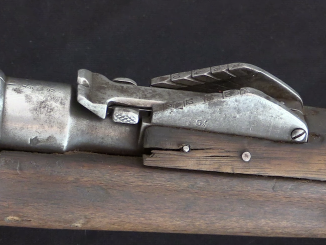
In 1872, two Austro-Hungarian military officers named Julius Payer and Carl Weyprecht set out on an expedition to find a northeast passage to reach the Orient by traversing across the Arctic Ocean above Russia. The expedition was well-funded, and among their other specialized articles equipment they had several bronze Gasser M1870 revolvers and Werndl rifles. Why bronze? That is a bit unclear; it may have been from concerns about iron becoming brittle at arctic temperatures, or perhaps to get better salt water corrosion resistance.
The expedition was not successful in finding passage to Japan, but it did discover and chart an archipelago which they named Franz Josef Land (now claimed by Russia). Despite losing their ship trapped in ice and having to escape by sledges and longboats, the expedition was able to successfully make it to Novaya Zemlya where they met up with Russian fishermen who helped them get transport back to Norway. It was a two year journey, and only one man died along the way (of tuberculosis). Ultimately, it led to a series of internationally coordinated sets of scientific expeditions (International Polar Years) to study the arctic in 1882/3, 1932/3, 1957/8, and 2007-2009.
Article on the 1872 expedition and its ramifications:

“(…)Austro-Hungarian(…)Julius Paye(..)expedition(…)Arctic(…)”
Eyewitness account is available at Project Gutenberg as New Lands Within the Arctic Circle https://gutenberg.org/ebooks/60258 during describing SLEDGE EXPEDITION part he claims that
As for arms, it is enough to have three double-barrelled Lefaucheux rifles and one revolver; and even in districts where encounters with bears may be daily expected, three cartridges a day are a sufficient stock of ammunition. These should be explosive shells, with steel points. Small shot cartridges are indispensable on sledge expeditions, as birds are not unfrequently met with. When the cold is excessive, great caution must be used with the cock of the lock, as the brittleness of the metal then causes it to be easily broken; and from the same cause the hammer will often not stand at half-cock. The guns must not be oiled, as it sometimes happens that the hammer on full-cock will not go down where the lock is smeared with oil. Light woollen gloves should be worn for shooting, in order that the fingers may not be frozen in handling the guns.
A possibility for the reason is black powder corrosion. The Boers (much later) boiled water to pour through their barrels, to prevent corrosion. How would you boil water on a sailing ship in the arctic? How would you clean black powder fouling from a pistol or rifle in freexing conditions?
How does bronze respond differently from iron, to black powder corrosion?
Just a thought, and a question that seems obvious.
Its not like they were waging a war in arctic on hordes of bears attacking them 24/7, really how often any gun needed to be shot.
For food! They didn’t know how long they would be gone. Do you think they carried ALL the food they might need, for who knows how long? It’s a good thing you don’t have to woryy about logistics and/or supply. For an expedition like this, they were clearly thinking like modern “preppers”.
It seems that if parts get brittle in cold, you’d want more than one revolver. Repairing broken lockwork in subzero cold would be demanding even if one had the expertise.
The Winchester Henry and Model 1866 were both bronze framed guns. They even made a 1866 with a solid sliver frame.
Bronze was also used for making artillery. For example during U.S.Civil War both sides deployed M1841 12-pounder howitzer which sported tube made from said material. Austrians did use bronze artillery for very long time, as they have limited volume of iron/steel processing ability, as https://www.globalsecurity.org/military/world/europe/history/at-kuk-artillery-1.htm notes At the outbreak of the Great War, Austro-Hungarian artillery had to fight with obsolete material, far inferior in quantity and completely inexperienced. It was a catastrophic position in every respect. Austria-Hungary was in the unpleasant situation of possessing only one steel barrel factory (the Skoda Works in Pilsen). The Artillery Arsenal was only capable of manufacturing bronze gun barrels and steel could not be processed. In 1914, only the Skoda Works were in a position to deliver guns immediately after the outbreak of the war. The Artillery Arsenal had to confine itself to supplying bronze barrels and gun equipment for want of suitable facilities…
Observe that bronze has also useful property for arctic weaponry, as it provides less friction than steel (making it more likely to work without grease). Due to this property it was widely used for bearing in railroading, to point that this dude http://www.cesa-project.si/en/lexicon/authors/jan-czochralski got sizable pay for development of Bahnmetall B which provide low enough friction for usage in bearing AND do not require stannum as input, as import of stannum into Germany was restricted in 1920s.
Interestingly there is known example of M1911A1 automatic pistol frame made from bronze
https://laststandonzombieisland.com/2020/11/12/brastil-m1911/
or more precisely Brastil.
solid or just slivers of it?
In any case, this falls perfectly in steampunk niche
Fascinating little tidbit of history…
Friend of mine used to work in what we could term a “High risk environment”, and he owned the most interesting set of “non-sparking bronze” tools I’ve ever encountered. Full toolset, all the usual suspects like ratchets and wrenches, all in bronze. Because they were so much softer, he had to periodically replace them, and it was always a treat to hear him bitching about it all. His command of profanity was something to marvel at.
There are some really esoteric jobs in the trades that pay really well, but whose costs are truly amazing. He used to drive around the country doing pipefitting and general factory setup/repair, and while it was very well-paid, his expenses for the specialized tools he required were ‘effing insane. He showed me a wrench he’d had to have custom-forged from bronze that cost him upwards of three thousand dollars, which back during the 1970s was a metric ton of money for a wrench…
$3,000 for one custom wrench? Makes me see why Achilles, Hector, et.al. were so keen to strip slain foe’s bronze armor back when. Iron was a financial revolution, not just technological.
I think the cost was mostly in having it made up in bronze non-sparking alloy, along with the certifications he had to have for it. The wrench came with a three-ring binder of documentation that he had to show before using it on the jobsite…
Millwrights live in a strange world that we mere mortals do not ken in the slightest. That dude was basically an itinerant mechanical savant whose fees were sky-high, and whose expenses were about equal. Lived out of Mitsubishi truck that he’d turned into a mobile workshop/toolroom/living quarters, only made it home for a few days at a time, and essentially wrote his own ticket through life. The people who hired him did not blink at five- and six-figure invoices, back in the 1970s.
I probably should have followed up on his apprenticeship offer, looking back at it all. I’m sure that whoever he eventually took on is still living a life of independent action.
5-and 6-figures half a century ago? I TOLD Mom my gender-studies major was so not a good idea!
Yeah, tell me about it. At the time, I had no context for it, being a stupid teenager.
Looking back on it, that guy had the life. He wrote his own ticket, being a highly qualified millwright working up and down the Pacific Coast. One week he’d be doing a cannery, the next a paper mill, week after that a lumber mill. And, most of it boiled down to “Yeah, I spent twenty years learning where to hit the machine the right way…”
He didn’t spend much money, either. He had that truck of his, and he didn’t even stay at campgrounds, just at friend’s places like ours.
Kirk, all these accounts, maybe the “legendary” guy “tweaked” the $ numbers and other details some…
Dont wanna be a rain parader sceptic, but if its sounding too perfect, probably its not that much – figures the guy living around in his Mitsubishi truck. Where is the family and other where he could spends all these earnings
Scepticism is always comnendable when talking money. Still there are plenty of other things to spend on besides family. I knew a guy who worked fishing in Alaska for some years. He spent a good part of each year in Asia or Argentina or Eastern Europe with money saved. Not the sex tourist thing. He spent a lot of his Asian time in a Thai monastery. Argentina hanging with followers of Nimrod de Rosario. There are other outlets beside family.
I saw the invoices he sent out.
Also saw the stack of checks he hadn’t cashed yet.
I really didn’t appreciate what I was seeing, as a young teenager. Years later, looking back? I was able to.
Have a look, sometime, at what it costs when a major facility is shut down. He was called in for jobs like that. In the days before cell phones, he relied a lot on his contacts like us for messaging and such; his service called us a lot while he was in the area based off our family farm, and it was always interesting to hear his half of the phone calls he’d take or make. I remember him telling someone during one of his calls that he was two states away and working on another job, so if they really needed him, then they’d have to pay for him to break the job he was on, and wait for travel time. He left the next day, and whoever he was talking to paid the people in Longview a bunch of money for them to let that happen.
Details of what he was working on? No idea; it was all industrial crap way over my head. All I could tell you for sure was that it was a lot of high-pressure steam and corrosive chemicals, from talking to him. Also, controls and actuators on said things.
Now that I think about it, some of those invoices included things he’d had to have fabricated or ordered in, so there was that going on that probably contributed to the amounts he was invoicing. He was always bitching about how hard it was to find parts and the kind of fabricators he needed where he needed the things they made. Also, a lot of phone calls with those suppliers after hours on occasion. We got one call from Siemens in Germany, which really stuck out in my mind at the time as a rather big deal. International phone calls were expensive as hell, and not something you usually ever even heard of.
He and my stepdad met because of that Mitsubishi truck; he’d needed work on it while he was tied up on a job, and since my stepdad was running a foreign car repair place at the time… One thing led to another, and he became a family friend for a couple of years, stopping by and camping out with us every four-five months or so.
From memory, this would have had to have been 1975-78, roughly.
@Martin,
Yeah, if you want to run into some really “odd” people, hang around the Alaskan fishing and canning industries. Lots of high-intensity work for a couple of months, rest of the year…? Nada. You work like a fool, then you’ve got the rest of the year to occupy.
One of the weird people my family knew was an Icelandic guy who did contract work as a boat captain up there. Gunnar was a living, breathing stereotype; he’d breeze in with his De Tomaso Pantera and a blond hottie on his arm, then breeze out back to Iceland until the next season. And, again, the car was the intersection; as I remember, whoever sold it to him up in Portland either could not or would not work on it, soooo… Referred him to my stepdad. I remember the car because a.) it was a stone bitch to work on, and b.) because we’d have it for months at the shop while Gunnar was either out at sea or gone home to Iceland. As I recall, a lot of money was going up the noses of both Gunnar and his girlfriends, if you know what I mean…
If you know people in the fishing industry in Alaska, you get used to “Yeah, I think Bob was on the (name of boat that went missing), but we don’t really know for sure… His girlfriend remembered him saying he was going to go looking for one up in Ketchikan, where (name of boat that went missing) was harboring, but nobody really knows for sure…”
High risk, high reward. Intermittent work. Tends to attract “vibrant personalities” who you get used to just popping up. Kid my brother grew up with did that gig, same as his dad, and you got used to him doing things like standing in the airport up in Anchorage at the end of the season and saying “Yeah, screw this… Bali sounds interesting…”, and instead of flying home, he’d fly to Bali for six months and not bother telling anyone what he was doing. He did that one year, and only bothered telling the rest of his family that he wasn’t coming home for that off-season until the week before the next one when he breezed in to check in with them before heading up north again. The rest of the time, he’d been hitch-hiking around Indonesia and Australia.
Income like that plus trekking the West Coast in the 70’s? A gal I knew from high school used to burst out with, ‘Hey! He’s got my life!’ over cases like this