
The FG-42 caught the attention of a lot of countries at the end of World War Two. The British and Swiss both used it as the starting point for some developments. The US went one step simpler, and simply cut up a captured FG-42 to make into the T44, the first prototype of what would become the M60 machine gun.
This project was done in 1946 by the Bridge Tool & Die Company, who spent about six months reinforcing an FG42 and adding an MG42 feed system to it to create an unholy hybrid kludge of a gun. It was, however, successful enough to justify continuing the project. Only this one example was made before moving on to much more practical models built from the ground up instead of hacking up captured German guns.
Thanks to the Springfield Armory National Historic Site for giving me access to this truly unique specimen from their reference collection to film for you! Don’t miss the chance to visit the museum there if you have a day free in Springfield, Massachusetts:
https://www.nps.gov/spar/index.htm
British Korsac E.M.1 FG-42 derivative:
Swiss Bern FG-42 derivatives:
WF-51: https://youtu.be/HCXtUQkXlxY
WF-54: https://youtu.be/OJrcPi5ItKo
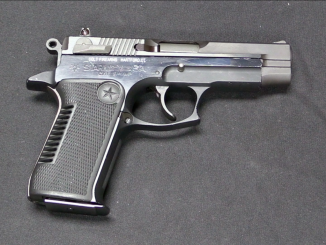
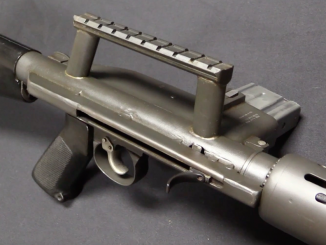
Oh boy. Kirk is gonna love this.
Oh, I do, I do…
I just wish Ian had gotten the bolt out for us to see, so that you could determine if the lack of “peening cuts” on the bolt body came from this specific FG42 not having them, or if that was something that they cut out of the development later on.
The really fascinating thing about this specific weapon is that it worked. And, seeing the way they went about actually improving the mechanism of stock retention and so forth, it’s obvious that someone knew what they were doing…
So, why did all the little details that could have made the M60 a much better weapon get deleted? There’s absolutely no reason for the firing pin spring and sleeve BS to be there; no semi-auto feature needing an energy boost to make the primer hit stronger. There’s no reason not to include the minor amount of extra milling that would have prevented the op rod tower from battering the bolt body at the end of its travel, and on and on.
The M60 could have been a truly great weapon. Unfortunately, the execution of the design, in detail, turned it into what it was: A kludged-together disaster that actually managed to be less than the sum of its contributing design ancestors.
What did in the M60 was all the little crap on it, like the decision to include a second gas system and bipod on the spare barrel, the fact that you couldn’t zero the sights on the barrel in order to prevent having to re-jigger the rear sight when changing barrels, and that the actual rear sight itself was designed in such a way that it was obvious that whoever did it never ran an MG team in combat.
There were so many things on the M60 that could have been designed out of it, but weren’t. Those are the things I rail against, and what made it such a shitty issue GPMG. It went to the field only half-made; the fixes it needed could well have been made, but never were. Even today, the E6 version shows clear indicators that the people behind it have not a damn clue what was really wrong with the M60, and they’ve retained most of the really irritating crap in the name of continuity.
Aside from the reciever beating itself to death; the spare barrel assembly is the thing that just leaves me utterly baffled that the Infantry Board accepted it.
I suppose the only reason that abomination was adopted was so that Ordnance could claim that the troops were armed with guns that were “100% American genius” and nothing else.
In contrast, the Belgians got it right with the FN MAG. At least the darn thing WORKED well in horrible field conditions. I could be wrong.
@JohnK,
Sadly, there’s no documentation that remains to explain that particular design choice, putting the gas system on the barrel. I speculate that they did it because they were concerned that with the way it functioned, that it also needed to cool off along with the barrel itself.
Good idea? Bad idea? Mostly “bad” in my book; you had the added weight, and then there was the extra complexity of specifically how the M60 gas system went together. I mean, c’mon, now… Three threaded bits? All of which had the habit of vibrating loose, and then “off entirely”? Requiring safety wire to prevent that from happening?
I’ve very little good to say about all that, aside from the fact that forcing the provision of safety-wire pliers and stainless steel safety wire in the armorer’s tool chest wasn’t a totally horrible thing… Used that crap a bunch of places, and was happy to have it. Wouldn’t have been there, without the M60 excresence of a gas system.
The other issues with the barrel system are just as you point out: No handle on the barrel, which is such a massive bit of stupidity that I’m morally certain no actual gun crew personnel were ever consulted. You were supposed to use the bipod leg to remove the barrel in the absence of the handy-to-carry(NOT) fiberglass mitten, but if the weapon was well-munged and heated, that usually didn’t afford you much leverage to actually do the barrel change from where you and your AG would actually be, in relation to the weapon, when under fire.
The M60, as I said earlier, was a decent pass at a prototype MG that still needed a lot of development work and refinement. If they’d done that work, maybe it would have been a better gun for actual use. Since they did not, it was a disaster in terms of actual use.
Quick clue to anyone doing weapons procurement: If you are issuing a weapon that takes up 10% or less of a given unit weapon’s fleet, and that 10% causes 90% of the maintenance effort…? You may have issued the wrong weapon.
The machineguns went from “Central focus of maintenance/training effort” with the M60 to “afterthought” with the M240. The M240 always just… Worked. I’m not even sure how you’d get one to emulate the crap I had to put up with, dealing with the M60. We had guns go to Iraq, come back, and which were still within the deployment inspection criteria. That simply did not happen with the M60s we were issued as part of the “float” over in Iraq; most of those were good for maybe a single deployment, and then they’d get coded out as soon as the new unit took over, due to wear/damage. The M240 just kept right on rolling along…
And, anyone complaining about the weight of the M240? I’ll ask this: Which would you prefer? A heavy weapon that was actually there for you to carry into combat, or that comfortably light POS that was probably back up at Third Shop being gauged for probable turn-in?
With the M60, odds are very good that your weapon would be in the shop when you needed it. I think that maybe half the exercises I did as an M60 gunner, I was actually carrying an M16, because the gun was in the shop. I was gunner for about a year in Germany and a year stateside… During my time in Germany, I unpackaged a brand-new gun when I got there, and within two months, that weapon was coded out after we ran about 10,000-15,000 rounds through it at a battalion qualification range. I had a rebuild next, and it only lasted about six months before time and abuse caught up to it.
One of the many things about the M60 that people failed to pay attention to was how the receiver failed; if it was ever allowed to rust, in all those nooks and crannies between the various composite pieces making it up, the resultant rust-induced expansion would “pop” the rivets in very short order. Once that happened, there was no amount of staking that would bring the gun back. If the receiver had been like the PK, one single nice thick pressing? It would have lasted a hell of a lot longer. As it was, all the little pieces that were riveted together just didn’t play well together, especially in corrosive environments. Like, Central Europe corrosive…
As a first-pass effort, the as-issued M60 wouldn’t have been a bad thing. They needed to complete the design loop, and get rid of all the little details that were wrong on it. They didn’t bother, and so issued a massive POS to the American soldier.
The thing that just baffles me is this: I spent about an hour really going over that weapon, as a buck private. Even at that stage of the game, I was like “WTF? You can put this thing together wrong in about six different ways? The barrels aren’t zeroable, so you have to change the rear sight to zero to each barrel, and those changes require fussy little tool work and the rear sight leaf itself is flimsy as it is possible to be? Then, the gas system has to be wired together? WTF, man… Just… WTF?”
I honestly don’t see how they could have possibly had any seriously experienced machine gun crew members involved in the design process. I mean, nobody who ever carried an MG and served on a gun crew could have possibly let most of those features go by, without saying something.
I mean, for the love of God, the M60 was just the least-effort weapon that the US could have issued, and it’s an insult to American machinegunners that it ever was. It’s that bad; the thing is just antiethical to every good gun team practice that it’s not even funny. They’d have done so much better just to have licensed the MG42 and the Lafette, but nobody in the American military ever took a moment to really go into what was different about German MG doctrine/practice, or why they did what they did.
You spend enough time trying to manage the M60 from the standpoint of use, maintenance, training, and leadership and I guarantee you that if you are a thinking person, you’ll come to loathe it the way I do. It’s such a nasty kludge of things that absolutely SHOULD have worked, but they managed to turn it into something that was actually far less than the sum of its parts.
Quite an anti-achievement, really.
Mack:
There has to be a reason why the M60 has a spare gas tube attached to every barrel. My guess, and it is only that, is that it was meant to help when the gun was on a tripod providing fire support. In that role, when the barrel was changed (with the asbestos glove!) you would get a nice new clean gas tube too. In the LMG role on the bipod, the stellite liner would mean that the barrel should not need changing often if at all. No need for the asbestos glove. I may be wrong, but it’s the only way I can make sense of the arrangement.
There’s a reply to this post, that wound up somewhere up above where it was made, for some damn reason. Apologies…
Kirk:
There has to be a reason for the gas tube being attached to the barrel hasn’t there? Maybe I am clutching at straws in trying to come up with one, but that’s my best effort.
If the M60 had been come up with by Britain in 1941 as a counterpart to the Sten it might have made sense. For it to have been adopted by the most powerful country in the world after years of development is essentially inexplicable.
I think honestly think that the more likely thing is that the barrel/gas system arrangement was performed in an utter absence of thought, and only justified after the fact.
I’m not even all that sure that the people in charge of the program were really all that sure how a quick-change barrel system was supposed to work, in a holistic sense. It’s as if they were working off of a checklist, with no understanding of why the items were on it, or how they were supposed to integrate or function together.
As I’ve pointed out, before: To what I know, there’s absolutely zipola out there in terms of what went into the design work on the M60. I looked for it, and never found a damn thing. I suspect it may have vanished in the great purge that happened at Springfield Arsenal in the surrounding period of the Ichord Committee testimonies. That wasn’t something that was at all well-documented, but I’ve reports that something like that went on from two independent sources I spoke with.
The information would show us a lot, but… It’s not out there. Either they didn’t do the work, or they destroyed it.
Maybe Daweo can find us something, but my efforts over the course of a couple of years back in the early 1990s turned up nothing.
Kirk:
I may well be overthinking it, in a desperate attempt to make sense of the bizarre world of the M60. Since no other LMG attaches the bipod and the gas tube to the detachable barrel, I felt there had to be a reason for it. There has to be, right?
Since you have used the pig, can you say if it was SOP to take the spare barrel out when using it as an LMG? How often was the spare needed? It just seems to me that if you are changing the barrel on the tripod it will be easily done (if you have the glove), and you will get a fresh gas tube too. But changing the barrel when it is using the bipod seems like such a nightmare I cannot see that it was ever envisaged as a normal action. Maybe I am wrong, it has been known. As you say, absent any evidence from the design team, we cannot know.
“(…)no other LMG attaches the bipod(…)to the detachable barrel, I felt there had to be a reason for it.(…)”
According to https://www.thefirearmblog.com/blog/nikitin-vs-kalashnikov-round-ii-the-tkb-015-44820181 Soviet studies have found that a bipod mounted near the muzzle improves the accuracy of the machine gun; the U.S. M60 may have influenced this finding. It was found that the TKB-015 and 6P6M machine guns, with a bipod attached close to the muzzle, showed significant improvement. The testing of the M60 showed that attaching the bipod to the barrel increased the weight and burden on the soldiers.
@JohnK,
The whole “do we take the spare” thing was usually mission-dependent. We’d often keep ours locked up in a pioneer tool box, and only pull it out for periodic checks during an exercise. If it was going to be a foot movement instead of vehicle-mounted, then it would definitely be mission-specific: If you were going to be doing sustained fire with the infantry (happened only once or twice during my career, that…) then you’d assuredly take it. If not, it was usually left on the trucks. Most infantry outfits did about the same thing… It’d be there, somewhere, but not necessarily with the gun, until there was an identified need.
Of course, the caveat here is that every unit was different. In a lot of the Vietnam-era infantry outfits, having the Assistant Gunner carrying the barrel with them at all times was usually the policy, because they’d constantly get into sustained-fire engagements where they’d need them.
I will say one thing: The inherent wear-in of the system did lead to rapid loss of interchangeability of the barrels, which meant that unlike the MG42/MG3 in Bundeswehr service, you couldn’t just swap random barrels between guns. That was a major failing, and it was absurd because there was no designed-in provision for marking the damn things… It was all down to safety-wiring dog tags onto them or something equally silly.
That sort of “absence of attention to detail” is a major failing of weapons designers everywhere. You know the barrels have to headspaced to the guns, why the hell aren’t the barrels and bolts set up with easy marking systems? Hell, just a flat spot for the armorer to stamp part of the serial number would be good, but noooooooo… There’s never any recognition that things like that are a constant problem for admin and maintenance.
The really irritating thing about working with the Arms Rooms in the Army was that absolutely NOTHING in the way of actual thought was put into the whole “Yeah, we’re gonna have to store and issue these weapons…” side of the design question. They couldn’t even be troubled to talk to armorers about “How should we design the Arms Rooms in new barracks…?”
Swear to God, make me king for a day? I’d take all the responsible parties out, make them do the armorer job, for a couple of months, and then watch their heads explode. There was one new barracks design that they did where the Arms Room was this literal hole in the wall of the supply/admin area, and you were supposed to somehow get an entire company’s worth of weapons and other “sensitive items” like night vision gear issued out from this tiny little cramped space that the assholes didn’t even provide adequate lighting for. The Arms Room itself was like this dank, dark little cave that you could barely fit all the racks into.
And, what killed me about that? The racks were standardized for decades; the dimensions known. Did they account for that in the arms room design? Nope; the whole thing was “Here’s this little concrete box with an alarm in it, figure it out… Oh, we didn’t even include provisions for locking the racks up to the chain, so you’re going to have to get a work order done with the base facilities people to come in and install eyelets for the chains…”
Which was another point of irritation: The racks themselves were not designed with the security regulations in mind. The armorer had to work out some sort of chaining system such that the racks were locked to something secure, and every friggin’ arms room in the Army was different.
W.T.Actual.F…
Weapons design needs to take in a hell of a lot more than just “Shooting the enemy”. The admin requirements alone are a huge burden; put the serial numbers on the weapon to where you can’t see them when they’re racked? What the hell is wrong with you? Design the racks so that the locking system obscures the numbers? Are you mad?
Yet, they do it all the damn time. Idiots. At some point in our nation’s future, there’s gonna be a crisis, like an attack on the Korean border, and one of the contributing factors to the likely disaster is gonna be “They couldn’t get the weapons out of the Arms Room fast enough…”
Kirk:
It is interesting that there seems to have been no SOP as to whether the spare barrel was carried. It seems as if the US did not have much of a machine gun doctrine after all. There must have been some rationale behind the design of the M60, but as you say, it seems to have all been lost.
Daweo:
I knew you would find something! Even so, it does seem that the M60 was unique in having the gas tube and bipod attached to the barrel. I have tried to rationalise this design decision, but ultimately we just don’t know.
I did find it interesting that the article said there is no tripod for the PK. Is that so? I had always thought it was a GPMG. Is there no Russian doctrine for a medium machine gun any more?
@JohnK,
What you’re looking at in that article is the result of a non-specialist person looking at something and just not seeing what is there.
The Soviets had a working tripod for the guns, and it had the equivalent of the Traverse & Elevation setup on them. The difference is that theirs is a much more refined variation where you don’t have the separate pieces like the US does on the excreble M122/M192 tripods, where there’s a lockbar traverse and a separate T&E that attaches to it. On the Soviet tripods, it’s just like the FN or UK versions of the T&E, where all the mechanism is integrated into the head of the tripod. It’s not as precise or as adaptable as the one on the Lafette, but it is there.
Here’s a good article that sort of goes over the Soviet tripods. Sadly, it too suffers from the issues of a non-specialist looking at something and not knowing what the hell they’re looking at…
https://www.safar-publishing.com/post/why-soviets-hated-pkm-tripod
The main reason that the Soviets did what they did was that they suffered from the same “Let’s do it all from an IFV…” mentality that the US developed; their MG doctrine, frankly, sucks ass. At least, compared to the far more effective and elegant German school…
You can read that article, and easily work out that the guy who wrote it had no idea what theh hell he was talking about with regards to how machineguns actually work, and I strongly suspect that was true of all too many in the Soviet hierarchy. The Border Guards seemed to do it better, but there again you have the “Well, we ain’t got access to the Army fires system, so we’re operating on our own…” syndrome, which is why I probably know more and had to do better with what I had (the MG…) than the infantry itself. I mean, when you’re out there hanging, and there’s nobody but you and your guys, you quickly learn how to make effective use of what tools you do have on hand. For us, the primary fire support weapon was always the MG, and that was ‘effing IT. Bastards often wouldn’t even give us the Dragon sight units we were supposedly entitled to, by the Tables of Organization and Equipment, ‘cos the Infantry needed spares to form a “float”, maintenance-wise, donchaknow?
‘Effing bastards that did that would often use us as either tripwire or probe units, looking for enemy contact. Lose the Engineer platoon? No biggie, now we know where the enemy is coming from…
If you wonder why I was such a freak about my MG systems, that’s it. It was literally all I had to keep my guys alive and on-mission. You had to know how to use them, which most of the Infantry…? Didn’t. They had their FO teams, their Dragons/Javelins, their mortars, their IFV cannon… TOW missile systems. The works.
We had precisely Jack and Sh*t. Oh, and if we were lucky? The M60 was up that week, and not up at 3rd Shop.
Kirk:
So it looks as if the Soviets/Russians really don’t use the tripod much? You don’t see them on tripods in photos. Odd to develop a GPMG and not have a doctrine for the use of the tripod. Still, the Russians do their own thing. Who knew the Ukrainian rustbelt was worth a million casualties?
@JohnK,
As I’ve stated innumerable times on here, my thesis is that the world has forgotten most of what it knew about how to use the machinegun effectively in combat. The weapon just isn’t taught or emphasized enough, and as a result, hardly anyone really understands how to use them effectively.
Anywhere.
Here would be the deal with regards to the machinegun and the tripod. If you go through the various tomes of machinegun knowledge, even today’s deracinated versions will point out that a machinegun off the bipod is only good out to about 800m, while a machinegun fired off the tripod is lethal out to 1800m or better, depending on cartridge?
Why is this? Well, it’s because the machinegun off the bipod is fired by some random PFC whose shoulder and eye simply cannot do as well in terms of supporting and “consistentizing” the gun. This affects two key factors: Dispersion, and the ability to repeatedly engage a given target effectively. With a bipod, you’re sitting there observing the fall of shot, and calling out things like “A little to the right; higher up; need to tighten that beaten zone…”
It is, in fact, more art than science. You take that same gun, put it on a tripod that’s stable, and all of a sudden you’re observing the fall of shot, and saying things like “10 mils left; up 20 mils, fire for effect, troops in the open…”
The tripod acts to allow certainty and predictability, as well as consistency. You left it in the base camp? Well, bubba-dumbass, you’re only going to be effective with it out to about 800m. Anything past that? Pure luck.
People have forgotten how to use a tripod (and, more importantly, why…) effectively in offensive dynamic combat. It’s all focused on “Tripod in the defense”, as you can read into those Soviet-referential articles. The US is pretty much the same; use of a tripod on the offense and while maneuvering is just not taught, not trained, and nowhere to be found on any “Mission Essential Task List” for planning or scheduling training.
Hell, half the dumbasses wearing commissioned ranks in the Army aren’t even consciously aware of what you can do with such a tool, let alone knowledgeable of the required techniques. That’s why the tripods never leave the base camps, and why nobody looks at the field manuals, says “This is dumb…” and changes things.
Due to all the other weapons available, nobody bothers with the machinegun. This is a worldwide phenomenon; any army with an IFV inevitably becomes denatured dragoons, not real infantry. They get used to fighting mounted, with all the shiny toys, and forget how to actually do their damn jobs as infantry. This is why you will often be shocked to find that the better close-combat types aren’t actually infantry branched, because the mass of infantry no longer train on the techniques and procedures; they spend rather more time worrying about maintenance and Table VIII gunnery than doing foot patrols and raids.
I’ll contend to my dying day that the IFV was a mistake, and that they most certainly never, ever should have integrated the IFV with the infantry the way that they have. An IFV ought to be a separate unit, led by different sorts of people, and focused on different things than the actual infantry. Too many mech infantry officers think that they’re Erwin Rommel, off fighting like modern knights on tankback, to coin a term, than being actual “Take ground; hold ground; fight” infantrymen.
The IFV mentality is pernicious; you go down that road, you focus on it, and everything else goes by the wayside, ‘cos “six million dollar vehicle in the motor pool”.
If you’re going to inflict the IFV on your infantry, then you need to keep them separately, and only bring them together for the bare minimum of joint training that they need to be operable as mech infantry. You do more than that, you’re gonna wind up with a bunch of essentially useless armored vehicle crewman that aren’t good for much besides trying to “survive the ride” as additional carry-along casualties for when that Bradley inevitably starts taking hits. Or, whatever other vehicle you’ve seen fit to equip them with…
The minute you permanently assign a vehicle to your infantry squad is the moment when you’ve made the actual decision to do away with your infantry… Which is something I’ll never understand.
Kirk:
The more I loom at it, it seems like the Germans in WWII are the only people to have been serious about MG doctrine. Nobody else seems to have given it much thought. It looks like they still don’t, and I rather suspect the Germans have forgotten about it too.
As for IFVs, after spending £5 billion, there are rumours that the Ajax might have to be scrapped by the British army. A 20 ton vehicle has ended up at 40 tons, and it just cannot be made to work. It vibrates so much its makes its occupants sick, and is so noisy it literally deafens them. The navy spent £6 billion on two aircraft carriers, but did at least get two aircraft carriers. That seems like a miracle these days.
Adding an MG42 feed system to just about anything is a worthy expenditure of tax dollars. A belt-fed SMLE included.
Hey I got an idea. invent a new shorter powerful round and adapt the mg42 and fg42 to use it. A modern mg and battle rifle in one go. Ready in 1946. Done!
“(…)project was done in 1946 by the Bridge Tool & Die Company(…)”
Why did they elected said entity? Did they have prior experience with developing fire-arms?
“(…)unholy hybrid kludge of a gun(…)”
Oh, automobile described by https://www.azlyrics.com/lyrics/johnnycash/onepieceatatime.html has Doppelganger in world of guns.
“(…)was, however, successful enough(…)”
What was Rate-of-Fire of said weapon?
is: “(…)Doppelganger(…)”
should be: “(…)Doppelgänger(…)”
Daweo;
The vast majority of American computer word processor apps and keyboards do not have the capability to do cute European, especially Germanic, “stunts” like umlauts and diacritical marks.
I might add that us dumb, unlettered Yankees have gotten along just fine without such etymological BS for two and a half centuries.
Maybe it’s time for everybody else to jettison such linguistic felgercarb as well.
cheers
eon
I’d happily trade the consistency of spelling in German for a lot, TBH. On the other hand, English is a much better tool for thinking, in some respects. Some. Not all.
I know just what you mean. I spent some time in Hungary a few years back. Whenever a local needed to explain something to me, he would switch to English. Clearly Hungarian is not a thinking man’s language either, just like the poor Germans’.
The difficulty with a lot of non-English languages is that there’s only one way to say or think about things. The polyglot nature of English means that there’s usually a half-dozen different nuanced ways to express a thought, and when you go comparing that capability to things like German, it’s a lot like wearing a straightjacket.
Of course, that insane multiplicity of thing is a huge disadvantage when you go to try and learn it, but… Yeah.
Also, no gendered BS. First time I ran into that line of insanity, I was like “OK, there’s got to be a logic to what is male, female, neuter… Right? Right…?”
Near as I can tell, there is none. Or, if there is, it’s apparently a state secret.
@ Kirk
There’s no logic, it’s only conventional, like English pronunciation.
It didn’t make sense already in Latin (Gladius is masculine, Spatha is feminine, Scutum is neuter), so romance languages got rid of the neuter, transferring all the neuter terms into masculine. Almost always, a term has a synonym in the other gender.
Kirk:
The gendering of nouns occurs in virtually every language other than English. I think it dropped out of English when Old English merged with Norman French to form English. For the same reason, English does not have the various cases of other languages, and the verbs are easier to decline. It is thus easier to pick up the basics of English, probably easier than for most languages. English is unusual because it formed from a Romance and a Germanic language, which means we do have more terms for the same thing than most. All in all, I rather like it.
What an ignorant and American statement. Or is that redundant?
Well you do know what to call a smart person in America, don’t you? A tourist.
You know, there’s a reason that American English is the operational language of civil aviation worldwide.
Including written reports.
cheers
eon
@ Eon
It’s calle “British Empire”, and then US economic and manufacturing supremacy at the dawn of civil aviation. It has nothing to do with a pretended superiority of the language itself.
@Dogwalker,
The real question is this: Which language is still going to be spoken in a thousand years…?
It does not look like it’s going to be anything European, outside of English.
English is, due to the nature of the people who spoke it historically, the “Borg” of languages. It consumes everything it encounters, and that’s why the spelling rules and such are so screwed up: It’s actually half-a-dozen other languages wearing a damn coat.
Sadly, a lot of the European languages are effectively dead, and their speakers are going extinct right alongside them. And, it’s nobody’s fault but their own.
Had Germany eschewed involvement in two world wars, German would likely be the dominant tongue in Central Europe, with pockets of use all the way out to the Urals. As is? The entire ethnicity is committing demographic suicide as we discuss this.
Remains to be seen where it all goes, but I will be placing bets on “dead languages walking” while English and Chinese march onwards unbothered. Sad, but true; the Europeans did it to themselves, and if they don’t pull their heads out, it’ll only get worse and faster.
Note the implications, here: https://instapundit.com/759828/
@ kirk
Which language was not spoken a thousand years ago?
No main European language was. No European is able to understand a sentence made in what his ancestors did speak in 1025 AD.
A thousand years is a lot of time for a language.
English will survive more than other languages? Maybe, Maybe not. But, if it happens, it will happen for the abovementioned reasons. It has nothing to do with the inherent charateristics of the language, or of the people that speak it.
An explanation why the English word ‘German’ for the language and ‘Germany’ for the country is not helpful: https://www.youtube.com/shorts/vWDpeM8fhkg
I did consulted myself with listing of English words https://archive.org/details/con00ciseoxforddicfowlrich now I see it should be doppel-gänger. I will apply this in future.
Point to be made here is that “doppelganger” is a legitimate loan-word taken up by English, and that the usual way of spelling it in English is as I do it here, sans umlaut.
So, you can be pretentious and use the umlaut, or you can go with the flow as most normal English speakers do and go on with life unbothered…
Gotta love that as a cludge like M1919 motivation… Half a bullpup, albeit not a… Mg… In practice. But like… Erklärungsnot. Kirk doesn’t like the M60 as stated and I think we can all appreciate why – Or, get at least he knows why, and trust him. And/or in that maybe you simply can’t do what they wanted, in 7.62mm nato and a belt “modular” issues I.e. The dreamy one thing does all. I blame the Soviets personally for starting it, has anyone tried Ppsh style shooting with a 7.62x39mm it really doesn’t work. We all laud well… The general public, sort of but the original does’ish. You can’t hit a barn door in full auto – 5.45 needed, to do. But that intermediate cartridge is no such thing, for that; fire ball, noise, low flying aircraft threat probably… The folks you shot at 100m away are still stood there, albeit somewhat shell shocked by the event.
One would think that extensive testing and tinkering with other products (like the Colt R75A or any European variant of the Browning Automatic Rifle) ensured that the M60 became a workable weapon that could be operated and maintained even by the most hastily trained machine gun crew. Apparently, one would be too optimistic. I wonder if Kirk would have stolen a Madsen-Saetter and tripod from Indonesia rather than be issued a brand new M60E6. I have yet to hear the Indonesians complain of the Madsen-Saetter or its mount falling to pieces during training. I could be wrong.
I’d have liked to have gotten some trigger time on the Madsen-Saetter. Never did, however…
Soooo… I’d have cheerfully bypassed any such battlefield pickups and chosen the guns I do know, the MG42 or MG3, and the MAG58.
From what I know of the Madsen, it looked like a good gun that just needed some minor developmental tweaks.
“(…)liked to have gotten some trigger time on the Madsen-Saetter(…)”
Then hopefully you will find DESCRIPTION
OF THE
MADSEN/SAETTER
MACHINE GUN
RIFLE CALIBRE
MARK II available at https://vdoc.pub/download/desc-of-the-madsen-saetter-machine-gun-rifle-cal-mk-ii-456b56ndf2f0 interesting
Knock one up in 7.62x39mm compromise, it has a bipod. Gain a bit of barrel length, to the Soviet belt fed… D… That one, which was actually good in full auto seemingly.
Oh right laws… Auto lark. Well, gast gun mount it, bump fire lark; 20k clubs could by it, that company who made fg42 replicas probably have/could make parts. Belt fed, it would knock them out that. Conversation point, for club membership sales; free coffee.
One pull of the trigger, is it law lark, use a twig, pulled; then jump back, bbbbbbbbbang. Worth 20k that how much are club memberships, a centrepiece, like a big turkey or something. Praise be.
“(…)20k clubs(…)”
What do you mean by that?
And that is not relegating the gast gun to bump fire, the aghast gun is two mk03 cannon over/under, rotary displacement api – Shortens the action by half, to load/eject; thus quicker. Not bump fire.
But you wouldn’t be able to have that as a centrepiece @ a club, I don’t think, legally. Bump fire, maybe; be a talking point.
“(…)mk03 cannon(…)”
Is that corrupted way of writing Mk III? If yes what exactly do you mean by that?
I think alcohol is involved here. Why seek precision when entertainment is the intent?
I think you may be right.
It was, hey… Monty Burns “Dynamiters need dynamite li’l Lisa” Pumpkin shooters, need… Pumpkins… And Gast guns, types of set ups. Ammo, is expensive, but… As above. Meh, sales… Niche, but; they really want to shoot fruit. Fair play I say.
Mk08, s’meh… Twin, bbbb’ang!! All good. Christmas in 3 wk, Jesus’s birthday… The other one, after Easter, whats not to like.
Tell you what I do remember about that thought “And I had been drinking lager” So what you may say; in regards lager. “You want to see me snot, and flip; must have developed some sort of wheat… Chemicals in lager Roni/miquel; honestly a sip, snot… Like flu, skin goes haywire, conk out 12 hrs… Never happened… Er… Well thinking back, well at least before 2020; then I was just drunk.” Honest, it’s a thing, age or something. Amerone tonight, and I am lucid, lucid.
Which is better, less weird “Like being poisoned” lager, with me now, just odd, they’ve put sommat in it, or I have changed. Meh.
WHAT DID I REMEMBER!
That Swiss toggle locked side job, rifle 30’s it was based on that in an instant, outfold bolts… A linkage, was along those lines… Had something, in away, at that point.
The Dutch company Artillerie-Inrichtingen came up with the M+G project for a 5.56x45mm NAT caliber side fed LMG/SAW: https://gunlab.net/the-mg-09-light-machinegun/
The M-60 can be fired full auto off-hand/standing and hit a barn firing short bursts. I did it, shot up some 50-gallon drums 50 to 100 yards. It is caused by technique and stance. The Danes just went back to the latest version of the M-60, which has improved reliability and toughness, it seems. My expereince is people hate it with a passion, like a certain now passed SOF magazine writer, or use it efficiently as in Vietnam and other locations. I don’t know if anyone loved it, but I think SOME people doth protest too much. Rust in the receiver? POOR CLEANING AND MAINTENANCE. The M-240 is too long and heavy for its intended use. Another reason why a 6MM GPMG is being developed to also be used at squad/platoon level. Now I will see the screaming and caterwauling.