
The SAR-80 was a design by Frank Waters at Sterling in the UK, but was not actually put into production by Sterling. Instead, it was licensed to Chartered Industries of Singapore in 1977, who eventually made about 80,000 of them for Singapore, Slovenia, Thailand, Papua New Guinea, and the Central African Republic. This is a thoroughly simplified and stripped-down version of the AR-180 with no frills at all.
A small batch of SAR-80 kits came into the US a number of years ago, but not much actually happened with them. Today, however, TTE Precision Metalwerks has a small batch of really nice semiauto rifles from them.
Disclosure: I bought this rifle with my own funds; I just want to support and encourage the small companies making unusual historic rifles like this.
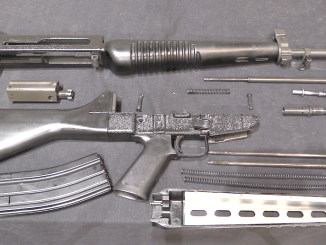


Everything you need and nothing you don’t. Basic infantry rifle, and a good choice for a ranch rifle or truck gun.
clear ether
eon
It seems it is quite possible to make a rifle based on the simple AR18 platform. Royal Ordnance should take note, but they can’t because they don’t exist any more.
According to https://taskandpurpose.com/tech-tactics/project-grayburn-sa80-l85/ After nearly 40 years, the British Army is preparing to retire the SA80. Project Grayburn will decide its replacement — and the future of British infantry. therefore please follow fate of GRAYBURN to conclude if they managed to learn lesson.
As has been said frequently, the AR18 design was copied so widely that its imitators well outnumber the original. Bloke on the Range has a video on how defective patents made this possible.
Because there was nothing really patentable in the rifle.
Not the multi-lug rotating bolt, not the short stroke gas piston, not even the twin recoil spring, if the “copier” didn’t even want to change it. All had been used before.
There wasn’t much there that they could patent, as Dogwalker rightly points out.
The true genius of the AR-18 was how they took already existing elements of design and then put them all together in order to build a lowest-common-denominator rifle that actually worked quite well.
The real marvel is that Royal Ordnance managed to munge all that up in order to produce the SA-80/L85 disaster. That took so much doing that you have to look at it and go “Wait… Did they do this on purpose…?” as some sort of final signing-off “Feck you” to the UK establishment that was destroying RO Enfield even as they finalized the weapon?
You have to wonder.
Not on purpose, just by having no clue about gunsmithing and… reading about some of the failures neither material science, metallurgy or even most basic mechanical engineering.
Why did this type of rifle went out of fashion, and was replaced by bulky bulging “fish guns”
’cause someone sold them something…
Somebody was getting a cut off the deal.
I would think for mass distribution to infantry, this rifle would be perfect. If made in quantities it would be inexpensive.
Once out in the field, if one broke, throw it away and get another one. Have each rifle company keep a number of spares on hand and don’t worry about finding an armorer to fix a broken rifle
A lot of the reason for the “fish guns” stems from the same thing that led to the HK G11 looking the way that it does: Ease of decontamination after a Nuclear/Biological/Chemical attack.
Smooth surfaces can be easily wiped clean; lots of nooks and crannies, and you’re looking at real difficulty in getting those agents neutralized or gone…
So, the smooth “fish gun” approach has some merit. My own take on it all is that the difficulties inherent to making an NBC attack really work are such that we’ll probably never see any peer-on-peer conflict that uses them. They’ll be relegated to using in conflicts where there’s such an extreme imbalance between forces that it amounts to pest-extermination by the superior party.
The accusations of chemical warfare going on in Southeast Asia after Vietnam and in Afghanistan are vaguely credible; couple of guys I trust both assert that there were things going on and samples recovered that showed very high probability that the Soviets were indeed using those agents, and that they’d been pretty damn ineffective in both environments, mostly because they had to be deniable. Absent the limitations induced by international PR concerns, I have no idea how effective the weapons would have been, or if anyone would use them in a serious conflict.
My suspicions are that the efficacy of chemical/biological weapons is nowhere near what the various wankers fantasize. As we can see from the blowback China got from just the COVID agent, the costs are entirely too unpredictable to make for decent weaponization; not to mention all the surrounding risk/unforeseen consequence. So… I highly doubt that “ease of decontamination” is really all that big a deal for the “fish gun” fad, going forward.
Frankly, my views on the whole “chemical warfare” thing are pretty cynical. Did all the classic Cold War training, to include one rather memorable coed decon site where we all had to get naked and decontaminate, which was decidedly “unsexy”. I honestly do not know how some people did it, after being in the field for more than a couple of weeks, and still found equally funky members of the opposite sex at all alluring as partners. My clearest memory of that decon site is basically “Ick…”; there was nothing arousing going on with a bunch of naked smelly people getting clean and “deconned”. I’m sure that there were some who rose to the occasion, but I sure as hell wasn’t one of them.
I am pretty sure that full-scale chemical warfare as imagined by all the nutters over the years would have resulted in mass casualties just from wearing the suits and masks, and that a lot of those casualties would have been due to suicides. You have no idea what hell is until you’ve donned Soviet protective gear and then spent a couple of hours driving around in the back of a BMP; I’m morally certain that the mass of Soviet shock troops would have been totally ineffective and likely mostly dead after their little drive through the chemical strike zones into NATO territory. It just would not have worked, the way that the boffins imagined; you got to the point where you’d do anything to get out of that BMP, but once you did, it was pretty much “Wander around in daze after tearing off protective gear…”
The NBC stuff was always something that struck me as “Yeah, I don’t think this crap is gonna work the way they say it will…” Even in US or other NATO gear, which was exponentially better than the Soviet stuff, the whole experience was one of “Yeah, we can do this in training… For a little while… But, you do it for realsies, with actual live agents out there…? This ain’t going to work so well…”
Friend of mine spent a tour doing training down at the live agent site that the US Army Chemical Corps maintains, and hearing him describe the number of “accidents and incidents” that they had, even with all the training precautions and experienced personnel on hand, plus all the extra safety gear? I’m pretty sure that the attrition rate, for anyone involved in real-world use of that crap, would be exponentially higher than anyone in the planning offices would have ever predicted. As in, a Soviet chemical strike would have probably had war-winning consequences… For NATO. Trying to fight through that crap, once they deployed it and created their little death zones? Yeeesh…
You really have no idea what they were going to demand of the Motorized Rifle Regiment members, until you’ve bopped around in that BMP with their NBC gear on. Once you’ve done that, you really start to feel pity for the poor bastards: I’m pretty sure a lot of them would have been in the full-on “Kill me…” mode after a day or so of running around Germany like that. I mean, yeah, they’re complaining about the Ajax vehicle in Great Britain, right now, but… I don’t think anyone ever did “Health and Safety” on the BMP, especially in the sense of “Long-term NBC warfare…”
In the last century, an army would have surely been nicely armed with a select fire version of that rifle.
The real problem is “3.7 kg empty”.
That’s the reason most of those stamped steel frame, 5.56 NATO, rifles had been, or are being, phased out.
Because, once you added an optic and a torch, the rifle weights over 4 kg still empty.
So you need other materials, that requires other shapes, due to different mechanical, working (IE aluminum can be cast or extruded, not stamped) and heat resistance charateristics.
I have to confess, I never have been a fan of the AR architecture. Just too many “frills” for my tastes. This could have been designed by the Russians, due to its brutal simplicity. I think the AKs have more parts than this. Wish it cost a lot less than $2,999. https://ttepmw.com/gear/sar-80-rifle/
If you like long-stroke gas piston and rotating bolt combined with few parts, then use Foote’s R68 https://guns.fandom.com/wiki/R68
An overview of Foote’s works. Among them the FAC-70 (semiauto version of the R68 and the MG69 machine gun. http://www.helstonforensics.com/wp-content/uploads/2018/03/foote-carbine-machine-gun-18310.pdf
Interesting, among the extreme simplicity of his designs, the use of an interrupted thread rotating bolt (like that of an FN CAL, IE) that’s not the simplest, or cheapest, solution.
Whats the weight difference, this compared to M16 ?
I’d reckon its not huge
According to https://modernfirearms.net/en/assault-rifles/singapore-assault-rifles/cis-sar-80-eng/ and https://modernfirearms.net/en/assault-rifles/u-s-a-assault-rifles/m16-a1-a2-a3-a4-eng/
CIS SAR-80 empty weight 3.7 kg
M16A1 empty weight 2.89 kg
M16A2 empty weight 3.77 kg
M16A4 empty weight 3.4 kg
Well only anti-wow effect would you get if you switch from 20rd m16a1 to 30rd sar 80, but apart from that, not that much of a difference.
Now, durability wise, stamping thickness of receivers of sar80 looks pretty flimsy thin…
(shoulder shrug) It’s a general-issue infantry weapon… How long is it supposed to last, and why is “longevity” a big deal in that role?
Unless you’re Switzerland, issuing weapons out that will have to last the career of a long-service conscript, the average “combat lifespan” of an individual weapon is vanishingly short. So, why design/build/buy something that will last decades, when the service life in combat is days, or at best, weeks?
There’s a cost/benefit ratio to be worked out and allowed for.
Youre right.
However, I suppose these receivers are not heat treated, as opposed to AKs, so if they are, though by added complexity of HT and set of problems it brings (cracking, distortion), they could be made stronger, but again, back to your point – why bother.
When you get right down to it, the real value in really high-quality weapons is mostly psychological: You hand out what amounts to a disposable Kleenex ™ weapon, and that’s signaling a certain, ah… Casual approach, to the lives of the soldiers you’re issuing them to…? They’re obviously low-value, so they get low-value weapons. That’s the signal you’re sending, by doing that…
On the other hand, you buy expensive stuff, high-quality and obviously so, then you’re telling your troops that they’re equally high-value, and you’re not going to be expending their lives in job lots and without real necessity… That’s the signal, there.
So… Yeah. Maybe there are other reasons the Swiss go in for the things they do, and that the Soviets chose what they did? Aside from the merits of the actual weapons…
Although, you could likely make a case for “high quality” by simply enabling battlefield recovery and reconditioning of the weapons; you’d be justified in doing so, if your numbers were high enough. Then, high-quality has a rationale, and might not prove out as a morale-booster: “Oh, they’re giving us this nice rifle ‘cos they expect to recover it, re-issue it, and do that a couple of times… That’s why it’s got this special blood-resistant coating, and the stock won’t rot or retain the odor of my rotting corpse…”
The more you go digging, the more obvious it gets that there are huge psychological components to everything you do with regards to weapons procurement. Some of which are actually anti-ethical to what you would think… Highly counter-intuitive.
Though, truth to be told, in lieu of been in wars in last 60 years (just like Switzerland) Singapore has also lot of conscripts and I suppose yearly training regimens, so having a rifle that can take beating of dozens of years in this training is not unprudent.
I’ve seen that thin end of upper receiver so evident here (where end of spring assembly goes, it feels like if stepped on or bumped, it would bend) is “upgraded” in SR-88 with 2 plates welded to it!
Philosophically speaking, maybe the sweet spot would be to have one set of never-issued mothballed slightly lower quality (cheaper) rifles for warfare and other, higher quality ones used and abused solely for training?
They kind did it (but reversely of what I propose) in some countries I know so well, having plethora of AK types in arsenals, where shitty AKs like romanian and other worn out were reserved for training.
@Storm,
The Swiss model of militia army is totally different from the Singaporean. Swiss system has the soldier taking home all of his call-up gear plus his rifle, which he’s been issued for the entire term of his career in the active militia. I think that this may be unique; it requires highly trustworthy soldiers and a much more egalitarian approach. Swiss soldiers are trusted with their weapon; it’s virtually a sacred thing.
Singapore, along with a lot of others like the Finns, have all the gear and weapons issued out centrally on call-up. In Switzerland, you walk to your closet, get your gear, and go off to the mobilization point, where your unit is forming up. Singapore and Finland, it’s “get alert, go to mobilization site, get gear, get weapons, go to unit location”.
Which is going to work out better? No idea, but I do know that at least a couple of Finns are highly dubious of how they do business in Finland, and would much prefer a Swiss-style “Keep your stuff at home” to the potentially disruption-susceptible central mobilization sites. The Finnish major I spoke with and was asking questions of about all this claimed that they’d had indications that the Soviets and now Russians had long-held plans for guerrilla forces in Finland to go after those mob sites and storage locations…
I think that in an high-trust society, you not only let your militia keep their stuff at home, you get them to pay for the privilege and buy their own toys, up to and including crew-served. Nobody does that, but I think it is something I’d aim for, in the right setting. You want the soldiers taking ownership of their weapons and readiness, there’s no better way than to make those weapons their own. Literally.
The idea behind the Swiss militia members having all their gear at home is that in 5 minutes the streets are full of armed men, ready to handle immediate problems, even before individual militia members reach their unit’s designated assembly points.