
The Whitney-Scharf was the final rifle manufactured by the Whitney company before it was bought out and closed down by Winchester in 1888. Only about 2,000 of these rifles were made before that time.
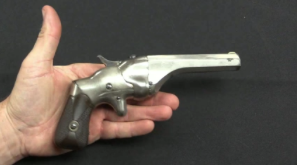
Handgun
Hammond Bulldog Pistol at RIA
Made in Naubuc Connecticut, the Hammond Bulldog was an interesting single-shot rimfire .44 caliber pistol. It used an unusual rotating breechblock, and had the potential to be a fairly strong action. Reportedly prototypes were made […]

Suppressor
LMT Ion-LT Suppressor: Multipurpose, Light, & Low Back-Pressure
LMT’s new line of suppressors is designed for multi-purpose use in mind. The .30 caliber Ion 30 and Ion LT are rated for anything from .17 HMR to .300 Winchester Magnum, including automatic use. Both […]
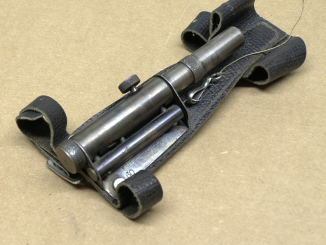
Single-shot Pistol
Carlstrom / Juhasz Concealed Sleeve Gun
Available at Morphy’s here: https://auctions.morphyauctions.com/_N__E__CARLSTROM_SLEEVE_PISTOL__ANY_OTHER_WEAPON__-LOT665729.aspx In 1929 Elek B. Juhasz of Lebanon PA patented this sleeve gun. It is a single-shot, manually cocked firing mechanism with a screw-on barrel and is worn on the inside […]
Great series of videos, I never miss them ;-). Didn’t Winchester also buy out and kill Spencer?
Yes and no.
Christopher Spencer sold out to Winchester after the Civil War, because he saw little future for his rifle vs. the more technologically advanced Winchester repeater. He did, however, go on to design the first pump-action, tube-magazine repeating shotgun in the late 1870s, thereby setting the pattern for most repeating “scatterguns” down to the present day.
After that, he went into industrial machine tool development, and then by the turn of the century, he was in the adding machine business, first with Herman Hollerith, the inventor of the first electrical tabulating machine in 1890 (when Hollerith worked for the U.S. Census Bureau), and then after Hollerith’s death on his own.
In his spare time, he helped bankroll the Wright Bothers and learned to be a heavier-than-air pilot from Wilbur Wright.
In 1910, he changed the name of the company he and Hollerith had started from Tabulating Machines Inc. to Business Machines Inc., as it expanded into teletypes, ticker tapes, and then even radio. By his death in 1924, it was beginning what would become its main business- electrical, and later electronic, calculating machines.
Just before his death, Spencer changed the name of the company again, just slightly, adding “International” in front of “Business Machines, Inc.”
Yes. It’s known today as IBM.
Founded by the inventor of the Spencer repeating rifle.
Isn’t history fun?
cheers
eon
Well, at least Spencer’s company didn’t go out like the Brewster Aeronautical Corporation, whose terrible management and almost nonexistent worker training led to its demise (to say nothing about the company president getting jailed for tax fraud or something). The US Navy actually took over the plants and shut them down having found quality control was so bad that at least half of the Brewster-made F3A-1 Corsairs (inferior license-built F4U’s) actually disintegrated midflight!!
J. Stalin said to Tupolev:
There are no trivialities in aviation; everything is serious and any uncorrected ‘triviality’ could lead to the loss of an aircraft and its crew.
(about ANT-40 bomber)
However this can be applied to other aeroplanes aswell and should be remembered not only by designer but assembly-line workers and ground crews too.
Just two examples:
Curtiss-Wright C-76 Caravan – when USA entered the war there was fear that aluminium shortage will occur, so USAAF requested wooden transport aeroplane, equivalent to C-47. YC-76 crashed killing its pilot, because of lack of some securing bolts. Anyway C-76 design proved to be flawed (has problems with lack-of-stability, wings too weak), but happily aluminium shortage didn’t happen so USAAF can order sufficient number of C-82 Packet transport aeroplane.
Air France Flight 4590 – Paris, 2000. BAe Concorde crashed shortly after take-off, because metal strip (17.1″ long, 1.3″ wide, 0.055″ thick) fall apart from previous aeroplane taking off (DC-10), when Concorde run over it, tyre was cut and chunk of tyre debris launched into fuel tank, this ruptured it, leaking fuel was set on fire and this lead to crash. All passengers and crew was killed. This was ONLY fatal accident with BAe Concorde.
Nice story… not a lot of truth in it but still a nice story.
This refers to the story about Spencer and IBM. Not true… look it up.
Interesting, these Whitney rifles. I have a Whitney rolling block rifle, originally chambered in .38 center fire.
Somewhat analogous to a S&W .38. It’s barrel was badly corroded so it’s barrel has been relined in .32-20 WCF.
Accurate, mild recoil and report. A nice weekend shooter.
Very Interesting the history. Especially of interest to me as I have inherited my father-in-laws WWII Japan bring-back Spencer rifle and my wife began her career working with early IBM computers at a large data processing company. She had no idea that firearms has some semblance of history to her work.
Sorry, but they don’t.
I can’t seem to find any link between Spencer and IBM either. Oh well…