
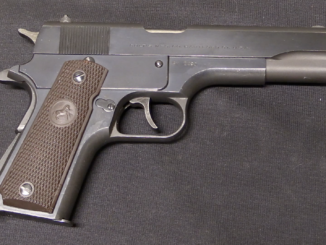
Rock Island Armory is best known for its Philippine-made 1911s, but expended into US pistol production with a novel design a couple years ago. The call it the 5.0, and it uses an interesting vertically-traveling locking block instead of the typical Browning tilting-barrel system. It is (concealed) hammer fired, chambered for 9x19mm, with a 4.9 inch barrel. They subsequently released the improved 5.0E (“Enhanced”) model, and that is what we are looking at.
It is not a perfect gun, but it is remarkably fun to shoot – recoil is soft, muzzle climb is quite good, and it just has a subjective feel that is excellent – everyone who shoots it really likes it. The mechanical design is innovative and very simple, and it has the potential to be very successful. However, it is priced at an eye-watering 2k MSRP (about 15% less at retail). It’s not really optimized for any particular use; it doesn’t have things like a magazine funnel and gas pedal to attract competition shooters, it’s too big to be a good compact carry pistol. RIA initially promised all sorts of modular options and accessories, none of which have become a reality (shocking, I know).
So it’s left being a legitimately very nice pistol but at a price point that really leaves me wondering who the expected customer base is.
Disclosure: RIA provided this pistol to me free of charge for filming.
It’s an expensive Shiny Thing for people who are impressed by expensive Shiny Things.
Even trust-fund babies in bespoke suits who drive Teslas buy guns, if nothing else to keep in the top right-hand drawers of their $10K home office desks.
It makes them feel special. Like a Korth revolver.
clear ether
eon
“(…)special(…)”
According to their own description https://www.armscor.com/ria50e it does contain
HANDCRAFTED ELEMENTS
Largely crafted by hand for the ultimate in fit and finish
Which certainly helps with that, but question appears: are parts interchangeable or do even minor fixes require hand fitting?
“Rock Island Armory is best known for its Philippine-made 1911(…)”
“(…)drawers of their $10K home office desks(…)”
After thinking about it I am wondering for who is https://iverjohnsonarms.com/store/p160/1911A1_Carbine.html intended?
People who don’t know the history of the M1 Carbine.
A stocked 1911 with an extended slide and a 16-shot magazine was proposed in 1939 and at least one prototype was built. It was rejected by the Infantry School and Ordnance didn’t push it.
The European concept of the “stocked pistol”, even for cavalry, just never caught on here.
cheers
eon
It has a price. Not a price point. What is with gun people’s fixation on using this stupid corporate term?
“(…)who the expected customer base is(…)”
According to RIA https://www.armscor.com/ria50e product description
The successor to one of the most
sought-after sporting pistols on
the market. and it does contain MATCH GRADE BARREL so they apparently to appeal to competition shooters.
I am still waiting for someone to come out with a new design, that takes advantage of new manufacturing and material technology, that is not a competition gun that costs the big bucks. Is there really a need for this though? Are the current work horses not in need of being put out to pasture?
Somehow the 1911 survives, as does the P35. And the perennial six-shot .38 or .357 revolver with a four-inch barrel.
And curiously, almost every serious person who owns one or more of the above also has a .38 or .357 snub, for when they can’t carry the full-bore service sidearm.
And most of those today probably have a miniature Ruger locked-breech .380 or 9mm auto tucked away somewhere, as well.
I suspect the first chapter of Death Sentence (1977) by Brian Garfield adequately explains why.
To paraphrase an old saying about war,
You may not be interested in violent crime, but rest assured violent crime is interested in you.
clear ether
eon
clear ether
eon
Not that old, Fannie Hurst first said it in 1940.
When I started typing my message, I was all grumpy about how all the new bells-and-whistles were only being applied to high priced pistols that most shooters would never be able to afford. But after I vented, it did occur to me that maybe, for general use, we have already reached the pinnacle of what is actually practical and affordable.
After further contemplation, I felt that nothing is likely to change, unless there is a major technology break through. Maybe a brilliant cycling mechanism that reduces the recoil of a .50AE round to that of a .22. Or maybe a breakthrough in caseless cartridges. Lots of noise has been made in the past few years about a new wonder caliber. But these are only going to fill small niches, not attract large scale migration of usage.
So time to clean and lube the 1911 granddaddy brought back from the trenches of France and keep plinking away.
“(…)new bells-and-whistles were only being applied to high priced(…)”
Novel features are often patent. So if you want to use them, then there is additional cost.
That being said if you are allergic to barrel tilt AND want not expensive locked breech automatic pistol, then you might use KelTec PR-5.7 XOR KelTec PR-3AT, both using rotation and with expected price of USD399.99.
Bren Ten, Colonel Cooper etc… Coopers corner. Better times, hee…
What specifically is wrong with the ‘current workhorses’ that demands they be put to pasture? More specifically is the 5.0 the gun to fix things? In what way?
Being too expensive for anyone but a member of the trendy ruling clique’ to afford?
Colt and Kimber charged the USMC $1500 each for M45Cs. Llama produced the Max-1, an essentially identical “Enhanced 1911” and sold it retail for under $500.
There’s a lesson in there, somewhere….
clear ether
eon
clear ether
eon
Sonny Crockett’s grandkid would probably go for the 5.0. The grampa practiced a subtle blend of law enforcement and upscale sybaritism back in the day
He and I used the same sidearm for several years. S&W 645 .45 automatic.
I used it because my agency decided to take a dim view of single-action autos carried in Condition One.
He used it because the Bren Ten sucked.
cheers
eon
Just what we needed another safe queen piece that will not see E D C or even a lot of range time.
Credit for correct use of whom.
Stillborn.
Possession of Solidworks and the internet has never turned anyone into a Brownig.
LOL
The only thing this pistol seems to suffer from is the aspersions lobbed by the perspective derived from Schadenfreude derangement syndrome.
A shame really, but similar cynicism was aimed at the Luger, 1905, 1911, Hi-Power, Garand, and AR15 when those new product designs using new materials were brought to market in their day.
What’s not to like about this pistol? It certainly offers reliability as seen by the video here. Accuracy seems to be an attribute too, probably due to how the barrel locks up in a way that more assimilates a fixed-barrel design once it does lock up because it hasn’t been jiggling around in the slide the barrel with excessive lateral or vertical movement as happens with most Browning camming barrel designs.
Oh yeah, the price. Throw it in the trash because of the price. I should think that like with most new releases of unique designs, the initial pricing is to cover the residual cost of incurred R&D, and then after a time, once that’s covered and methods of tooling and producing it improve, the price comes down. That’s essentially a given for any new product brought to market. At the same time, if it doesn’t sell, then it dies an expensive death. Justified? Maybe, but it doesn’t mean it wasn’t a great gun. Such as, time will tell if the innovative Laugo Alien and any derivatives have staying power solely due to it’s asking price.
But is the price so prominent that everything else about the execution of an excellent design and reliability of this pistol then goes ignored? Does it still have high value even if the price is fat?
Made in USA, minimalist number of parts, ingenious application of a proven barrel locking mechanism that also contributes to lower bore axis, robust build quality, match barrel, uses a reliable magazine design, and what appears to be the ability to invite upgrading the trigger by independent proprietors, given the opportunity, and much easier than most other guns allow.
So maybe it DOES become a ‘safe queen’ due to price, and maybe one day it’s a collector’s item fetching $6,000 to $10,000 a pop, like the Semmerling LM4, Bren-Ten, Mateba Unica, LAR Grizzly Mark V, Wildey Survivor, HK-P7M13, the Manurhin MR 73, Korth revolvers or the PRS, and so on.
Casting pearls before swine……..
.
Is quite big, like, not high point size but – I mean, it is going more that way… In regards size. I thought it was a .50ae at 1st with the name; thought thats small – And watched the vid thus.
Big fat and ugly… 9mm, some plastic… Like it, but no… Shouldn’t be so hi-point sized, for that; missing something… Not being in need of ozempec you cookie dough loving bitch you! Stop eating it, like smoking. No it is wrong. Fat. Polymer, fat feck.
Is there another ~5”-barrel 15+round rail-equipped optic-cut 9mm pistol with grip-angle < 18 degrees and bore-axis height < 1.25 inches? For any money?
Walther has several these days. Developed because the “legacy” designs from PP to P5 (especially the P.38) could no longer be manufactured and sold for a price that didn’t lose the company money. Simply too much handwork involved in fitting, just as Josserand & Stevenson predicted in Pistols, Revolvers and Ammunition in 1969.
Colt’s entire line of double-action revolvers met the same fate in the 1990s. Their modern line may have the same names (well, except for the Grizzly) but internally they are entirely different- and still pricey.
S&W has “tweaked” their DA revolver line design-wise, but today they mainly sell to collectors at Rodeo Drive prices. Their automatics compete with Glock for the most part.
Taurus introduced their “Millennium” line of revolvers in the early “oughts”, and they are quite good. They still look like S&W clones for the most part, but inside they are remarkably like the Ruger line, with all coil springs. The 627 Tracker .357/9mm looks like the love child of a tryst between a S&W 686Plus and a 1980s Colt King Cobra (Not the “Colt Magnum Carry” sold under that name today).
Like every Taurus DA revolver today, it has the “crane lock” now also used by S&W, replacing the troublesome front-end-of-ejector-rod latch. (Yes, in 1917, S&W deleted the wrong front latch in going from the Triple Lock to the M1917 and subsequent “Hand Ejector” revolvers.)
The survival of the 1911 today is mainly due to just having a huge “installed base” that can supply anything from frames to small fiddly bits, these days often made by CAD/CAM or even 3D metal printing. Although one obvious change is that many 1911s today have an external hook extractor like a Glock instead of the old long extractor coming in from the back end of the slide. This is mostly done to make room for a firing pin safety, a design change the Star Super A from Spain had seventy years ago.
The handgun “market” is changing, as J & S predicted when I was in 5th grade (and got my first now dog-eared copy of their book for Christmas).
But exactly how and why it’s changing isn’t always going in anticipated directions.
cheers
eon
By looks this gun is a strange beast, at the same time nice (surface) and ugly (proportions), its a rare feat to get that reaction and mixture (at least by my standards)
It does shoot well “Ian is hitting things” he likes it – You know with him being cross eyed or something, and not doing sometimes.”
Just to be picky here:
Vertically-moving locking block, I suppose, starts with Broonhandle Mauser (but is also shown in Maxim’s first machine gun patents), then carries on with Walther P38, though of course Mauser and Walther blocks swivel to drop while Bergmann and Nambu (and BAR!) blocks rise.
Another expensive pistol, the Korth semi-auto, situated their Walther-style locking block under the muzzle, which at the time was considered a feature that kept muzzle flip down (I have no personal experience in the matter).
Can’t really call this RIA hammer “concealed,” because you can see it. “Covered?” “Semi-enclosed?” “Internal but visible?” Seems actually useful in this location — won’t catch on holster or clothes, and you can see or feel if the gun is cocked or not.
Thanks as always for this presentation.
“(…)Vertically-moving locking block, I suppose, starts with(…)”
This will depend if you want limit yourself to automatic weapons. In 19th century there were https://www.rockislandauction.com/riac-blog/falling-block-rifle-an-early-lever-action various falling block single-shot fire-arms with “vertically-moving locking block” but propelled by user’s muscles.
Hmmm… Clever, Saw all those other mentioned guns (Using a similar design – Can’t say I ever “Got them” as much as this though.) Reckon, maybe the front one on this means a slide with more mass, as oppose doing it further back. Decent gun.
Thought “grip safety” as not a safety, but pushing funny angled piece… Forward… Against cylinder locking pin thing, to reduce mass. Well pissed currently though. Amazing what you forget, really – The other guns, hmmm… Reduced slide mass; nice gun that like – Proof, shoots well… But a big gun, mass wise. May or may not, help… Or could do the same but be smaller, better thus.
Can safely say that is fair big for a 9mm, works well as it does… Just, thinking. Interesting that, as ever.
2,000 bux… .50Ae maybe… Too fat, and ugly, you cookie dough bitch. 2,000 dollars. It’s just wrong, but right… In other ways. 2,000 dollars… Ian could throw a highpoint at someone. Throw it, bazooka.
Grip safety pushes on said rod, what do I mean… I will watch again. Nambu bastard, cookie dough fat bitch. Compton, Jeff cooper feck you up .45… Something.