The PSS is a semiautomatic pistol using captive piston ammunition to achieve a comparable level of sound suppression to a .22 pistol with a good normal suppressor. It was developed to replace a couple multi-barrel derringer style captive piston pistols in Soviet use, with the semiautomatic action and (6-round) detachable magazines making it suitable for a wider variety of missions than the previous guns.
It was given the GRU catalog designation 6P28 and entered service in 1983. It fires a cylindrical steel projectile weighing 155 grains at about 620 fps, with a noise of 122 dB (1m left of the muzzle) as measured by silencer legend Phil Dater. Mechanically, the design takes its fire control system from the Makarov but uses a floating chamber system to cycle reliably with the unique ammunition. After the fall of the Soviet Union, the pistols were available for commercial export by Russian state-run export companies, although that ended in 2018. In Russian service, the PSS was replaced with the much improved PSS-2 in 2011.
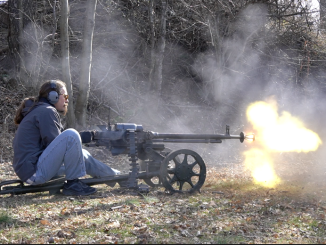

“(…)GRU catalog designation 6P28(…)”
No. Not GRU (Main Intelligence Directorate) but GRAU (Main Rocketry-Artillery Directorate, they were also response for hand-held fire-arms).
“(…)uses a floating chamber system to cycle reliably with the unique ammunition.(…)”
According to https://modernfirearms.net/en/handguns/handguns-en/russia-semi-automatic-pistols/pss-besshumnyj-eng/ This recoiling part increases the weight of the moving parts at the initial stages of recoil, and also is used to slow down the slide on its final stages of movement, to dampen the sound of the slide hitting the stop on the end of the recoil cycle.
Smoothbore, or rifled? Accuracy?
Hold my spoon and wait a minute…
Rifled, in part.
https://modernfirearms.net/en/handguns/handguns-en/russia-semi-automatic-pistols/pss-besshumnyj-eng/
Accuracy is probably no further than you can spit. So I would say that if the target picture is wider than the sight picture, you have a decent shot of hitting somewhere on the target. But after that, start throwing rocks.
Here is a link to the Youtube videos that Ian showed.
https://www.youtube.com/@Rosoboronexport/search?query=pistol
The accuracy for the derringer style is listed as 5 meters. The PSS is stated to be accurate up to 50 meters.
Captive piston ammunition tends to be low velocity to begin with, as we found out with the “tunnel weapon” (A modified S&W M29 firing that kind of ammunition) in Cu Chi Province in 1969-70. 180 grain at 550 F/S for 120 FPE was the best it wanted to do.
With one like this, with even less KE, you’re going to have to shoot for the heart or the brain, period.
Now determine how far away you can expect to hit either of two roughly 6″ (15cm) diameter targets.
Good luck.
I would have to say that Hollywood doesn’t have a monopoly on “super-spy” fantasies.
clear ether
eon
I’d be curious to hear real operational feedback on these.
I mean, the Russians have their blind spots, and some strange ideas, but… They usually don’t build stuff that doesn’t work at all, and/or keep on building iterative improvements on those things. This pistol has a successor model, sooooo… One has to assume that they found it useful for their needs.
Whatever the hell those were. Executing Chechen sentries, maybe?
In toying around with my gedankenspiel “fire shelter” self-defense idea, one thing I gave some thought to was “low signature”, and thus went to “captive piston”. US experience with that idea has not been particularly positive, but the Russians keep building the damn things, so… Maybe? I dunno; you can posit a lot of technology improvements enabling things, but I think that in order to achieve those, you first have to go up or down that particular branch of the tech-tree.
The 7.62 x 41mm cartridge looks to me like a rimless version of the 7.62 x 38Rmm Nagant revolver round, using the “bottleneck” to catch the “piston” when fired.
A straight-blowback would probably be the only way self-loading action could be achieved, as I would suspect recoil impulse would be low.
I’m old enough to remember when KGB experimented with all-plastic pistols firing hollow glass bullets loaded with poison, using electric ignition. This seems to have had a similar motivation on somebody’s part.
Its exact tactical niche is hard to determine. Bodyguard duty? Why would you want reduced sound signature for that? When you’re dealing with an AoP, you want all the attention you can get, and few things attract attention as fast as gunfire.
Elimination of dissidents? Why use a self-loader that throws out empties of a type that basically says “I’m a Soviet Agent and I killed this guy”? Not exactly SOP. “Cyanide sprayers” hidden in rolled newspapers, and air guns disguised as umbrellas firing ricin pellets, make at least a bit more sense.
I’m thinking it might be like CIA’s legendary “dart gun” that showed up in the Church hearings in the late Seventies. Somebody’s brilliant idea that got picked up by higher-ups with 007-ish pretensions and low sales resistance.
Sometimes, as with useless “apps” in software today, things get stuck in the inventory simply because some self-anointed genius whines, “But it’s coooool!”
cheers
eon
I’d be the first to agree with you on this explanation, because it fits so well into my worldview.
But… As with a lot of things Soviet/Russian in my experience, the miserable bastards tend to have good reasons for the insanity. I remember hearing for years the misinterpretation about the AK safety, wherein all the sources expounded on the idea that the first position was full auto because that was the one they wanted the troops to default to…
It wasn’t until years later, after someone actually talked to some real Soviets that the drill was “sweep safety off, all the way to semi…” as a gross motor function, and that was supposed to be the default. Clicking back to full auto was supposed to be something you had to think about doing…
So much for “interpreting” the Soviet mindset. We didn’t get that, just like we didn’t get a lot of things about their decisions and tech choices.
I’ll be happy to critique their actions and products, once I understand what the hell I’m looking at. With these things, and all the money/effort lavished on them? I can’t help but think there has to be a pony there, somewhere, buried under the pile of horseshit…
No idea at all what it is. Whatever it is, it’s kept some Russians busy, and they’ve spent significant money on it, sooooo… Maybe? I dunno. I hear hooves, but I’ve no idea if “horses” or “zebras”.
Which is the intriguing thing about all of these sorts of things: Trying to winkle out what the hell they were thinking is entertaining, if nothing else.
I’ll be damned if I can come up with a use-case, either. A semi-auto assassination pistol just doesn’t make a lick of sense, especially with that unique case left behind. The only thing that really comes to mind with this technology is if you had to use the damn things in explosive atmosphere, but…? Where would that be, and how effective are these captive piston designs at eliminating the risk of starting an explosion?
I mean, if you’re going to posit a use-case, about the only thing I can come up with is maybe sentry/guard duty in a flour mill/granary? Anywhere there’s a lot of organic dust, and you don’t want to set off a massive dust explosion?
You have to wonder. Nobody else has felt the necessity for such things, so why the hell are the Soviets doing it?
“(…)posit a use-case(…)”
https://modernfirearms.net/en/handguns/handguns-en/russia-semi-automatic-pistols/pss-besshumnyj-eng/ claims that At the present time the PSS is used by most elite Russian anti-terrorist teams.
@ Kirk;
The only thing I can think of offhand is a sidearm for the equivalent of a “Sky Marshal”, or even a cosmonaut. Something that could be fired in even a pure-O2 atmosphere without risk of igniting a flash fire.
But even for that, just manufacturing captive-piston ammunition in 7.62 x 38Rmm for a Nagant-type “gas-seal” revolver would make a lot more sense. Seven shots, double-action, no waiting.
cheers
eon
@Daweo, 3:16am:
Yeah, but what the hell is the utility for that? You would think that you’d want a weapon that didn’t leave unique signature calling cards behind, if you were an intelligence asset doing “wet work”, no?
And, if you wanted them to know you did it, why not use a normal weapon?
A revolver or derringer affair that keeps the cartridges under control makes sense as an assassination weapon; a semi-auto ejecting cartridges just… Doesn’t.
@eon,
Does anyone expect to fight in pure oxygen atmospheres, anywhere?
About all I could think of was refinery operations, high dust environments like coal mines and grain-handling, or maybe specialized atmosphere mixes for deep-sea diving. Other than that… Why? Just… Why?
Like I said… Yes, the Soviets/Russians do some weird stuff, but it’s usually just that it looks weird to outsiders. This is definitely one of those cases, and while I would like to say that it looks like a useless and strange technical obsession to develop, maybe there’s a reason for it…?
On the other hand, it could well be that this is a case of “Keeping up with the Joneses…”, because the US was working on it, and the Soviets/Russians didn’t want to get left behind, thinking there had to be a pony in there, somewhere.
An astonishing amount of aviation stuff got developed due to that factor. The Mig-25 Foxbat was supposed to be a B-70 killer, and then the US didn’t actually deploy any, sooooooo… They had to find a use for it.
You go digging, even slightly, into Soviet technological development, and it all becomes a house of mirrors in disturbingly short order.
“(…)an intelligence asset doing “wet work”, no?(…)”
You seems to have very wide definition of anti-terrorist actions.
“(…)120 FPE was the best it wanted to do.
With one like this, with even less KE, (…)”
Actually SP-4 https://modernfirearms.net/en/cartridge/7-62×41-sp-4-7n36/ fives muzzle energy of 339 J, which is more than twice of 162.6982 J and is on par with original 9×20mm Browning Long.
“(…)Accuracy?”
According to user testimony at https://www.armoury-online.ru/articles/pistols/russia/pss/ PSS accuracy is superior to PM (Makarov) as whilst both share same trigger mechanism former has better sights.
If they were worried about an explosive atmosphere, why would they use a steel bullet, and risk a spark? Why not just use lead? Or brass, copper, etc? Lots of room for speculation here.
Some stud guns use a captive piston to impart momentum to the stud using a blank cartridge. The other design directly uses gas from a hi/low propelling cartridge similar to the hi/low design of the 40 mm grenade cartridge. I’ve used both and the ones using the captive piston are quieter, but that’s my subjective opinion.
Strictly speaking the hi/low effect isn’t in the cartridge used in the stud gun, its a metering port that part of the gun itself. The cartridge is a standard stud gun blank or propelling charge.
You should also interested in: Philip H. Dater: Beyond Quiet: The Russian PSS Captive Piston Pistol
https://web.archive.org/web/20220704031403/https://sadefensejournal.com/beyond-quiet-the-russian-pss-captive-piston-pistol/
* * *
By the way: I think a revolver in .410/3 in. caliber would be a good donor for a pair of captive pistol gun and ammunition. The .410/3 in. shell provides a longer length for acceleration.
One of first Soviet piston designs was paired with revolver https://modernfirearms.net/en/handguns/double-action-revolvers/russia-double-action-revolvers/gurevich-noiseless-revolver/
For SP-4 (cartridge used in PSS) Stechkin developed OTs-38 https://modernfirearms.net/en/handguns/double-action-revolvers/russia-double-action-revolvers/oc-38-besshumnyj-eng/
Regarding piston shot-shell according to https://thefiringline.com/forums/showthread.php?t=45639 It was designed by Robert Schnepfe in 1967 for a U.S.Navy contract for a low-signture munition that could be fired and ejected from standard military 12 gauge shotguns. The munition was required to possess a high hit-and-kill probability at short range in quick-reaction situations to poorly defined targets. When perfected, it was destined for use in jungle operations by navy SEALS and Marine Corps Reconnaissance Teams.
It employed the AAI-patented powder-actuated Telecartridge device conceived originally for use in missiles. It was designed not to rupture during or after the power stroke. It was then adapted to the development of the Silent Shotgun Shell.
By early 1968 samples were being tested. The payload consisted of 12 hardened No. 4 buckshot, arranged in three interlocking rows. Excluding the plastic pusher, the payload weighed slightly more than 0.5 ounce. It was sealed by an aluminuim, cup-shaped closure disc. A sealing compound waterproofed the mouth. It was 2.5 inches long unfired. Fired, the expanded Telecatridge cup protruded from the mouth of the case approximately .32 inch or about the same as the fold crimp on a standard shell.
The prototype rounds had a muzzle velocity of 550 fps, however testing revealed excessive shot dispersion and some failures at this velocity. A reduction to 450 fps solved all of these problems.
The round was said to be quieter in functioning than the mechanical, repicrocating noises of the weapon that fired it. Its sound signature was considerably lower than that of the best firearms suppressors of the day.
It was never manufactured beyond the original prototype test lot though, for reasons of priorities and economics.
By the way 2.: I have a question! What are about the captive piston guns? – Not captive piston ammunition: captive pistol guns.
Like the 6П15 Тишина [Tishina]:
“Launch of grenade is performed by special blank cartridges, which are loaded into detachable box magazine. Magazine fits into the pistol grip of the launcher. Cartridges are fed into the chamber by manually operated rifle-type rotary bolt action mechanism. To achieve the noise- and flash-less launch, blank cartridges are discharged into the limited volume breech, which is fitted with movable telescopic piston at the front. Upon discharge, this piston violently pushes the grenade, loaded into the muzzle part of the launcher, out of the barrel, and then stops and seals the expanding powder gases inside the rear part of the launcher’s barrel. After a short while pressure inside drops to safe level and gun can be reloaded by operating the bolt (to extract spent blank and load a fresh launching cartridge) and then loading the new grenade from the muzzle.” – Maxim Popenker: Modern Firearms
https://modernfirearms.net/en/grenade-launchers/russia-grenade-launchers/bs-1-tishina-eng/
How can they release the overpressure after the shot, quietly and safely? – Does anyone find a patent relating this?
One more aspect – using this, was like depositing a KGB/GRU business card.
Professor Hardesty, who taught me freshman English back in the dinosaur era, had a catchphrase that fits this creature perfectly: “post-optimal technology.” It does what you want it to do, but in a way that’s far more complicated than necessary.
Ian asked the question as to why this and not a regular suppressed pistol. The one advantage is concealability. Don’t want to give away what you are up to. But that is blown when you start spreading around weird spent cartridge cases.
It is almost as if some team, call them A, collected feedback about existing assassination pistols from team B, the actual assassins. B said they needed better accuracy and higher shot capacity. So A tasked the engineers of team C to design such a pistol. C designed such a gun in blissful unawareness that expended brass, especially of such a distinctive type, would be an issue. Each team did its assigned task and the result is a perfectly adequate killing tool that you don’t want to use outside your own basement for fear of getting fingered. Sub-optimal bureaucracy call it. This is just a guess, I hasten to add.