
The typical pepperbox revolver is a sleek and small .31 caliber double action pocket gun, like the Allen & Thurber standard type. This one, however, is anything but typical. This London-made gun is a far larger than normal, and sports 8 barrels, with a center square of four and an addition four outside of those. Those barrels are .36 caliber, and the firing mechanism is single action only. In addition, it is unusual in requiring manual indexing of the barrel cluster between shots – most pepperboxes index automatically when the trigger is pulled. I have no further information on the date or original of this piece beyond its “London” marking, and bring it to you as just one example of the wide variety of this sort of firearm that exists.
Bolt Action Rifles
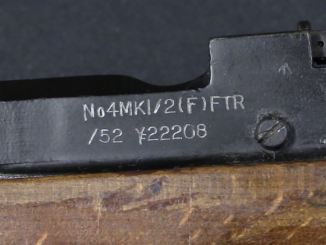
No4 MkII: The Lee Enfield’s Final Standard Upgrade
The final standard pattern of the venerable Lee Enfield as a standard-issue service rifle was the No4 MkII, introduced after the end of World War Two. The new pattern was adopted to resolve problems that […]

Light MGs
Project Lightening Episode 03: Walking Fire
Project Lightening is a collaborative series with Othais and Mae of C&Rsenal in which we test all seven light machine guns and automatic rifles of World War One and put them through a series of […]
Percussion
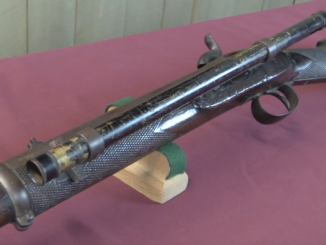
Confederate Whitworth Sniper: Hexagonal Bullets in 1860
Sir Joseph Whitworth is quite the famous name in engineering circles, credited with the development of such things as Whitworth threading (the first standardized thread pattern) and engineer’s blue. When he decided to make a […]
“Say hello to my big, barking friend!” Considering how massive the barrel cluster must be, would any indexing device be strong enough to rotate the assembly while small enough to fit on a pistol?
Maybe its just a “fungun”. The high society loved curiosa, from shrunken heads from Papua-New Guinea to lambs with two heads in a jar…
Hilarious.
So why no over exaggerated gangster gun?
This weapon reminded me about Chaineaux pin-fire revolver
http://guns.wikia.com/wiki/Chaineux_revolver
One version has capacity of 20 (TWENTY) rounds, caliber 7 mm pin-fire (dimension-wise it is on par with .32 S&W (“Short”))
20-shot HDH revolver, which can be see here: http://littlegun.be/arme%20belge/artisans%20identifies%20h/a%20h%20d%20h%20gb.htm
also use similar idea of two-layered (“inner-ring”, “outer-ring”) layout, nonetheless such approach was rare in metallic-cartridge revolvers, apparently bigger capacity was not worth additional mass/size in most cases.
Another example of this sort from this side of the pond was the American Primitive pepperbox, a four-shot, hand-rotated, single-action .45 caliber. It was even larger than this one.
There were also similar four-shot “turnover” pistols made in Britain and on the Continent. They were usually around .50 caliber, and had dual hammers and triggers like the double-barreled “howdah” pistols often used by British officers in the Crimean War.
The difference with these “infidel killers” was that when you’d fired your two shots, you recocked the hammers and then turned the four-barrel cluster 180 degrees to bring two more loaded and capped barrels topside, so you could have another go without stopping to reload.
I might add that even today, any display of “improvised” weapons found in cell searches in prisons here or anywhere will generally include at least one or two hand-rotated revolvers, barreled type or pepperbox. These may be either cartridge-firing or percussion types, the latter using the “blue” tips from strike-anywhere matches (potassium perchlorate) as their priming compound.
cheers
eon
Are you referring to one of ancestor of the Lancaster pistol?
That’s possible. But the turnover pistol was a case of using technology of the time to improvise a concept of the future. Having multiple shots on tap was okay until cartridge technology and some creative design could allow for practical breech loaded hand held weapons. I could be wrong.
You don’t understand what it’s like to be incessantly rogered by an appreciative subject.
Proof of the success of our Empire!
“Friendly natives”