
The LMG-25 was designed by Adolph Furrer at Waffenfabrik Bern in the 1920s. Furrer was a devoted fan of the toggle locking system, and also designed a toggle-locked submachine gun that Switzerland (unwisely) adopted in 1941. The LMG-25 was first produced in 1924, adopted in 1925, and remained in production until 1946 with a total of 23,045 standard models and 1,742 optics-equipped fortress models made.
It is chambered for the standard 7.5x55mm Swiss cartridge with a 30-round side-mounted magazine (interchangeable with the later Stgw 57 magazine, incidentally). It is an effective design, if expensive to produce, and served Switzerland well for several decades.
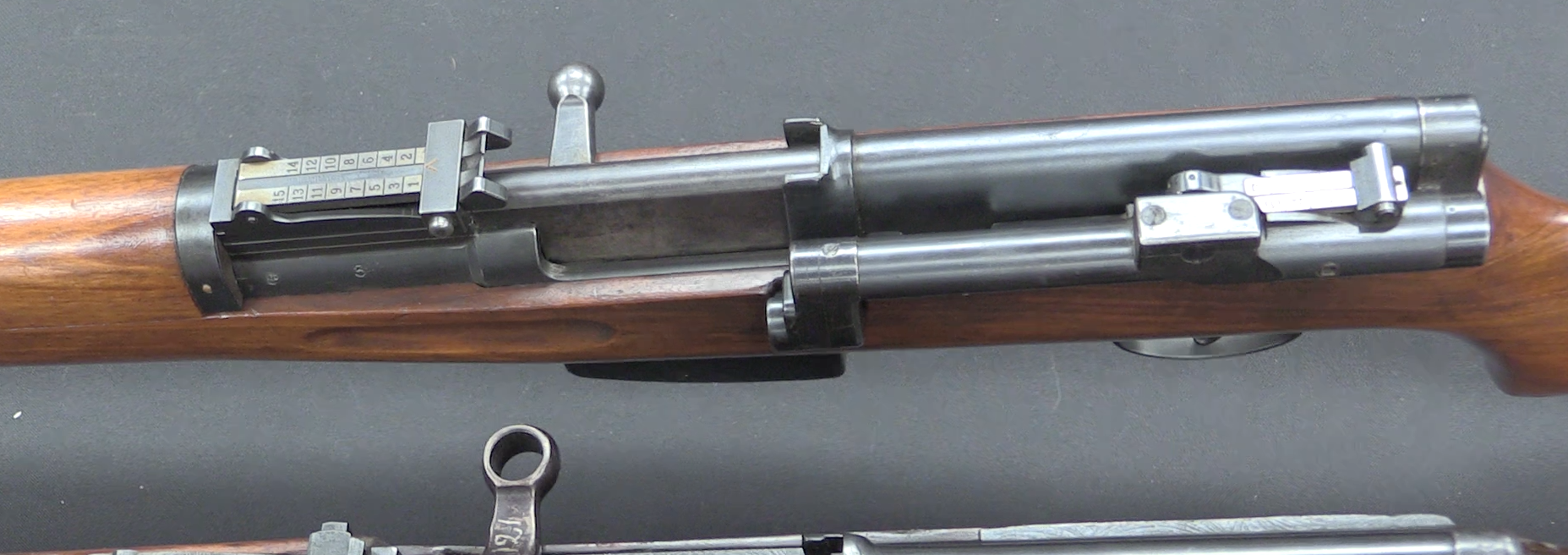
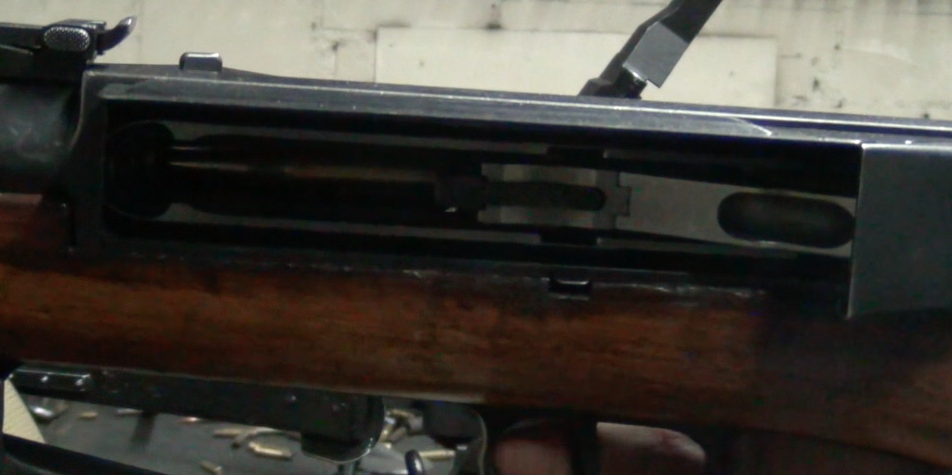
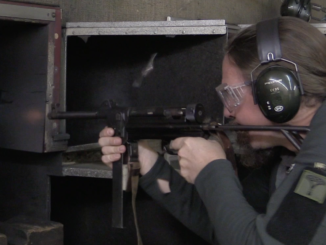
Talk about “Built like a Swiss watch!” The fit and polish of the interior parts just isn’t seen these days.
I am reminded that the more complicated a Swiss watch is, the better. It means it can be sold for more money. That obviously carried over into small arms.
“(…)fan of the toggle locking system, and also designed a toggle-locked submachine gun(…)”
He was also able to upscale said design to create 24 mm Tankbüchse 41 https://guns.fandom.com/wiki/24_mm_Tankb%C3%BCchse_41 and 34 mm Flab Kan 38 https://militaerfahrzeuge.ch/unterkategorie_26_34_398.html
Only slightly on-topic so ignore if you wish:
Looking at this fairly light looking LMG on a very well thought out, versatile biopod gives me an idea. As has been pointed out several times on this site, the introduction of cheap, improvised loitering munitions (aka drones) does tend to put the conventional LMG team in a position where getting into extended firefights might not be desirable. However, it strikes me that the guerrilla sniping methods advocated in John West’s “Fry the Brain” might be applicable here. What I mean is, what if we started thinking of crew served machine guns more like recoilless rifles: you show up, pick your target, let of one almighty salvo of lead, and then immediately scoot to the next position. In order to do this, you would want a combination of an LMG that was both extremely light, had decent effective range, and had a blisteringly high rate of fire. You would also need the lightest, quickest to set up tripod possible. Ideally, one would try to engage targets at a long enough range that they could not easily respond before you were gone. A good machine gun optic would also be essential. This tactic would obviosly work best as an ambush or a surprise attack, though it seems like it might be made to work for a defense in depth as well. Caveat emptor: I have no military experience, and am talking out of my posterior here.
I think you’re going to see a lot more things like Remote Weapons Stations showing up, probably on Unmanned Ground Vehicles like that one they just highlighted for doing a 45-day defense:
https://defenceleaders.com/news/ukrainian-combat-robot-holds-frontline-position-for-six-weeks-in-sign-of-growing-ugv-maturity/
Ain’t no point to putting people at risk, when you can send a machine to do the work for you, which is precisely what this represents.
I’m sure you’ll see “minor tactics” versions of what we’re currently doing using artillery, the so-called “Artillery Raid” ploy, but with UGV systems equipped with machineguns. Imagine waking up one morning with a couple of these things doing mutually-supported fires inside the perimeter of your Forward Operating Base, wandering around shooting everything up while your support troops run around in circles screaming and shouting…
War is certainly going to be different, and if you think you’re going to get away with having two-tier uniformed combat forces where a bunch of people aren’t equipped or trained to deal with these things, you’re quite mistaken.
I was bummed that there was no explanation of how the API is implemented in the lockwork. Did that segment end up on the cutting room floor?
Anybody out there know?
So, it’s not just me?
I missed the same information in the video, and I still can’t find it… Ian shows the control, but never shows the inner workings.
I have to ding him for that, but offer kudos for the tripod and accessory descriptions…
As a guess, it simply allows the barrel to go few mm further forward. So, when the action closes and the firing pin strikes the primer, the bolt-barrel assembly is still advancing.
How many hours of machining were needed to create the operating system? That looks like a very expensive, labor-intensive job to make each one. Parts interchangeability other than the whole barrel assembly?
I remember reading somewhere that the barrels and the rest were not interchangeable at all, without significant gauging taking place along with careful fitting. The gentleman writing about it described it as “Send it back to the factory complicated” if you got parts mixed up between sets. Lots and lots of feeler gauges were involved…
It’s pretty complicate, but I would say no more complicate than the bolt and gas piston assembly of a BREN. At 8.65 kg it was also remarkably lightweight for a LMG of the time.
Main issue, provided that the toggle lock system worked, would have been the lack of a quick exchange barrel (a strip field to change the bolt-barrel assembly is not exactly the same thing).
Be warned that according to https://modernfirearms.net/en/machineguns/switzerland-machineguns/wf-lmg-25-eng/ …specific aspect of the Furrer system, as compared to other short-recoil operated guns (toggle-locked and others), is that the bolt and barrel are mechanically linked for the entire cycle of the action, not just through its “locked” part. This means that the entire movement of the bolt is controlled by the recoiling movement of the barrel, although the bolt recoil velocity is necessarily much higher than recoil velocity of the barrel. This linkage results in constant and accurate timing between all moving parts; another benefit is the greater reliability of the system, as the entire mass of the recoiling barrel is used to move the bolt through the whole operating cycle. Yet another benefit of this system is a relatively slow cyclic rate of fire. The drawback is the very close tolerances necessary in the linkage system to achieve proper timing, which increases the cost of the weapon….
Switzerland was neutral during WWII so the LMG-25 never action except on the firing range? Was it ever used in combat. Was it sold to other nations after WWII? Such a fine machined gun seemed like such a waste of effort.
Sun Zi says a war deterred is a war won.
Swiss weapons design philosophy is predicated by the fact that they issue weapons permanently to the conscripts. From what I understand, this goes all the way back to “push of pike” days, and the mentality is that you’re not going to be issuing out crap to said conscripts, because they were more-or-less “professional” conscripts, unlike the typical slave-soldier types prevalent elsewhere in Europe during those eras.
Because of that, every damn thing the Swiss issue is meant for long service, “buy once, cry once”. Were you to suggest to a Swiss procurement type that whatever they were buying was effectively disposable because “soldier gonna die in first five minutes of combat”, well… That’d be anathema. The mentality there is that they’re caring for fellow citizens, and there’s no expense to be spared.
It’s quite refreshing, really. You see a lot of gear issued out by people like the Soviets, and it’s all shortchanged on the longevity side of the equation because they see the soldiers as effectively disposable items to be used up. The Swiss can’t wrap their heads around that…
“(…)sold to other nations after WWII?(…)”
Please note said weapon uses cartridge specific to Switzerland. Any foreign user would either need to change that (I do not know how hard would it be) or accept using another cartridge. Another Swiss light machine gun of that did find some use abroad, as it was from start made as export product, namely KE-7 https://modernfirearms.net/en/machineguns/switzerland-machineguns/sig-ke-7-eng/
Gentlemen, the Lmg 25 cannot use advanced primer ignition in the usual sense “the fixed firing pin ignites the primer mix while the bolt still moves forward”.
The Lmg 25 is a locked breech, recoil operated weapon. Barrel and bolt are completely locked (toggle is straight, firing pin cocked) when still 8 mm away from the battery position. As Daweo correctly stated in his “Be warned…” message, barrel and bolt are a single assembly that travels to and fro in the weapon. Just like a Luger pistol, by the way.
The usual Lmg 25 mode, called “Vorzündung”, is to release the firing pin while this comletely locked barrel-bolt-assembly still travels forward.
The gun can be switched to “Nachzündung”: the firing pin is released when the barrel-bolt-assembly has come to rest in forward position.
The field manual says, the latter is done to enhance recoil, in case the weapon is dirty or must be fired in a steep downhill angle. It is always used when firing blanks.
Swiss Lmg 25 manual 53.121 describes the function in detail, including drawings. It exists in French, Italian and (titled “Das leichte Maschinengewehr”) German.
I wasn’t aware of the two settings for the position where firing occurs, but it does make sense.
there’s a lot to be said, both for and against the Furrer style of toggle action in ground based machine guns.
in aircraft use, I gather that the Furrer Cannons (like the Oerlikon type Cannons) minimised stress transfer to the airframe,
but the weight of the reciprocating parts does not appear to be consistent with achieving high rates of fire
According to Chinn, the 20mm Aerial cannon by Furrer fired at 400 RPM, that’s indeed pretty slow, even for a 20mm automatic cannon of the ’30s.
Thats a really good, machine gun – Not Mg42; which is also very good, but different… The Swiss have gone for hitting with 30rnd mags… With an elaborate tripod “Defensive” more than the mg42… But it is so great, this Swiss gun. Reminded me about the Gast gun
idea, the one piece barrel/action lark, the stock pins, use two units one pin to a tripod through both, looking at it again… Api thing… Going to watch this a few hundred more times, he he.
That really is very good, & very well made…
Suppose the Gast gun, lark, basically… Is Api by the other gun, so not from a spring “Which is fab in this gun” But the other gun now going forward, or back… 97 of 100 vid watches, hee. Over and under config… Forward, Gun 1… Closes Gun two, BANG!!! Gun 1 back, Gun 2 fires… S’meh… 96 more watches… Hee.
Be along those lines; doing that, the Gast should cheapen manfacture in away, just via the above… Must be much simplified, more; on Gast premise, though. Wants to replicate gatling gun no bolt “move” fire rate, as much as possible, but cheaper… This is definately a great base for an “Aghast gun” on the basis of 30mm anti drone, grenades. Niti fuses, rotated by the barrel blast cap for range adjust. Good job I bought this jd blackberry. Which is nice incidentally. Some hope for cheaper’ness – Having another gun attached does provide some mass… To help, were it a normal gun. S’meh, I will just watch it again. Be along those lines.
JUDO!!! HI’YAH!! Throw thing. Get forward you other mass gun, BANG!!! You know you want to blast it forward “Cheap though aye we explosive power blast cartridge thing; think Newton or some shit – You know you want to be made, help me out.” BANG!!! Hi’YAH! Nice this Jd incidentally.
So well made, thought out that Swiss gun, isn’t it, I love that tripod, a masterpiece.
Anyway, I am just going to keep watching, see what happens… Can comment to myself, I have a digital note thing… But right though, premise, including tolerances etc as mentioned by clever folk above. Feck that, via Gast gun, get forward and back you bastard BANG!!! & Adjust to fit. Hope… Aye. There is.
Aye, I am right, the link thing for the feed belts will intergral to both action and feed… That will be the key. After I have watched this video another 95 times, burp. Out! Enjoy your evening. Not as sweet as Southern Comfort this JD Blackberry – Similar 35% job, but… Different, nicer? Well… In away, room in the world for both, eh.
Probably be some sort of circular piece… That itself is fixed to a mount, like the underlever Winchester gast gun, lark’ish… Burp. Like the sort of artillery use of Vickers guns in reverse this Swiss gun, hits… Defensive positions. Sort of… Well made, thought out, great gun that Swiss thing, tripod, bipod 1925 really nice.
Wants to be cheap though, and 30mm mk108 rnds, get forward and back you bastard and blow up stuff with wee bombs. My version. Service life… Meh, cheap and violent.
Very much like drones… Or Napoleonic era soldiers. Mind you they built some fair decent churches when they got back, government job lark – They are quite good, still standing, no issues, overall, given the time period; roofs… Well you know, Vicars… Jd, probably not as bad as they make out.
We have a church 12th nowt up with it, vicar gets a fortune spent on it; to be fair, their is a fair amount of pissed peasants pass through periodically. Costly like but, meh… Anyone got any better ideas. Probably not.
12th c a bit of it, St someone doubtless shaking his fist at some heathens raping and pillaging below, said tower… Meh, fair play to him, probably.
Semi circular… Bits… Wee pin on one, up and down over a circular central piece, wee pin on the other. Hmmm… Bit stumped, be along said lines. Anyway, just going to watch it again. Right though overall.
Heil! Adolf… Furrer, he he.
I will be quiet, but that api selector switch, must be related to the toggle lock given it used normal non rebated rim “Mk108” style rounds… So a special gun. So well made… Thought out. Defensive, mg42 offensive really.
Forward momentum of the toggle as oppose other systems; I.e. It must get to a certain point in the “snappy forward” bit, for api, to be viable – As it isn’t usually is it, without rebated rim cartridges; it must slam them in the chamber, at just the right point… Clever.
I owned one for a few years with all accessories but never got to shoot more than 10 rounds due to the lack of 7.5 Swiss ammo in shootable quantity. The quality of manufacture is simply stunning, much better than the German & Czech LMG’s of the pre-war years which were impressive enough!