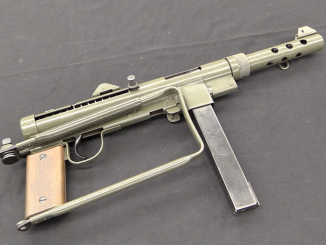
The Hovea M44 was tested by the Danish and Swedish militaries in 1945, competing agains the Carl Gustaf M45. It was designed and produced by Husqvarna (yes, the chainsaw company) and just 10 of them were made for testing. It was designed around the Suomi quad-stack magazine, which was also originally a Swedish design. Sweden chose the Carl Gustaf, but Denmark preferred the Hovea – but with a couple modifications. Specifically, they wanted the grip and stock from the Carl Gustaf, and that ended up becoming the Hovea M49 which was adopted into Danish service.
Hovea M49 video: https://youtu.be/r4mRIDjUCQE
Many thanks to the Royal Armouries for allowing me to film and disassemble this rare prototype! The NFC collection there – perhaps the best military small arms collection in Western Europe – is available by appointment to researchers:
https://royalarmouries.org/research/national-firearms-centre/
You can browse the various Armouries collections online here:
https://royalarmouries.org/collection/

You have to wonder at how all these rare prototypes wound up at the Royal Armouries. I can completely get how they’d have all the various UK weapons, but esoteric prototypes from Danish trials…? How? Were there little Armoury gnomes out there, running around Europe, begging for the remnant left-overs? Was there some sort of background drug deal, where they’d give UK weapons prototypes up in exchange?
Seriously… I think Ian and the guys at Royal Armouries are missing a bet, here. Tell us how the hell all of those weird one-off weapons wound up at Royal Armouries along with showing them off to us, please…
It’d just be tragic if there was no backstory, here. I mean, there ought to be entries in the catalog, somewhere, saying how that weapon arrived at the Armoury, and who collected it. I mean, I would hope…
I would like to imagine that there are collectors that sound just like Steve Irwin out there, looking for accessions to the collection…
Good question. One imagines embassy military attaches were told to keep a finger on the local weapon scene’s pulse. Still it’s one thing to gather info, quite another to buy what one is researching. Posing into embassy budgets might yield some insight. But getting access is highly problematic. British embassies discourage contact for any but clearly routine reasons.
‘Poking’ not ‘posing.’
I would imagine they go around after the trials are over, buying up leftover trials guns for their reference collection, and if your nation already has a close relationship with the UK, why not? It’s not like they were going to do much with them
I can only see now, thanks to Mr. M’Collum’s video, why the Swedish army preferred the kpist m/45 to this HVA/ Hovea SMG, and why when Denmark adopted this gun for armored crews and whatnot, they chose the stock and foregrip of the m/45 Carl Gustaf. Absent this video, I never had a very clear idea of how the parts “fit” together and how it operated as a system. Just goes to show how videos online have allowed us all–weapon enthusiasts, military historians, gun nerds, etc.– to “see under the hood” and understand more about how these weapons operated absent “hands on” experience.
I might note that the Danish Madsen M/50 and M/53 stamped, sheet-metal SMGs were never formally adopted–as far as I know?–by the Danish military, but were considered by the UK as a sort of “PDF” for troops not armed by the Atlee government with the “No. 9” rifle, aka, the “EM-2” rifle/ SMG/ Automatic rifle in a 7mm/.280 UK squad with EM-2 rifles and automatic rifles and TADEN belt-fed machine guns. Sales abroad were OK for Madsen, although in a world awash with WWII-vintage SMGs, still rather lackluster. Still, the Madsen guns served as inspiration for the Brazilian INA Model 953 “ideal submachine gun for the urban guerrilla” according to the late Carlos Marighella (1911-1969)of the ALN:
https://www.marxists.org/archive/marighella-carlos/1969/06/minimanual-urban-guerrilla/ch05.htm
I do not know what PDF mean, as I do not know all Swedish military acronyms, nonetheless according to https://guns.fandom.com/wiki/Madsen_M/50
claims was produced for the ongoing British trials and was very nearly adopted in Britain, but ultimately it was beaten out by the Sterling.
so it was most probably seen as sub-machine gun (or maybe machine carbine, as I am not sure when this category was deleted in United Kingdom) at that time.
Thanks. I meant “PDW” not “pdf.” Mis-typed. The Sterling as the SMG seems a “shoe-in” to me, but perhaps the simplicity of the Madsen m/50 commended it to the people holding the trials.