
The Grendel P10 is a .380 ACP pistol designed to use 10-round stripper clips in a fixed magazine. Specifically, it used M16 clips – the case head of .380 is nearly identical to that of 5.56mm, and so the clips can be interchanged. Neat! The downside is that the Grendel has a terrible trigger, pretty bad sights, and a reputation for malfunctioning. A lot. So, what could go wrong? Sounds like a perfect gun for the BUG Match!

Q&A
Ask Ian: What Rifles Were the M2-M13?
From Dennis on Patreon: “What rifles were between the M1 Garand and the M14? I went through Basic with an M14 and I know the M15 was supposed to be a BAR replacement. Google doesn’t […]
Bolt Action Rifles
Colt Franklin: Detachable 9-Round Magazine of .45-70 in 1884
This is lot #3213 in the upcoming RIA Premier Auction. It was scheduled for April, but has been postponed – check their web site for upcoming Online Only auctions every month, though! Patented in 1884 […]
Antiques
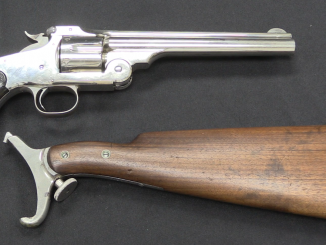
S&W’s Pistol-Carbine for the South Australian Police
In 1880, the South Australian Police service was introduced to the Smith & Wesson No3 New Model revolver at the Melbourne Exhibition. They took a liking to the design, and promptly ordered 250 of them, […]
“(…)a terrible trigger, pretty bad sights, and a reputation for malfunctioning.(…)”
https://www.imfdb.org/wiki/Grendel_P-10_/_P-12 reports that One of the complaints of the P-10 was its tendency to eject several unexpended cartridges out of the top of the internal box magazine when the first shot was fired, thus dumping out unused rounds onto the ground. which certainly count as malfunction, but I want to point that is especially severe disadvantage in timed competitions where loading (requiring lot of dexterity) is part of measured time. Were this and other malfunctions of P-10 fixed in production or by after-market kits?
A bit of lore from the Old West. Having only six shots in revolver was not a big problem as most civilian encounters were settled in less than six shots.
True. But that’s like saying the Pieces River is a foot deep ‘on average.’ One can still step into a hole over his head. If I pay for a 10 shot pistol, I expect 10 shots
Pecos River
Obviously, if a gun has a ten rounds magazine, it should be able to fire all ten rounds. But, as difficulty to reload is mentioned, what had been said about the Kel-Tec PR-5.7 is still valid. Most people that daily carry semiautos, don’t carry a spare magazine anyway.
Not making a comment on the issues with this gun. Trying to make the point that the need to reload, for civilians in a self-defense situation, may not be that important.
The thing about relying on statistics is that when you do that…? You almost ensure that you’re going to personally run into an outlier situation.
That’s just been my experience of this universe, so far.
I suppose someone should mention that the P10 is George Kellgren’s pre-Kel-Tec design and the precursor to the current PR57. Considering that the ASP channel has reviewed thousands of civilian gunfights and noted only one armed citizen needing a reload (in Pakistan!), the idea of a fixed-magazine high(ish)-capacity compact civilian self-defense pistol is not that unreasonable. Of course the execution could have been better.
A bit of Russian lore. When loading an AK from a stripper clip, grab the slug of the top most round by the tip with the index finger and pull up. While keeping the first round rotated up, push down on its base with the thumb to push all of the rounds into the magazine.
This works for the AK since the rounds are bottle necked and long, so fingers can get between the top and second rounds. Don’t know how well this would work with the fully cylindrical rounds like 9mm. There may not be enough wiggle to get a gap between the first two rounds to insert fingers.
Instructional video
https://www.youtube.com/watch?v=7nLyv8Xe1zQ
Why is it in video sks and not ak?
Same ammo and clips. Should also work on ARs, if clip loading is a thing. Works on .303 British Lee-Enfields. I don’t know about calibers that are not tapered or bottle necked.
Because the Soviets did not issue ammo for the AK on stripper clips. Those were usually separate items, and hard as hell to get ahold of. Soldiers and Border Guard types issued AKs were expected to roll their own clips, if they could find any.
I had a former Red Army motorized rifleman in one of my units; he was shocked that we issued ammo the way we did, because he’d never, ever seen AK ammo of any variety issued already on clips. If you could find them, per his description, they were a neat thing to have in order to speedload magazines under fire, but hardly anyone ever had them.
I think this works as the pressure is put on the base of the cartridges. If you push the middle of the top cartridge, you risk making the base rotate upwards. This does not apply the proper force to the rest of the cartridges.
I have to say, after some consideration, that this is about the least surprising things I’ve ever heard.
You push down on the tips with 5.56 stripper clips in the M16 magazine loader, the same exact thing happens. That’s why you find the edge of a table, or “something else”, place the cartridge base of the top cartridge against it, and then push.
You push the tip, or even up around the bottleneck, the cartridges all do this exact same thing.
Why the hell this is surprising, or seen as some “trick of the trade” is beyond me. All stripper clips above about the five-round size do this; it is a function of length and cartridge numbers. Five-round clips don’t do this; they’re too short to have the problem.
Has anyone here actually had to load lots and lots of M16 magazines? As in, at a military range, with military-issue ammo on clips? If not, then I can see why this might be “surprising”, but if you have, and find it amazing that you have to press on the cartridge base of the Soviet stripper clip to get it to work… All I can say is “Wow…”
This issue and technique is endemic to every single ten-round and higher stripper clip I’ve ever encountered. Your thumb has to go there at the base, or it jams up…
All the awkward loading and malfunction to eject issues aside, and suffering fixed combat style sites with a horrible trigger – I was much surprised at how accurate it performed at all for a schlocky .380 pistol. Take into consideration the Grendel P12 with detachable magazines that came later (much the same pistol, albeit detachable mags) maybe that’s something to look at and a follow-up video to do in comparison to the P10.
“(…)Grendel P12 with detachable magazines that came later (much the same pistol, albeit detachable mags) (…)”
How it did affect reliability?
You did it, Congratulations!
Any idea why this pistol was made this way?
Was the use of stripper clips an attempt to make the product as simple as possible? Was this some kind of legal workaround for a state level magazine capacity restriction? Was it just an attempt to do something different?
Remember this pistol is nearly fifty years old — before limits on mag capacity. I would argue that it was produced as competition to snubnosed revolvers, which are also hard to reload. This package is flatter, holds ten rounds, and sports the same trigger pull and lack of complication as a revolver (though arguably not as reliable in execution). I would also argue the fixed mag reduces costs (less sheet metal, only one mag spring), complexity, and weapon width. Fixed feed lips should have increased reliability, but the current PR57 seems utterly reliable once broken in. And in answer to your last question, designer Kellgren seems always trying to do something different.
It was made this way to be the highest capacity with the lightest weight, and as small a possible. By using stripper clips, a lot of internal parts and mechanisms that are needed to facilitate, retain, and grab/release magazines could be left out, including what is essentially a double wall of frame grip and magazine. As Ian applied it here, it was intended to be a back-up gun (BUG Match) that was as small as possible, as light as possible, with the most capacity available, without a lot of complexity. It’s still one of the lightest pistols available with the highest capacity on tap. This was at time where it was thought 6 to 8 rounds was more than sufficient for a back-up gun, even though there were few to no magazine capacity restrictions at that time. It was not intended to be something you would load while on the fly. It was meant to be loaded once, set, and to have 10 rounds when ready – then that’s it, that’s what you got. It’s not likely someone would carry 10 rounds on stripper-clips on them along with a feed-assist spoon as one would with back-up magazines. It was as least as small as a 2″ S&W J-Frame, but held 10 rounds ready rather than just 5. And most compact semi-autos at the time like the Colt Mustang Pocket-Lite only held 5 or 6 rounds. Other contenders were the LW Seecamp in .32ACP which held only 6 rounds, the Beretta Tomcat with 7 rounds, the Detonics Pocket-9 (a BRICK of a gun holding only 6 rounds), the PPK with 6 or 7 rounds, among others, but few were higher capacity than 6 or 7 rounds. Ironically, the much older Colt Model 1908 Pocket Hammerless held 8-rounds in .380, or the Makarov in 9X18 holding 9 rounds were only slightly larger than the P10 but much heavier being steel framed rather than polymer. But the P10 was a precursor to being as compact as possible in polymer, and once Glock introduced the 26 in 1995, and others followed, small magazine-fed pistols of at least 10 rounds became the norm – especially in the face of the 1994-2004 magazine restrictions to 10-rounds only. And today, we have all sorts of higher-capacity ultracompact guns to choose from in .380 to 9mm.
Good points all. Looked at in context like that the pistol makes a whole lot of sense
You are talking an OUNCE saved on mechanisms relating to a standard magazine release setup?
An OUNCE. Or less.
But just think of the imperceptible .04″ of saved grip thickness for the walls of the detachable magazine, LOL
Actually, much more than that if you see it in person, over a comparably sized firearm. But add to that it was of a polymer framed design which in 1987 when it came out, was still a relatively novel idea with only the HK VP70 and Glock being mass production contemporaries. Now most people take that for granted, but it was innovative on many fronts. But it wasn’t just about weight. It was for simplicity that was to be a back-up gun on the ready, without a lot of ancillary controls. The idea being once loaded, it was ready, and loaded that once. And sure, a ‘throw-away pistol’ as well if it so pleases. Without a magazine, there was less complexity for feed lips, additional tooling and parts that drive up the cost, as well as other added controls one must operate.
“(…)why this pistol was made this way?”
I have tried to search for patent by George Kellgren from that period, but failed to find any. Was P-10 covered by any patent?
In gimmickyness, Kellgren is surely a late 20th century John Browning of it.
One is going to deal with stripper nonsense in a firefight?
What is the point of this pistol? I’d rather fight with a slingshot and steel ball bearings!
The piece is nearly fifty years old. Back then an awful lot of guys carried a S&W five shot snubby as backup. This has twice the capacity at less than half the weight. Back then speed loaders for rebolvers were a novelty. All in all, the gun was not a clearly idiotic solution. Still, yeah. Back then gimme a Walther in 9mm Kurz and a spare mag.
This isn’t an ancient relic of a benighted age. Savage advertised “Ten Shots Quick” [with detachable magazines] in the 1900s. It’s about Kel-Tec falsely claiming that stripper clips make a necessary (or even significant) difference, even in 2026.
Giving new ideas a chance is great. It makes no sense to rehash old ideas that had their day, ruled the market for a while, then were categorically rejected by every manufacturer, every department, and every pragmatic civilian customer once a better idea went out of patent protection.
You do realize this pistol came out in 1987, right? I don’t understand your 2026 reference. And this wasn’t Kel-Tec, it was Grendel, a precursor company to Kel-Tec by the same owner, but a separate company nonetheless and no longer around since Kel-Tec was started.
And it made perfect sense in its day for the intent of its purpose; a simple back-up gun as light as possible, that could hold 10 rounds, as small as possible, without a lot of controls, with a minimum of parts, and be very affordable to make, and still be reasonably accurate – which this video proved – not to mention one of the earliest polymer framed pistols on the market. This was a time when a lot of unique variations for back-up guns were tried, the Semmerling LM4 for example with its manually operated slide with 6 rounds in .45ACP, or the 4-Barreled swing-open COP derringer out of Torrance, California in .357Mag/.38Spcl, or Detonics with their Combatmaster in .45ACP.
For its own part, Grendel went on to make the P12 which was essentially the same version of this gun with 12-round detachable magazines. So you can say that they did the same of rejecting their own idea to improve on it with the P12.
I think I’ve got it now – you’re referring to the PR57 regarding Kel-Tec – I see the point you’re making, understood. A fair assessment. And yet, people still bought plenty of those, and particularly relevant in places that limit magazines to 10 rounds. A 20-round back-up gun in 5.7X28mm would still be a great support in the same intent of having a one-time load back-up gun holding 20 rounds, with minimal controls, and sufficient stopping power.
I mostly was (sorry if I was unclear) focusing on the PR-5.7. Thank you for reminding me of the even more egregious claim: those “loopholes” were in the 80s, and have been closed. Remaining “internal magazine exemptions” are narrow and specific (e.g. California’s is for rimfire rifle tube mags).
I am not overall anti-Kel Tec (I even paid dvmb “early adopter” prices for some of their innovations). They deserve full credit for the winning formula that gave us the P365 etc.; it just had nothing to do with counterproductive stripper clips.
Doing a “Keltec Fluff & Buff”, has come in handy for Every pistol & rifle I’ve ever owned!!
Further, I’ve been carrying my P-10 for decades, it’s never let me down. Mostly use it for nuisance critters. So it sees regular use.
I think it would have helped him a lot if he spent more time with it and did a Fluff & Buff, it works wonders for reliability!!