The Forehand & Wadsworth company was a better firearms manufacturer than most people tend to give them credit for. It evolved from Allen & Wheelock, with Sullivan Forehand and Henry Wadsworth both having married daughters of Ethan Allen. When Wheelock died in 1863, the two were made partners in the firm, which became Ethan Allen & Co. Forehand was a particularly hard worker, and when Allen also passed away in 1871, the company again changed names to Forehand & Wadsworth. Their main business was .32 and .38 pocket revolvers, which they made a quiet large number of. In 1873 they decided to compete in the service revolver arena, releasing the Army model we see here today. It was a 2.5 lb gun with a 7.5 inch barrel, chambered for the .44 Russian cartridge. Single action only, with a 6-shot cylinder and a rather weak and clumsy manual ejector rod. Ultimately, the gun simply could not compete with the superior Colt and Smith & Wesson offerings, and less than a thousand would be made in total. A slightly improved version chambered for .44-40 was introduced in 1878, but this also failed to gain any significant traction in the market.
Ammunition
.30 Super Carry: My 7.65 French Long is Back! (feat. S&W Shield Plus)
Want a more in-depth review of the S&W Shield Plus in .30SC? Check out James Reeves’ video today on TFBTV: When Federal announced their new .30 Super Carry cartridge, I was really excited to see […]
General Purpose MGs
The First M60 Prototype: FG42 + MG42 = T44
The FG-42 caught the attention of a lot of countries at the end of World War Two. The British and Swiss both used it as the starting point for some developments. The US went one […]
Lever Action Rifles
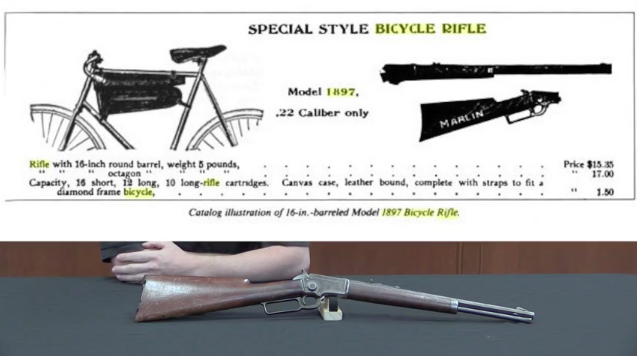
RIA: Marlin 1897 Bicycle Rifle
Marlin’s 1892 lever action rifle in .22 rimfire caliber proved to be a very popular firearm, and so the company released an improved version in 1897, offered only as a rimfire takedown model. The 1897 […]
This sounds very similar to the under-appreciated square-piston steam engines, which provided plenty of good horsepower in compact packages.The automatic stokers on some steam locomotives were powered by square piston engines owing to their compact nature and simplicity in terms of maintenance. Just look up the Dake engine and you’ll know what I mean…
“(…)Dake(…)”
For explanation how it works see 4th image from top: http://www.douglas-self.com/MUSEUM/POWER/squarepiston/square.htm
Note that such engine were made in small size – bigger one would probably be problematic sealing-wise. That is example that direct scaling might be often not viable path and also that to attain commercial success you need to find at least one niche for your invention. Honestly, I do not see any outstanding features which would made it highly desirable by 1870s clients.
Interesting comparison might be with Merwin Hulbert revolvers:
http://www.imfdb.org/wiki/Merwin_Hulbert_Model_Revolver
they were introduced in 1876 i.e. bit later than S&W No. 3 and Colt Peacemaker, but distinguished from them by possessing ability to quickly swap barrels, allowing user to swap between short and long one effortlessly. Moreover, they were designed, so that spent cases only (not complete cartridge) were thrown away when it was opened for reloading. I think they might be called “1870s high-tech”. Manufacturer sadly eventually went bankrupt, but it is worth noted that earlier, according to https://en.wikipedia.org/wiki/Merwin_Hulbert
A company associate literally stole the firm’s operating capital and disappeared. During 1880–1881, Merwin and Hulbert was in receivership, but it was able to recover.
Which hints that these particular revolver (made between 1876 and 1891) generated some income.
As side note: due to relatively low production (compared to S&W and Colt revolver) these marked Merwin and Hulbert today are prized collectors items.
is: “(…)made it highly(…)”
should be: “(…)made Forehand & Wadsworth Old Army Revolver highly(…)”
I always thought the Forehand & Wadsworth pocket revolvers I have seen were of higher quality than the prices they bring. Great work as always Ian!!
Worcester Massachusetts has a rich history of manufacturing.
Firearms are still produced in the city to this day.
I own a Forhand and Wadsworth .44 Russian 7 & 1/2″ barrel old army serial # 8##. It has a Bear stamped on the left side below the cylinder. The grips and the bore are mint but the gun has about 10% bluing on it with patina on the other areas. I am asking anyone who knows about this gun and it’s value to please e mail me for I cannot find much information on it. Thanks, Joe