
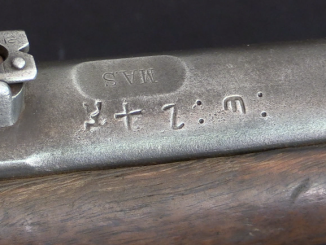
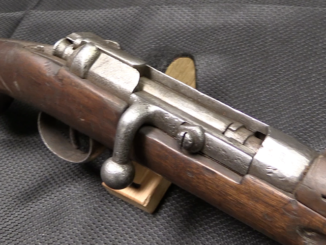
Today’s Ethiopian Oddity appears to be a factory-built Mauser short rifle, but embellished with a couple replacement parts (nosecap retainer, stock, bayonet lug) and some truly mysterious markings. The top of the receiver has been milled down flat, and hand-engraved with a quite odd crest, along with the markings “Mo43” and “GERMANY”. Several other parts are also hand-numbered “43”. The question is, why were these markings put on this rifle?
Bolt Action Rifles
The Gras in Ethiopia: Carbines of Emperor Menelik II and Empress Taytu
Ethiopia is a fascinating and unique example of an African nation that was able to uphold its sovereignty through force of arms, and resist become a possession of any of the European powers during the […]
Bolt Action Rifles
Ethiopian Oddities: Strange Smallbore Gewehr 71 Carbine
Today’s Ethiopian Oddity is a Gewehr 1871 carbine – remarkably still with its matching bolt – rechamsbered for a small bore, smokeless powder cartridge. It is a quite interesting example of an Ethiopian armorer’s work…

Uncategorized
An Aladdin’s Cave of Ethiopian Arms from InterOrdnance
I have been able to bring you a bunch of videos of guns with Ethiopian connections over the last few months thanks to InterOrdnance, aka Royal Tiger Imports. They have purchased essentially the entire stock […]
Look like tribal engraving
The Ethopian writing system is quite ancient. There were Christians in Ethopia while most Europeans were still diddling goats
The hooked nose cap doesn’t seems original. Maybe be taken from a G98.
“(…)Mo43(…)”
But… is that actually o letter? It does look like
Mo
43
first line is somewhat akin to symbole numéro
https://en.wikipedia.org/wiki/Numero_sign
but with M rather N. Whatever was imbuing this weapon with symbols had access to N (GERMANY), but might nonetheless make mistake, especially if had not specimen to look after. If this is case it would simply mean 43th example.
o should be underlined in my post
Looks more like a European abbreviation for “Modello 43”, or Model 43. Which makes sense with the Italian interest in Ethiopia. Not sure why they would modify them this way, I am speculating some sort of shady arms deal. or maybe some form of public relations, Italians providing Ethiopian guerillas, or warlords with arms and trying to make sure the public knows where they came from.
That’s a bit of meat off that receiver ring.
For sure. But a Mauser can spare plenty and still be more than strong enough. A stock Mauser action can take magnum cartridges easily, so I doubt losing a bit o metal off the top is going to seriously compromise the rifle.
Yep. This actually reminds me of the Ethiopian contract FN Mausers that have one side of the receiver milled flat like this in order to take a rack number (Ian did a video on those, and like he mentioned that system was actually quite brilliant if the rifles are stored receiver up/towards).
I’m by no means a mauser expert, but I don’t believe the stock is original to the rifle in question. 43 in the Ethiopian calendar would be 36 Gregorian. That’s the year Germany supplied rifles to Ethiopia in response to Italian concerns over Austrian unification. Perhaps the rifles sent were scrubbed and marked as in the video. Mystery mausers like this are one of the most wonderful things about Forgotten Weapons.