Available from Morphys here:
7.65 P38 – https://auctions.morphyauctions.com/_C__RARE_EARLY_WALTHER_P38_7_65_SEMI_AUTOMATIC_PIS-LOT658919.aspx
7.65 Walther HP – https://auctions.morphyauctions.com/_C__WALTHER_HP__30_LUGER_SEMI_AUTOMATIC_PISTOL_-LOT658893.aspx
When Walther first developed the P38, it was designated the Heerespistole – “Army Pistol”. Only after getting official Wehrmacht adoption did it get the designation P38. Walther offered models with both designations for commercial sale, albeit not to just anyone. Army officers, Party members, and other high-placed individuals could get pistols from Walther outside military orders. About 20,000 such guns were made during the war, and a tiny subset of them – just 225 – were made specifically in 7.65mm Parabellum instead of 9mm Parabellum. Today we are looking at two examples of those…
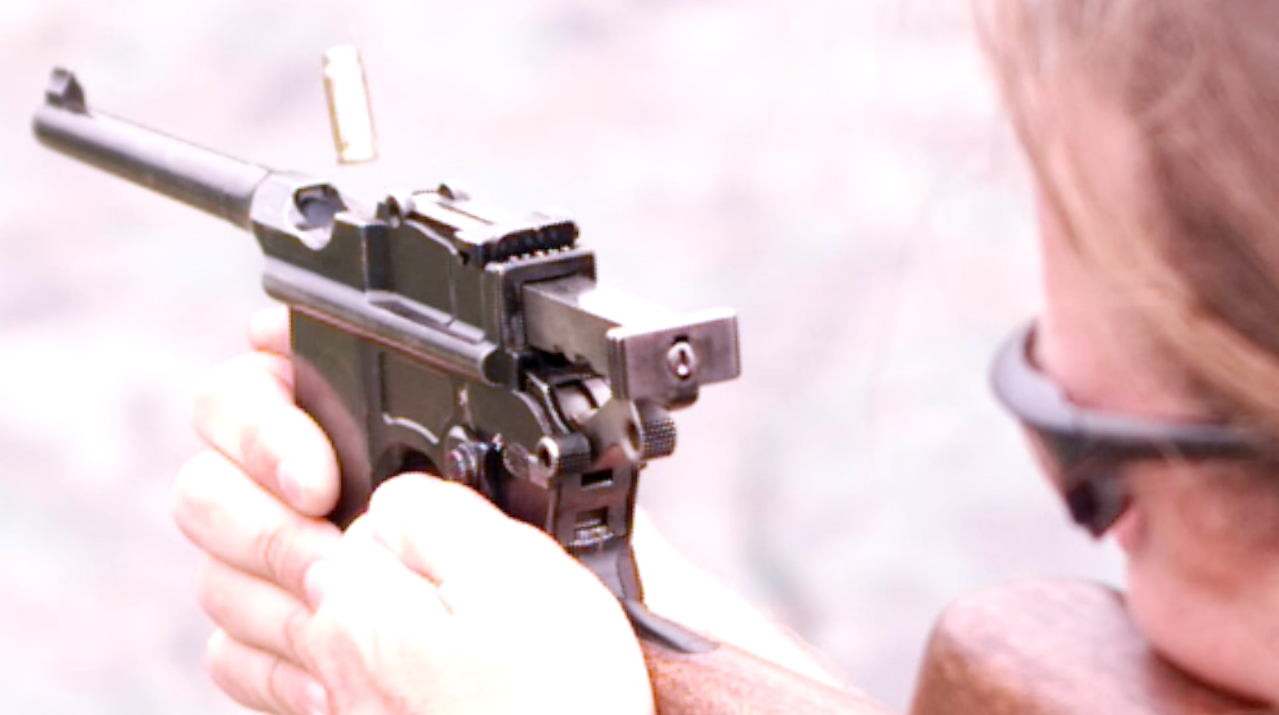

I’m going to go out on a limb, and suggest that the red paint on the rear sight and back top-of-slide was there to remind someone that “Hey, this is a 7.65mm Luger pistol, not 9mm…”
I can only imagine the result of firing 9mm in one of those, and I’d imagine that anyone who bought one likely regretted the snot out of it after making that “mistake”.
It would be my firm assertion that if you’re going to buy things like an AR-15 that come in multiple calibers, it’s the height of idiocy to buy them that way and choose calibers that can be “accidentally intermingled”. People who buy and mix up things like .300 Blackout and 5.56mm versions of an AR-15 are basically demonstrations of how evolution weeds out the weak and stupid. Don’t do it; don’t even set the scene for it. If you’re going to go with .300 Blackout, it’d be my heartfelt advice to keep everything AR-15 in that caliber, and that caliber alone. Also, don’t go to your ranges with friends, because friends do stupid things like hand you a full magazine of .300 Blackout for your 5.56mm AR-15, thinking they’re doing you a favor…
Smart people do not do things like set themselves up for these issues. Keep your calibers on separate platforms… It’s rather hard to lock a 5.45X39 magazine from an AK-74 into your AR-15, and that’s a good thing.
Public service announcement, that.
That “evolution weeds out weak and stupid” is an wishful thinking of himalayic proportions…
Evolution might. Our tertiary stage dis-civilization actively promotes the congenitally incompetent
Based on the case dimensions, i don’t think you could squeeze a 9mm into a 7.65 chamber. A 380, maybe, but the 9 case is too fat where the 7.65 bottleneck exists.
Other way round will fit.
Y’know… I owe you one on that. You just made me re-examine a long-held “Fudd-lore” piece of information that I always just “knew” from someone somewhere either telling me something or reading it somewhere.
I suspect that the reason this mistake was so dangerous was that the problems arose when you had the 9mm projectile set back into the cartridge case upon chambering. If you didn’t get projectile setback, then you’d never close the action, but if you did, by way of forcing it? Big badaboom, if you get my meaning.
Not in the habit of trying stupid crap like that, so I’ve no idea how hard it is to set those projectiles back like that.
So, this might be a bit of internalized Fudd-lore, or it might not. I’ve never made the experiment or seen it happen in the field. You may be right that this is mechanically unlikely or impossible, but I just don’t know.
I’ve tried it. No can do.
In the third edition of Firearms Investigation, Identification, and Evidence (Hatcher, Jury and Weller 1959) they reported a case in which a 7.63mm Mauser c/96 pistol was used in a bank holdup- loaded with 9x19mm.
The ammunition did chamber, with the bullet nose in the shoulder area. When fired, the .355in 9mm bullet was swaged down to the nominal .308in bore. No the pistol did not undergo “catastrophic self-disassembly”.
But I’m quite sure Messrs. Jury & Weller were a bit concerned about firing it to obtain an exemplar bullet for evidence.
clear ether
eon
Iirc there is a video I think on youtube, or some forum thread with pics, I really cant remember now, on aftermath of such action, with these c96 swaged bullets. I mentioned it few weeks before.
So its not a myth
Found it, on ytbe vid named:
” Mauser C96: Be careful with the caliber!! “
It may be that the C96 can handle the “error”, but there aren’t a lot of other pistols that can:
https://youtube.com/shorts/dH9HELuTdOA?si=55IEO0AdVyaj8kGv
The more I think about it, the more I suspect that my memories of this issue are colored by second-hand relations of things that were done back in the days of yore, when Tokarevs were cheap and all sorts of weird little conversions were on the market. I think I heard someone telling the tale of mixing up 9mm and firing it through his Tokarev, thinking he had a 9mm conversion barrel mounted in it, and the result was something like that barrel shown in the video.
I wish I could recall just where I got all that from, but it’s just been a long-held bit of “knowledge” that I picked up somewhere and never really questioned or thought about.
Interesting that a C96 could survive that idiocy unharmed, though. I’d always thought those pistols were somewhat fragile, with the way the bolt locked up. I’m obviously wrong, or based my opinion on Chinesium knock-offs…
Take note that pistol from the video is most likely from Pakistan – Darra Adam Khel copied stuff from every junk steel they can get their hands on, as they call calibers there “30 bore”, as well as name of channel.
So, it could be original russian made Tokarev would not suffer such failure – maybe.
As for c96, its possible its locking action somehow helps, opposed to some other systems…
It could be one of those things some people can do safely once or twice, then…not so safely.Kind of like the badasses who say ‘Drugs can’t kill me. I already tried everything.’
“Civil” Heerespistole (HP) & Wehrmacht Contract P.38: Pre-production P.38 began in mid-1939 and ended in early 1940. Manual H.D.v. 245, “The Pistol 38,” was issued on February 1, 1940; the new military pistol was officially adopted by the Wehrmacht on April 26, 1940.
The primary difference between the ‘HP’ and the ‘P.38’—aside from design changes to the firing pin and the safety mechanism was the relaxation of tolerances to enable cost-optimized mass production of the ‘P.38’. In this process, the highly polished surfaces were also replaced with simply ground surfaces featuring a matte “military finish.” The ‘HP,’ on the other hand, remained an unrefined “luxury P.38,” at least until around the end of 1940. A soldier or other authorized person could not purchase a ‘P.38’ contract weapon as a “private” defensive weapon, but could purchase a “civilian” ‘HP.’ The purchase was recorded in the service record book, and the owner was permitted to carry it in the field. However, for cost reasons, it was likely purchased only by those with higher pay grades (“self-clad,” i.e., officers or non-commissioned officers with epaulets).
Before mass production of the ‘P.38’ began, the ‘HP’ was also given as gifts to dignitaries and officials, as traditional lobbying already existed back then. For sport shooters, the ‘HP’ was also manufactured in the more precise 7.65x21mm (.30 Luger) as “Patrone 08” (9mm Luger) caliber; upon request, it could even be equipped with a refined standard trigger (“Single Action”), which WALTHER referred to at the time as the “Olympic trigger.”
The design of the ‘HP’ / ‘P.38’, meticulously tailored to the “DIN industrial standard,” perfectly captured the spirit of the times. The new pistol completely lacks the charm of its predecessor, the Luger ‘P.08’, with its almost Art Nouveau-esque nonchalance and elegance. The P.38, on the other hand, with its brutal angularity, almost metaphorically embodies the ideology of National Socialism. Note: It’s truly astonishing how a “collective consciousness” manifests itself not only constructively but also in design.
The “HP” was also exported starting in mid-1939, for example to the United States. The list price at the “STOEGER ARMS CORPORATION” at that time was $75. That was equivalent to approximately 190 RM (Reichsmark) at the time.
So what does the 1911 Colt model? Lots of angles there too. Benevolent angularity? The Tokarev auto the Soviets used has a slightly more rounded appearance than either the P-38 or the 1911 Colt. I guess it models a truly beneficient order, right? For that matter the Mauser C-96 is all sharp angles. I guess that stands for seminal NSDAP?
What the HP and P.38 “modeled” was mainly Walther trying to build a locked-breech 9 x 19mm pistol that retained most of the handling characteristics of the earlier blowback PP and PPK types.
As someone who at one time owned all three simultaneously, I can attest that other than the larger pistol grip on the P.38, the three handled pretty much identically, right to that reprehensible slide-mounted “hammer dropper” so-called “safety”.
As someone accustomed to putting 1911s and P35s in Condition Two with my off-hand thumb on the hammer, I managed to ignore the Walther “safety” for years, even on the Beretta M9.
clear ether
eon
“developed the P38, it was designated the Heerespistole – “Army Pistol””
Please keep in mind that by collectors Walther ArmeePistole (AP) and Walther Heerespistole (HP) are considered to be different entities https://pistole38.nl/WW2-Variations with former could be detected by having concealed hammer.
Commercial P-38’s in 7.65 Parabellum were available in the U.S. in the 1970′ because I had one. Nice gun, I always preferred the 7.65 to the 9. There were High Powers in 7.65 available in the 80’s as well. The biggest problem with the 7.65 is that the factory rounds are grossly underloaded. When handloaded they equaled or exceeded the 9.
Maybe they were targeting the export market just south of the Rhine? There is a small country that kept an interest for toggle locked complications in 7,65 Parabellum… So anybody looking out for something more modern might be interested in the German successor…
By the 1970s commercial guns were made in calibres like .30 Luger for sale in places where laws forbade owning a “military” calibre.
such as France and Italy
What is the ratio for such law?
Italy had such a law. P.38s in 7.65 x 21, as well as other brands (Bernadelli, etc.) were available to civilians, but 9 x 19mm was not.
Just FYI, 9 x 19mm was developed by DWM in 1904-05 and debuted in the 1906 Parabellum at the request of the German police, which had adopted the Model 1900 Parabellum in 1901. They were perfectly satisfied with the “stopping power” of the 7.65mm Parabellum round, but they were dissatisfied with its rather dubious feeding reliability in the Parabellum pistol.
Unlike the 7.63 x 25mm in the Mauser C/96 pattern, which had a bolt-action-rifle-like feed path almost straight into the chamber, the 7.65 x 21mm in the Parabellum had a more convoluted path, and the cartridge did not “cooperate” as much as the end-user would have liked.
DWM’s solution? Blow out the bottlenecked 7.65 x 21mm cartridge case to accept a 9mm bullet, creating a slightly-tapered “straight wall” profile and losing 2mm of case OAL in the process. The larger, round-nosed bullet, and lack of a bottleneck, pretty much solved the feeding problems in the Parabellum mechanism.
Presto. The 9 x 19mm Parabellum, now the most common centerfire pistol cartridge in use worldwide.
Developed more or less by accident.
clear ether
eon
Yeah, yeah, true, but why were they so hellbent that civilians could not posess dreaded “military” calibres? What is the logic behind it
Fear of revolutions, or at least, that was the rationale.
Mexico does the same thing; no dreaded “military calibers” for the civilian, lest they rise up in arms… Or, something. Not sure if they’re still doing it, but Mexico was one reason that Colt made so many M1911A1s in .38 Super.
It’s a fairly insane thing for a government to do, but there ya go. I speculate that it was mostly “control freak” bureaucrats behind it all, because if I were a military officer, I’d be making the exact opposite regulation: I’d want everything in my military calibers, to ensure easy take-up of civilian arms if needed in wartime…