
Italy adopted the Villar Perosa in 1915, a gun that is sometimes considered the first submachine gun. Despite being fully automatic and chambered for pistol ammo (9mm Glisenti/Parabellum), it was actually not a submachine gun in practice. It was actually a twin gun, fired usually from a bipod using spade grips. It had some very specific applications, but was generally not very useful, and Italy set about looking for alternative uses for them. The solution they found was to split the guns into single receivers and fit them with buttstocks and traditional triggers. This led to the first true Italian submachine gun – the OVP-1918 – and also the Beretta 1918, which was originally a semiauto-only carbine.
The Beretta was made using Villar Perosa magazines, magazine latches, receivers, and bolt assemblies. The stocks came from Vetterli rifles and the bayonets from Carcano carbines. Only a few parts like the trigger assembly and ejection port housing were made from scratch. Beretta was given a contract late in the war to convert 5,000 Villar Perosas into these carbines, but was unable to complete the work before the war ended and the contract was cancelled. Of the guns that were completed, many were later converted into Beretta M1918/30 carbines and others were sold as surplus. A bunch of them went to Ethiopia, where some were ironically recaptured by Italian forces in the 1930s and put back into service in World War Two in North Africa. This example is one of a few recently found intact in Ethiopia.
Villar Perosa: https://youtu.be/NAsH0fVAoxc
Shooting the Villar Perosa: https://youtu.be/WLFA8VXVkRQ
OVP-1918: https://youtu.be/K2nhwH1I8PU
Beretta M1918/30: https://youtu.be/jNrAsnfI5-k
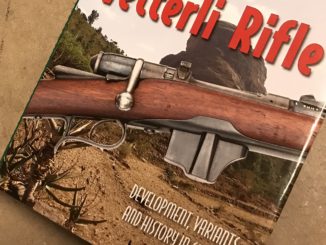
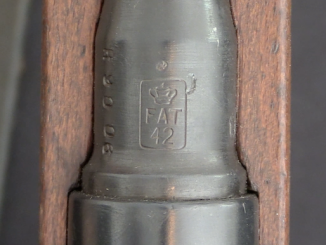
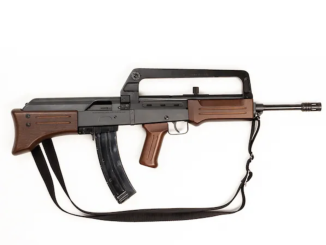
The ejection tube is likely there to avoid the shooter to cover the ejection port with his hand.
Maybe that’s not why it had been done that way but, being the sights on the right side, a right handed shooter, as long as he keeps both eyes open, has not his field of vision limited by the magazine.
Weapon of choice scenario, stupid winter break action-comedy edition:
Okay, we’re stuck on a security contract to deal with the “wet bandits” (okay, stop laughing, these crooks are more dangerous than Harry and Marv from Home Alone, plus the “wet bandits” consist of a dozen violent thugs). Several houses in this particular town have been ransacked and flooded in the past few months, and the police chief wants this nonsense to end. His words: “Get those guys, DEAD OR ALIVE.” For the moment, we are guarding the bait house, which has been dressed up to look like a typical rich family’s home for the holidays. Given that we can’t borrow the police-issue gear, I’ve resorted to hiding odd things around the place.
What do you pick to defend the place once the bandits show up?
1. Beretta Mod. 1918
2. Furrer LMG-25
3. Hyde M3A1
4. Winchester Model 12 Trench Gun with bayonet fixed
5. Ruger Old Army (well, a pair of them)
6. Lupara (why do I have this!?)
7. Aluminum baseball bat
8. Fully loaded MG3 with Lafette mount dug in on the front lawn under a tarp (was this on Kirk’s Christmas list!?)
9. Mauser Schnellfeuer with stock (Say hello to my little friend!)
10. SCREW THE BUDGET!!
Not likely anyone’s going to see this post but if you want to reply, please don’t use foul language.
Happy New Year, everyone!
#8, of course…
Providing I’m not paying for the damn ammo, that is. If I am, then it’s gonna be a .22LR silenced pistol neatly placed behind someone’s ear…
I agree with Kirk. But having a second MG3 im Lafette inside at the far end of the entry hall wouldn’t hurt my feelings a bit.
Happy New Year, everybody.
cheers
eon
I think I would use the shotgun in the hall.
None of the above. Self-defense is out of keeping with the neighborhood’s ‘ diverse and vibrant’ character. Embrazos no ballados and all that, know what I’m saying?
Happy New Year! I prefer Mauser Broomhandle with 20 round magazine. It is Cool!
Once again an excellent video about a very interesting WW1 proto-SMG – but if I might offer one significant correction!
The gun in this video is not the Beretta Model 1918. This is the Moschetto Automatico Revelli-Beretta (sometimes Beretta-Revelli), which was never given the numerical designation ‘mod. 1918’. Though Marengoni is often credited with the design, it is not clear that it is his, as nobody except Pietro Beretta and Bethel-Abiel Revelli were credited with the design in contemporary documentation, and indeed many of the ‘moschetto automatico’ prototypes submitted by the Italian Army in 1917 – 1918 exhibited the same central design principles so it seems likely that Beretta were simply responding to a set of design requirements that had already been conceived by official committee.
The actual ‘Beretta Model 1918’ was merely an early iteration of the later mod. 1918/30 carbine, with a cylindrical closed-bolt arranged actuated by a hammer and ring-shaped cocking piece. Pietro Beretta’s patent of 28 September 1918, explicitly titled ‘Moschetto automatico mod. 1918 per cartucce regolamentari mod. 1916’, confirms this. It is not entirely clear why Beretta chose to develop this more elaborate design in late 1918, as there was little chance it would ever be taken into service so soon after the Revelli-Beretta had been adopted – perhaps they felt they could do better. In any case, it was shelved until the late 1920s, when it was eventually put into production with incremental improvements to the trigger mechanism and bolt release, under the designations mod. 1918/28 and mod. 1918/30.
The understandable confusion between the Revelli-Beretta and the Beretta mod. 1918 has unfortunately plagued practically all literature about the weapon and has led to the popular misconception that Revelli-Berettas were converted into mod. 1918/30s. Except for the Vetterli trigger guard and Carcano bayonet, the two guns in fact have nothing in common and the mod. 1918/30 was, for all intents and purposes, an entirely new endeavor which was merely derived from an old 1918 prototype.
A production total for the Revelli-Beretta remains elusive, but a reliable Italian source puts it at only 1,400 guns (converted from 705 Villar Perosas) by the time of the armistice in November 1918. Probably none ever reached the front. This figure would comfortably explain the rarity of these guns today without the need for any to have been supposedly converted into mod. 1918/30 carbines.
RE: weapon of choice scenario.
Personally, I would chose the Hyde carbine, with as many spare magazines as I could get.
I would also take the liberty of stripping out the ends of some extension cords, and leaving them plugged in behind curtains and doors. 110v might or might not kill the bandits, but it would sure slow them down. Also, a few asphalt shingles with nails through them in strategic locations would be a good idea. Kevin was on to something there.
What if you have to move around in the house? With the lights out? I know it’s a bait house, but the bad guys may strike from unexpected directions. I’d feel better if there weren’t live wired and nails impeding my progress
Maybe this is why teammates should communicate, as in “tell everyone else where you put the traps.” And have an easily updated map of the house. Hopefully, only the bandits will get the nasty injuries: https://www.youtube.com/watch?v=8WKgNyvsNDM&pp=ygUYaG9tZSBhbG9uZSBob25lc3QgYWN0aW9u
Maybe just release a couple dozen bamboo kraits inside and wait out back in a van in the alley.