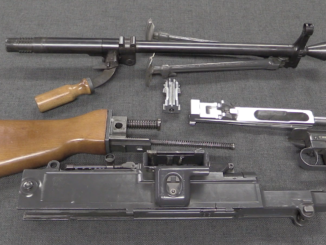
The ZK-381 was designed by Josef Koucký, his first design of 1938 (hence 381). This is one of the last of the Czech pre-war self-loading rifle projects, of which there were quite a lot. It uses a tilting bolt and a short-stroke gas piston, with ZB26 machine gun magazines and chambered for 7.92mm Mauser (although they would have been happy to offer a model in any other modern rifle cartridge). It was tested in the spring of 1938 by the Soviet Union, which liked it enough that they requested a model in 7.62x54R – and those were tested in November 1938. Ultimately domestic Russian designs were chosen instead, and tests in German, France, Spain, and Italy also led to naught.
Thanks to the Czech Military History Institute (VHU) for graciously giving me access to this one-of-a-kind prototype to film for you! If you have the opportunity, don’t miss seeing their museums in Prague:
https://www.vhu.cz/en/english-summary/


“(…)Czech weapons designations. Z
means it’s a small arm. K means it was
developed by a guy with a K last name.(…)”
How to reconcile above with ZB 26 which is Holek design?
What appears to be trigger is bolt release is also true for ZH-29 https://modernfirearms.net/en/military-rifles/self-loading-rifles/czech-republic-self-loading-rifles/zh-29-eng/ it also hinge for disassembly https://www.forgottenweapons.com/early-semiauto-rifles/czech-zh29-rifle/ which leads to question: do they tried to compete with ZH-29, if yes how they want to make potential clients to believe they need yet another self-loading rifle?
Regarding trials in Soviet Union https://www.rusarmy.com/forum/threads/ognestrelnyj-antikvariat.1634/post-1506018 claims that at 26 August 1938 trials were hold with 11 soviet self-loading rifles designs and ZK-381 at НИПСВО АУ РКК.
Three competitors (all soviet) were deemed not refined enough and were barred from entering competition. After 1st round, only 4 (all soviet) remained in game. After 2nd round there was none left. During that Tokarev design was found most promising.
It screams “LMG-like quality”. Probably a little too expensive to be adopted.
The receiver is also very long. There is an eternity between the trigger and the sear.
The muzzle brake sure looks a lot like the SVT-38 and SVT-40, no? I mean there were all kinds of Soviet muzzle brake designs, just not quite like that style, maybe?
One wonders, or at least I do, about the 7.62x54mmR magazines for the Kouck´y 381 and possible prototypes or kindred designs in Russia.
The main spring in the buttstock is a lot like the FAL as Mr. M’Collum noted, also a bit like the ZK-383 from the same factory, no? That it also powers the hammer to fire the rifle reminded me a bit of the John C. Garand Springfield Armory light rifle prototype entrant for the M1 carbine trials. His top-feed/ 45 degree angle magazine was quite like John Pedersen’s “Pedersen device” but the operating system was gas operated and used a rotating bolt, rather a lot like the Lewis gun.
Very elegant and exemplary design, and as others have noted, most über-expensive in terms of machining, quality, etc. That gas system is clever, at least to me. I suppose that a zb26 magazine could be readily adapted to operate in this rifle, no? Drive up the already heavy weight a good deal.
The recoil spring actuated hammer is a really clever solution. You can see how the relative positioning of the hinges make so that, even when the hammer is catched by the sear, the recoil spring still keeps pushing the bolt forward, to secure closing.
Other than sparing parts in the trigger group, it also would make a trigger group that fires from a closed bolt in semiauto and open bolt in full auto really simple (it only needs the selector to make the sear catch the hammer in semiauto and the bolt in full auto, IE moving it left-right).
Beautiful.
Way too complicated for a military issue weapon