
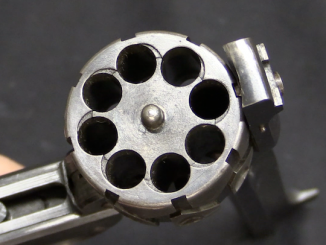
Webley made a variety of .22 rimfire revolvers and revolver conversions for most of its history. Rimfire conversions were used by the military for reduced-cost training, and they were popular on the civilian market for sport and competition shooting. When Webley introduced its MkIV small-frame revolver, it was available in .38 and .32 caliber, and in 1932 they introduced a factory .22 rimfire model. It was intended specifically for target shooting, with a 6” barrel (the longest standard Webley barrel length) and adjustable sights. Initially it used a stepped cylinder, but this changed to a full-profile design by 1940. The firing pin was redesigned slightly to hit the rim of a cartridge instead of central primer, but the gun is otherwise mechanically the same as a normal .38 MkIV. Production ran until 1967, but relatively small numbers were made and they are fairly rare to find today.
Revolver
.38 ACP Webley-Fosbery Automatic Revolver
The rarest variation of the Webley-Fosbery automatic revolver is the .38 ACP model. Only 341 of these were made by Webley, in an attempt to compete with the new semiautomatic pistols appearing on the market […]
Heavy MGs
Vickers Heavy Machine Gun (Video)
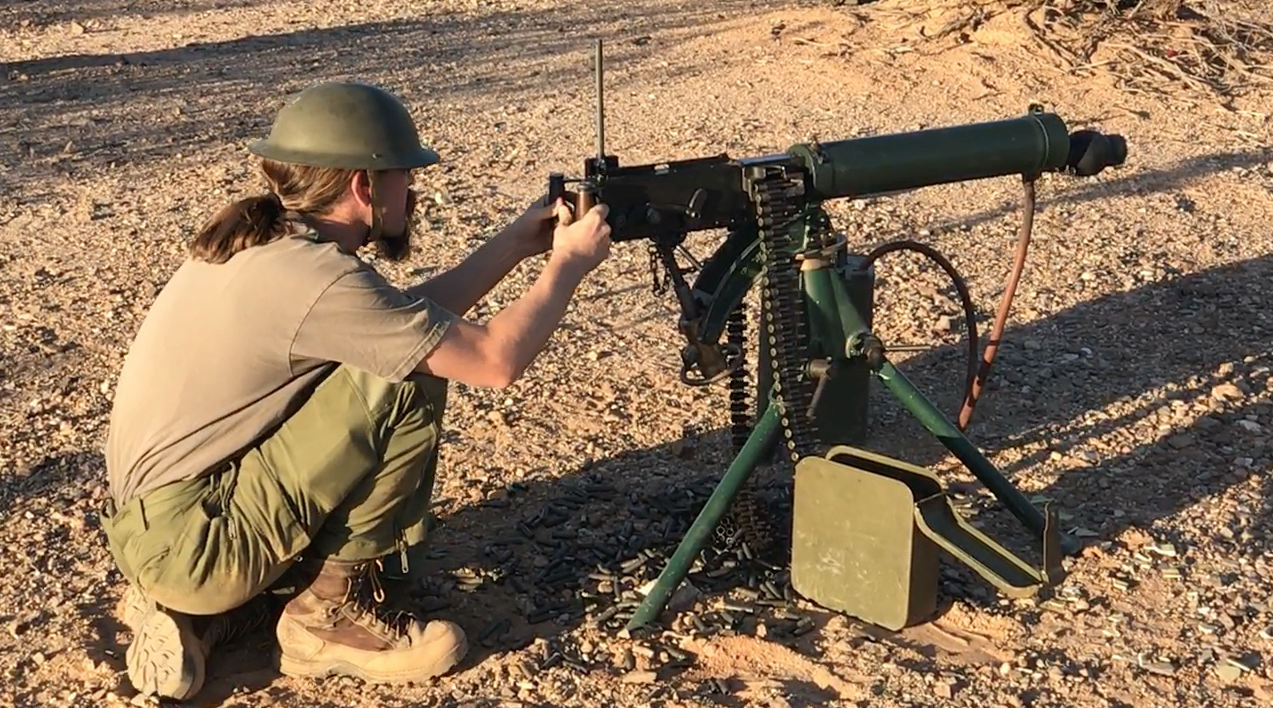
The Vickers is quite simply the best heavy machine gun ever made.

Bolt Action Rifles
L96A1: The Green Meanie – the First Modern Sniper Rifle
The Accuracy International Precision Marksman rifle was the winner of the British MoD’s competition to replace the L42A1 as the standard British sniper rifle, and was accordingly adopted as the L96A1. It was the vanguard […]
They might have sold well in the U.S. through Stoeger’s, Webley’s American sales agent.
But by the time the .22 MK IV was introduced, Harrington & Richardson had been making their broadly similar Model 999 “Sportsman” top-break nine-shot .22 DA target revolver for nearly a decade. And they had pretty much cornered the market.
In an ironic twist, not long after Webley converted the .0.380in MK IV to .22 rimfire, production of both .22s (Webley and H&R) was suspended due to the outbreak of World War Two.
And H&R, as previously noted here, developed the 926 Defender from the 999 Sportsman. A five-round .38 S&W to fill the needs of defense plant guards, police, and private citizens for service/defensive sidearms without affecting war production.
Similar results starting from opposite ends, you might say.
clear ether
eon
After all those “War Finish” .38 Mark IVs, how nice to see one with a proper polished blued surface.
.32 Mark IVs are being manufactured in India at present. Perhaps they could get up a .22 target line and send them here?
Indian “Webley because we bought the name” are junky and insanely expensive.
A sweet little plinker. I wonder how the weight and balance compare to the 38 SW version.
I love these old top-break revolvers, but every time I see one? I’m left wondering why the hell nobody ever made one for a full-moon clip or even a half-moon clip.
So far as I’m aware, they had speedloaders for these, but not until the M1917 revolvers did anyone make the leap to a permanent clip for the ammo.
It’s always looked like a no-brainer from where I sit, but what do I know? I still think you’d do pretty well with a modern top-break and a full-moon clip system for something like 9mm or 10mm… Even .45 ACP.
I want Hellboy’s revolver: “The Samaritan”. Looks like a cross between H&R’s Top Breaks and Taurus’s Judge.
To be honest, I think it’s that before WW I, nobody really thought about needing to hit quick combat reloads on a pistol; that came with their use as offensive weapons by trench raiders. Even autoloaders were usually only issued with one spare mag, if that. so I guess until then, it was kind of a good answer for a question nobody was really asking
One would imagine that Islawanda, Rorke’s Drift, the Boxer Rebellion would have shown the wisdom of fast reloading capability. For that matter the Second Opinion War and the Pandy Revolt, though these were in the cap and ball era
sure, people saw that, and they thought “how do we improve the ROF of our infantry rifles?” because pistols were just an officer’s last-ditch defense option against one or two attackers *if* they got past the riflemen who were *supposed* to do the important shooting
There was not only abundant evidence from the American West (and a lot of urban / CQB examples in the wars Martin Tyrsegg cited, where the four-foot infantry rifles of the day were suboptimal at best), but Denison had also written that revolvers were the natural successors of sabers and lances in British Empire cavalry doctrine.
Like Keith, I love the typo.
The turn of the century shift to the Mauser C96, Luger P-08, 1911 Colt indicates at least some militaries already recognized fast reloads for handguns made sense.
I’m loving that typo
The Webley topbreaks did in fact have the Prideaux “simultaneous loader” during WW1;
https://www.forgottenweapons.com/ww1-prideaux-speedloader-for-the-455-webley-revolvers/
But yes, a full-moon clip in a topbreak is such a blindingly obvious thing that it probably explains why nobody thought of it at the time.
Note that the Webley-Fosbery automatic revolver, being chambered in .38 ACP, would have been a logical choice to convert to full-moon clip loading. The .455in version rather less so.
cheers
eon
“(…)top-break(…)moon clip(…).45 ACP.”
If you need weapon having all these features then TK Custom does offer upgrade for UBERTI SCHOFIELD which result in such weapon, see photos at https://www.gunblast.com/TK-Schofield.htm
I realise that people here are talking about revolvers other than the one in the actual article, but just in case anyone thinks that half-moon clips would be cool with a rimfire revolver it’s worth pointing out that there would be pressure on the part of the cartridge not supported by the clip or the chamber. This does not matter with solid-head centrefire cartridges, and all .45″ ACP cartridges would be solid head as far as I know. .45″ LC not so much and probably not most of the older rounds that would chamber in .455″ Webley either.
I wonder if that has anything to do with the fact that “speedloaders” didn’t happen until well into the era of solid-head centrefire cases, because even though the cartridge would be fully supported once loaded by such means, older balloon-head cases would be weaker just where the speedloader is putting a bit of force on them as they are slammed into the gun compared to manual reloading? I think it’s not improbable that such a case might buckle or crease if speedloaded and this might worry people even if there was no great risk of a case-head separation.
Speedloaders for the Webleys did exist and they may even have been where the idea came from, but as far as I know they didn’t happen until after the solid-head cartridge case had become the norm.
All rimfire cases are inherently balloon-head even today.
The “moon clip” (half, full, or third) was invented to make using the rimless .45 ACP round possible in the Colt and S&W M1917 revolvers during WW1. Without the “clip”, extraction was a problem.
Since the 1970s, the idea has been adapted to other rimless cartridges in revolvers with swingout cylinders and simultaneous ejection. There has also been the development of specially-designed “rimless” extractor stars for same, as on the S&W 547, Ruger SP101, and Taurus 692, all either in 9 x19mm or, in the case of the Taurus, interchangeable .357 Magnum/.38 Special and 9x19mm cylinders.
Back in 1969, Michel Josserand and Jan Stevenson pointed out that with “moon clips”, we could chamber almost all our revolvers for autopistol-type rimless cartridges, simplifying supply and with little if any loss of real capability. They were thinking in terms of +P 9x19mm or even the old 9x25mm Mauser replacing .357 Magnum, or the .44 AutoMag replacing .44 Remington Magnum. Today, with 9mm Winchester Magnum and .45 Winchester Magnum, to say nothing of .50 Action Express, such a replacement is certainly feasible except perhaps for some monster-hunting rounds like .500 S&W.
Then again, there is .50 Beowulf…
Note that single-action rod-ejecting revolvers don’t need “clips” to use rimless rounds. Just a shoulder in each chamber for proper headspacing.
Even in the 21st Century, the Peacemaker is still a viable alternative.
clear ether
eon
in the past I have seen .22 replacement training unit for an Enfield revolver. It had a .22 barrel and .22 cylinder but could be returned to .38 by removing the unit and replacing the .38 cylinder. This was possible by the .22 cylinder being divergently bored (the .22 chambers were at a slight angle) so that the cenrerfire hammer would strike the rim of the .22.