
In 1852-53, the Watervliet Arsenal in New York produced 1,500 fencing bayonets for the West Point Academy. These were made for practicing bayonet fencing with live opponents without risk of injury. They were comprised of a regular bayonet socket fitted with a holder and thumb screw for a “blade” made of whale baleen and a soft leather ball at the tip, filled with gutta percha or cork. The baleen (a pseudo-tooth from a filter-feeding whale) is a flexible and resilient material ideal for this sort of application, in many ways usable like we use polymers today. While the converted sockets are not too difficult to find today, intact complete bayonets are extremely rare. The apocryphal story is that hundreds were sold to Bannerman’s as surplus, but rats got into the barrels and ate all the baleen. Whoops!

Book review
Book Review: Archaeological Perspectives on the Battle of the Little Bighorn
I’m sure all my American readers are familiar with George Custer and the Battle of the Little Bighorn, one of the more famous disasters in American military history. For our European folks, a bit of […]
Bolt Action Rifles
Turner Semiauto SMLE Conversion (Video)
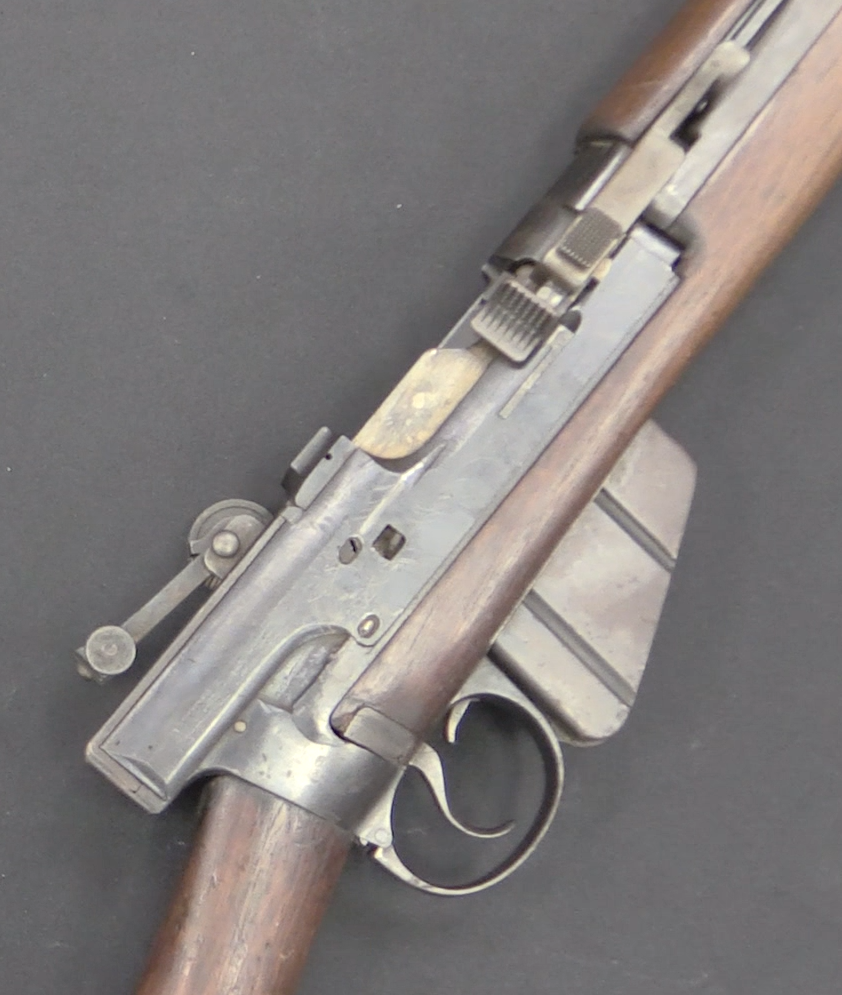
Russell Turner was a Pennsylvania gunsmith and inventor who developed this semiautomatic conversion of an SMLE bolt action rifle circa 1940. It was intended for trial and potential sale to the Canadian military, as it […]
Prototype
Yes, the AR-14 is a Real Gun…Sort Of
The AR-14 was the subject of a widely-seen political gaffe a while back – but what was the real AR-14? Because yes, there was one! It was one of many firearms planned by Armalite, but […]
Bayonet fencing was quite popular in communist countries in 1950′ – 1960′. The target area was the whole body minus the hands, forearms, feet and lower legs (elbow excluded, knee included, if I remember). Thrusts only. No hits with the butt. The rules resemble foil rather than epee – whomever was attacking, had a priority in a case of a double touch, then riposting had a priority over a renewed attack, etc. Obviously non-electric, so five referees per a fighting pair.
I remember these “fencing rifles” still lingering in my fencing club armoury in 1980′ and 1990′, in a dark corner with forgotten and antiquated stuff. They vaguely resembled Mosins; the bayonets came in two varieties – made from a broken (or cut) foil blades and more stiff ones, bespoke, mounted on a spring.
I am not quite sure why this sport dwindled into oblivion. Apparently, they are still some enthusiasts in Europe. I even helped one Dutch guy to buy one of of our old rifles.
As for the presented piece, I wonder how baleen used to break?
All fencing blades break sooner or later, but it makes a very big difference between these which break blunt and these which break sharp, occasionally – and mostly unintentionally – wounding or even killing an opponent.
Salute!
It’s a limited sample, but I ran into an ancient corset back when I was a kid, and it had been bent hard enough by something that when I went to pick it up, the stays were basically broken. About the best way to describe the result was “It was like a broken fiberglass fishing rod” with fibrous matter keeping the pieces together. I actually thought it was fiberglass, and when I asked someone what the hell they were doing with fiberglass back in the day, I was told “baleen”.
So, it would break, but there’s a fibrous consistency to it that kinda keeps it together? I imagine that different types of baleen at different ages would behave differently…
Exactly what I wondered. I knew a guy who took a hellacious wound wearing shorts when the cheap plastic stool he was sitting on broke, and he fell narrowly missing his femoral artery. Even a ‘flexible’ piece of baleen serms like it could get nasty
I owned a pair of early Lee Enfield fencing muskets long ago (Sold when the kid arrived)
that had a spring loaded steel rod protruding from the barrel with a steel button on the end.
I often wondered where the young men who practiced with these ended up and whether the training was of any actual use in combat other than instilling “The spirit of the Bayonet”.
LTC Anthony Herbert’s autobio ‘Soldier’ berues the lack of bayonet training and its effect on the U.S. Army in Korea. But Herbert has come in for criticism as to veracity over the years re: other issues. Still his basic point seems sound. The PLA trained in and used bayonets against UN troops that were not so well schooled or ready. To really address the issue one would need to check medical records of wound types
To really address the issue one would need to check medical records of wound types
Uhm… Yeah. About that.
I’ve said this before, and I’ll say it again: Medical records aren’t going to give you anything at all like an accurate picture regarding “bayonet lethality”. Or, much of anything else, really.
The issue lays in the nature of the bayonet: If you’re going to get one through your guts, odds are you’re only going to be seen by Graves Registration, and since they’re not exactly doing forensics work out there in the field, if you are a victim of bayonetting…? Do the math. The numbers aren’t going to get captured in the numbers of wounds going back to the Aid Station.
I would point out that the PLA was not a “firepower”-based force. They relied on the bayonet, the grenade, and getting up close and personal with the enemy. This worked for them. The US forces that allowed them to do this? Either unlucky or incompetent. Possibly both…
My take on the bayonet is that it’s mostly a morale weapon, and if you’re going to rely on it as a primary tactical tool, you’d better either be vastly better at infiltration or outnumber your opponents considerably. If not, you’re going to die in really large numbers.
Which, if you look at it a certain way, was pretty much what the Chinese PLA wanted to happen. A huge number of the Chinese soldiers killed in the Korean War were former Nationalist Chinese who were deliberately and with malice aforethought fed into that war with the bare minimum of weapons, with the intent of getting rid of them in order to enhance CCP security.
If you’re in a bayonet fight, in today’s world? You screwed the pooch, and will pay the price. If you choose to deliberately use the bayonet, well… You’re suicidal, and I hope your subordinates have the means of tranquilizing and restraining your silly ass until they can get you off the battlefield.
OK. Should have mentioned graves registration too. My omission. In any case, events back when in Korea seem to have been a definite outlier conflict as you point out. One does not see human waves of Russkie muzhiks parrying and thrusting their Ukranian foe while drones overhead livestream the action. Far from it
… Ian’s story was about a fencing implement.
I doubt whether bayonet fencing was really meant to be a preparatory drill to the “real thing”, at least in the minds of those who actually practiced it and invented this most interesting bit of kit. Like sport sabre or epee (or even more – kendo) – it was just a sport manifesting a rather weak and fairly remote link to the martial activity it sprouted from.
The complex rules of sport bayonet fencing were plainly idiotic with regard to the skills needed to fight for life in the WW1 or Balkan Wars reality. The sport was very strongly conventionalised, promoting actions which would be completely irrational (would you really aim at somebody’s thigh, even if severing the femoral artery is sub-rapidly lethal?…). And prohibiting very rational ones, like hitting with the buttstock or slashing with a bayonet if the distance has got shortened.
The skills involved in this sport would be highly superfluous ona a battlefield. I cannot comment on the art of bayonet, but – having practiced sword fencing for nearly 50 years – I know almost everything about this sport and – from reliable sources – I know something about how “fencing” was taught in the Polish pre-war cavalry (I am old enough to had a privilege to listen to the Old Blokes Who Were There). They had three types of cuts, one thrust and no parries. This is how the privates and NCOs have been instructed. Compare this to the current sport sabre refinement.
Bayonet fencing existed, because a group of people had a lot of fun practicing it. And somehow they managed – at least for a while – to convince a bunch of geriatric and demented commie Blimps (who were deciding where resources would go) that it was an excellent preparatory sport to increase the marital prowess of the Warsaw Pact. Which it was not.
🙂
Funny story, but rats can’t digest baleen or ay other sort of keratin- like hair for example. It passes right through.
Actually there is a fair amount of data on on bayonet wounds in the Civil War.
It’s been a while since I looked at it, but IIRC those reported seemed to be about equally divided between enemy action versus disputes in camp among “friendly” forces and accidental wounding.
Wiki describes these amazing books:
“The Medical and Surgical History of the War of the Rebellion, 1861–65 (the MSHWR) was a United States Government Printing Office publication consisting of six volumes, issued between 1870 and 1888 and “prepared Under the Direction of Surgeon General United States Army, Joseph K. Barnes”. The History was divided into three parts, each consisting of a medical history volume and a surgical history volume. The works detail tens of thousands of surgical cases and diseases occurring during the Civil War.”