Check out Headstamp Publishing’s extensive catalog of excellent books:
https://www.headstamppublishing.com/home-forgotten
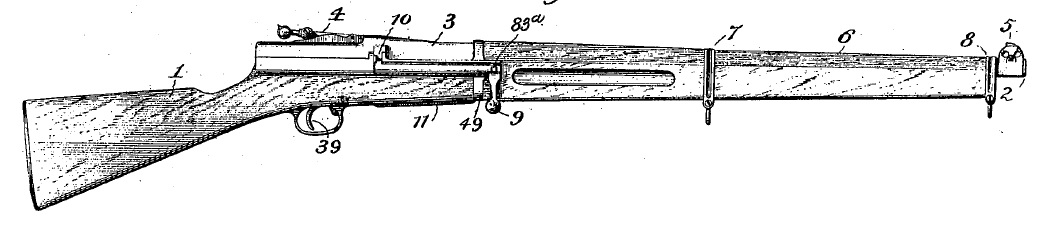
The name “tanker” has been applied to shortened M1 Garand rifles for a long time and today we are looking at one of the rifle that was the genesis of that concept. It actually has nothing to do with tanks; the idea for a shortened M1 came from the Pacific Warfare Board of the US Army, looking for a handier weapon for jungle fighting. During 1944 when this idea was proposed, Springfield Arsenal was already independently working on the M1E5, a very similar paratrooper version of the M1. The PWB ordered the 6th Infantry Division in the Philippines to make 150 samples for testing, of which two were sent back to Springfield for testing.
In testing, the T26 showed the same problems as the M1E5 – excessive recoil, noise, and concussion. Despite this, 15,000 were recommended for production in the summer of 1945, but the war ended before any production actually took place. The name “tanker” came later, when companies started making cut-down Garands for commercial sale and thought that marketing them as specialized tanker weapons would help them sell.
Thanks to the Springfield Armory National Historic Site for giving me access to this truly unique specimen from their reference collection to film for you! Don’t miss the chance to visit the museum there if you have a day free in Springfield, Massachusetts:
https://www.nps.gov/spar/index.htm
It is odd that the USA had a perfectly good carbine, but then opted to mess around with this impractical monstrosity. Did they have a bit too much time on their hands at the Ordnance Board?
Great Point. Jungle fighting means closer engagement ranges. Add to that the 15 round mag vs 8 round enbloc, and your point is a very good one.
Dunlap addressed the “Tanker M1” in Ordnance Went Up Front.
The Garand did not react well to jungle conditions, not least due to its corrosive-primed ammunition. Rust buildup was rapid, often literally destroying the gas piston head assembly. Similar problems plagued the BAR and the British Bren and Besal MGs.
Dunlap stated that with its shorter stroke gas piston assembly, the “Tanker” would likely have even greater difficulties in coping with high heat and humidity. In other words, it would be a very bad choice for “jungle fighting”.
Two decades later, the failure of the M14’s similarly-shortened gas system in Vietnam bore out the analysis.
clear ether
eon
“(…)British(…)Besal MGs.(…)”
Wait. Are you claiming https://www.forgottenweapons.com/besal-britains-emergency-simplified-light-machine-gun/ was actually used in combat conditions?
Yes, ones made in India were used by the Indian Army.
cheers
eon
Were there any made in India? First time I hear
@eon…
I gotta see the citation on that.
So far as I’m aware, the Indian Army used the Vickers-Berthier and BREN, while the BESAL never got into any production whatsoever. It was validated for such, but no actual examples were ever issued to anyone.
Kirk:
That is my understanding. The Besal was a sort of Sten version of the Bren gun, to be made if ever Enfield was bombed out. Since that never happened, it never went into production.
Looks like the US Army NEVER learned a freaking thing about jungle brawling. You cannot ask that “every man be a perfect shot” if all your rifles are rusted and your opponents are within bad breath range, disguised as underbrush.
Overall, this represents yet another horror we were saved from by the nuking of Hiroshima and Nagasaki…
Friend of mine had one of those “Tanker Garands”, and it was everything bad about the Garand cubed. I think it ran well for a couple of boxes of ammo, then started demonstrating “issues” he never resolved. Probably still in his gunsafe, TBH.
One of these days it would be nice to see one of those “Vulcan” rifles built on an M1 Carbine receiver … a pump ation to boot!