
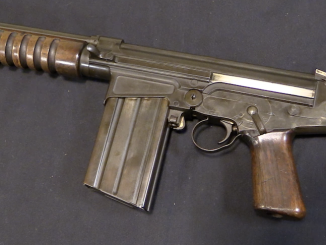
Venezuela was one of the early adopters of the FAL rifle. They purchased two of the initial FN prototypes, and made the decision to purchase it in quantity in 1955, with an initial order of 5,000 rifles. Venezuela had previously bought FN49 rifles in 7mm Mauser, and wanted to retain the 7mm bore diameter to simplify ammunition production. At this time, FN was offering the FAL in both 7.62x51mm and also a cartridge called 7mm Optimum 2, or 7mm Liviano. This is basically the American T65 case paired with the 7mm Mauser projectile, and it required only a different barrel to use in the FAL (the bolt and magazine are identical to 7.62mm). Venezuela was the one and only country to adopt the FAL in this caliber.
Within a few years, the caliber decision was changed, and later Venezuelan purchases were chambered for 7.62mm NATO. A batch of new barrels was bought, and the guns in Venezuelan inventory were rebarreled for 7.62mm. This example from the Ars Mechanica collection is still in 7mm, and also includes other very early Venezuelan features including the unique flash hider and rotary rear sight (which was used only by Venezuela and Paraguay). Many thanks to the Ars Mechanica Foundation for giving me access to this unique rifle to film for you!

Huge fan of the FAL and the 7mm. Seems like the perfect combination.
Sad it went to 7.62
“(…)American T65 case paired with the 7mm Mauser projectile(…)”
https://www.cartridgecollector.net/cartridge/7-x-49-second-optimum-liviano/
Wait… this sounds like wildcat. Whilst usage of such cartridges is common for hunting it seems odd for general service rifle. Did similar solution (creating new cartridge for general service rifle from components of different existing cartridges) was used anywhere else?
Consider all the cartridges made from the .30 Remington case. Also the .41 Action Express was made to use .41 Magnum bullets. It came too late to be adopted, but the 8mm Ribeyrolles. was a .451 WSL neked down to accomodate a 8mm “Balle D” bullet.
Watching this video was eye-opening.
I’ve handled 7mm Liviano before, or what I was told was 7mm Liviano. Whatever th hell it was, I am now dubious of the proposition that it was, indeed, 7mm Liviano. What that cartridge collector showed me and let me handle was not something you could have done a caliber conversion to 7.62 NATO with simply by changing the barrel, so I’m now having to reconcile what I thought I knew with reality.
I hadn’t connected the contradictions of “barrel conversion” and the cartridge I thought I knew as 7mm Liviano. The cartridges I handled were true intermediate cartridges, kinda short and fat. They weren’t necked-down T-65 cases, in other words. What I was told was 7mm Liviano must have been something else, because the cases themselves were between about 40-45mm in length, and fatter around than 7.62 NATO by a millimeter or two. Number-code headstamps were the only other distinguishing marks.
Leads me to wonder what the hell he had that he’d mistaken for Liviano, because everything else he showed me was spot-on and accurate.
Alternatively, I may have conflated some things in my memory, because what I thought was 7mm Liviano would have required the Venezuelans to basically replace most of the rifles they’d bought, rather than just the barrels.
Which is something I never really connected until this video of Ian’s. I also have to wonder about the guy who told me he’d fired this rifle while in Venezuelan service, because what I remember him telling me about the experience is much different than what Ian shows us.
Up until this, I’d thought the Venezuelan cartridge and rifle were basically the FAL in .280 British, much closer to true intermediate cartridge examples. I’m now left reconsidering what I thought I knew.
My impression is that the “real” 7mm Liviano is a lot like the sporting 7mm-08 Remington. Which translates to “Yet Another 7 x 57mm Mauser Clone”.
Which brings us back to the basic question; Is 7 x 57mm Mauser the “ideal” military rifle cartridge? Or is it something better used only in the GPMG?
Would an actual 7mm intermediate cartridge (say a 7mm version of Frank Barnes’ 1960s-vintage .30 Kurz or .308 x 1.5″ wildcat) be a better choice for the IW?
For that matter, what about the 6.5 x 45mm derived from .223 Remington?
I could see a future infantry arms roster consisting of M4-type carbines in 6.5 x 45mm, with GPMGs in 7mm-08, and backed up by HMGs in .408 Cheytac (10.3 x 77mm). If nothing else, it would eliminate errors in loading, not to mention the whole “reduced-charge” BS.
A Vulcan in .408 might make a highly-practical helicopter gun. Assuming that we still have helicopters ten years from now, which I have a sneaking suspicion we might not. (Anti-drone ROWP on top of whatever passes for an MBT in 2040?)
Or maybe we get lucky and get frickin’ lasers.
We can hope.
(Come on, Trekkies, show your stuff.)
clear ether
eon
“(…)frickin’ lasers(…)”
If this is adjective from Fritz then this is possible, see https://www.aerotime.aero/articles/germany-mbda-airborne-laser-weapon-demonstrator though this is still described as demonstrator
“(…)6.5 x 45mm derived from .223 Remington?(…)”
Observe that https://www.thefirearmblog.com/blog/2024/01/10/new-russian-6-02×41-cartridge-and-prototype-rifles-ak-22-mini-svch/ is different case than 5,45×39 mm.
I think I know why we both enjoy science fiction, eon.
Rational firearms development choices would only happen in that realm. In the real world, it’s all irrationality, all the time.
SF writers make a lot of assumptions. My favorite is the “plasma beam” weapon. One of the characters in my own stories (think Marvel’s Thundra but she’s a weapons genius) points out that a plasma “beam” discharge would be a lot like having a nuclear Bangalore torpedo; with you putting one end up against the target while you held on to the other end while pushing the button. Not optimal. Plasma weapons should fire pulses, not a steady beam, to avoid frying the operator.
Yes, the “Phasers” in the original Star Trek were where I came to that conclusion once I’d crunched the numbers- at age nine. I notice in the rebooted version they now fire pulses, not a steady beam. I guess somebody finally cracked a book on high-energy physics.
I’ve noticed that Japanese anime’ can get very weird in the weapon department, especially where small arms are concerned. Like the android-destroying gun in Galaxy Express 999; it’s a modified Colt Dragoon. (?)
Project A-Ko in all its iterations has weaponry that could charitably be defined as “Crazier than anything Wile E. Coyote ever bought from Acme”.
The whole Ghost in the Shell opus does tend to get things right. Such as the inadvisability of firing 9mm +P+ in a Mac-10. And of course Togusa with his Mateba .357 Magnum automatic revolver. (Did they really make those in .357? All the ones I’ve seen were .44s.)
When you get into the more “realistic” giant robot stories, where the “robots” are basically just another variety of MBT (think Fang of the Sun Dougram or Xabungle), however advanced the robot’s weapons are, their pilots are probably packing something we’d use today. In Xabungle, for instance, pilots’ sidearms range from Colt M1911A1s, to S&W M29s, to P.08 9mms, to at least one Mauser 712 Schnellfeuer. (Did they do their procurement through Rock Island Auction?)
I still think Larry Niven got it right in the February 1966 issue of “Worlds of If” in “The Warriors”, the very first Known Space story and the first to introduce the Kzin. The Kzinti Lesson; A reaction drive is a weapon deadly in exact proportion to its efficiency as a drive. The Angel’s Pencil had a “photon drive”; another term for which is “Really Big Effing Laser Cannon”. Niven noted that when the Kzin reached the Sol System, they were (briefly) surprised when the supposedly pacifist humans opened fire on them with “launching lasers” in the Asteroid Belt, built to get Bussard ramjet fusion “torchships” up to ram velocity (about .45 c). Then those “torchships” went to work on the Kzin with their “reaction drives”. Ouch.
Yes, when I watched Apollo 11 lift off from the Cape three years later, my perception of those five F1 liquid-fuel engines shoving 3,500 tons of spacecraft upwards was a little different. I understood why the launch pad’s flame bucket and blast suppressors had to be built the way they were;they had to survive a barely sub-nuclear blast effect.
H.Beam Piper probably had the right of it. In Space Viking, the ships are protected by collapsed-nickel armor, and whale on each other with autocannon (that sound suspiciously like a development of the M51 75mm Skysweeper), and their heavy punch consists of TV-guided missiles with Bethe solar-phoenix reaction thermonuclear warheads Subtract that last bit, and he was describing pretty much what we and the Germans were just starting to field at V-E Day.
And Piper had people carrying 10mm automatic pistols twenty years before the .40 G&A and the “Bren Ten”.
SF writers make assumptions. Sometimes they’re smarter about it than Ordnance is.
cheers
eon
Part of the problem with the whole “ripped from the pages” thing we’re presuming is that you can only go so far with your projections and extrapolations before you’re running into “Yeah, but what if…?” issues of the usual out-of-context discovery or development.
Were you anyone on this planet before the advent of gunpowder, and someone asked you to think about weapons, what would they have come up with? Purely muscle-powered devices or stored-energy in the form of bowstaves or torsion assemblies. Chemical propellant weapons? Nope; not in the entire scheme of things foreseen anywhere.
I once did a deep scrape, looking for airguns before gunpowder. Could not find a single example, anywhere… Apparently, before the idea of an airgun with stored or mechanically-compressed air could be conceived of, you needed something like a firearm as an intermediate step.
So, whatever they’re going to be using “after guns” is going to be something we are not able to really project, because we simply don’t have the context yet. You can say in generic terms “energy weapon”, but how the hell would that work? The plasma lance sort of affair that you’d produce with most particle beam weapons really lacks the range you’d need to be practical because we don’t have the means of containing the beam, nor do we have any way of creating some sort of energy containment field that collapses at just the right moment in just the right way to achieve an effective release of an energetic plasma particle field.
Whatever enables that sort of thing to work, the science simply isn’t there as of yet. Which means that speculation is almost useless, except in the most general terms.
Of course, once the essential insight is made, the whole thing will look childishly simple to everyone who comes after.
I’m still of the opinion that the firearm will be with us for a long time to come, and probably still in a cartridge-based format. It just works too damn well to really be supplanted easily, and it’s simple enough that I suspect the format will still be in use in the far future.
@ Kirk;
There was one kinda-sorta-pre-gunpowder “air gun” setup. During the post-Ptolemy Roman rule of Egypt, the legions found that the skeins that powered their “scorpions” (late mostly-bronze ballistas) didn’t last long in the dry, hot local climate.
Since they still had the Alexandrian Library to refer to at that point, they went back to the two basic books on air pressure, Hero’s Pneumatics (c. 70 AD) and Philo of Byzantium’s Pneumatica (c. 200 BC).
They replaced the skeins with bronze syringe tubes with waxed leather gaskets on the plungers, which were connected to the “arms” of the scorpions.
Winding the arms back with the usual attached windlass at the rear end pushed to syringe plungers in, compressing the air in each tube to about three atmospheres (50 PSI or so).
When released, the syringes shoved back and snapped the arms forward with enough force to throw a dart about 100 Roman “paces” (about 150 meters).
Keep in mind that a scorpion “dart” was about four feet long, weighed about ten pounds, and had and “arrow head” about the size and weight of that on a sarissa.
This version was apparently not seen too often outside of “Khem” simply because it was expensive to build and a major PITA to maintain.
Still, it has to be classed as at least an early attempt at an “air gun”, and one that worked very like the one Col. Sebastian Moran used, at that.
cheers
eon
“(…)Mateba .357 Magnum automatic revolver. (Did they really make those in .357?(…)”
Yes, see https://www.youtube.com/watch?v=ZjTEHwzh2dI
@eon,
Now that I am reminded, I do remember about those “air spring” Roman catapults. I chose not to consider those as “air gun” because they were basically just substitue standard for the torsion assemblies or bowstaves, and did not actually act directly on a projectile.
Thinking about it, if those had gone further, with better materials? They might well have eventually evolved into an actual thing I’d consider gun-like, namely a directly-propelled projectile launched by the device.
I probably should have defined my terms, better.
In any event, the “air-sprung” torsion ballista didn’t go anywhere. Might not have been able to, but maybe someone would have found it again, and then gone on to extrapolate using the stored air pressure to act directly on the projectile, cutting out the middleman of the mechanical arms to provide actuation.
Maybe. You pause to consider the world without gunpowder, and then a couple of things like this come to mind. Another one being “steam powered gun” wherein you have a means of rapidly converting a bit of water into steam through some means, rapid heating or otherwise. You could posit something like a steam matchlock, where you had something that stayed hot enough to flash-boil water, a chamber lined with it, and then a metered amount of water being introduced into said chamber behind a projectile… Possibly a non-water liquid propellant that would convert to steam more quickly?
Possible path, there. Maybe.
@eon, yet again…
It occurs to me that we’re being rather impolite to Ian, here, with all of our extraneous off-topics.
I wonder, should we ask Ian to connect us via email, and go direct such that we’re no longer creating these comment threads from hell?
@Kirk: Ktesibios of Alexandria c.300 B.C. allegedly developed a compressed air catapult. But, like Archimedes’ ‘steam engine’, the idea does not seem to have caught on.I have not been able to get any details as to how the catapult actually used the compressed air. I am guessing that sealing the air reservoirs would have been one big problem for pre-industrial manufacture
That’d be one I missed…
I don’t get much on a search; do you have a cite for that?
I wonder how such a thing could have been implemented. Skin bladders, maybe?
Classical sources include Athenaeus and Vitrivius. (The inventor’s name is also trabskirerared with an initial ‘C’ instead of ‘K’). http://www.aquinicum.hu, a nuseum in Budapest has an article in English. I don’t know if the museum has more. When I was there I was on an Evola jag and was scouting stuff about Mithras. Budapest was a major Roman outpost. Apparently our inventor was active there. The article suggests the catapult used a piston, but has no diagram as to how this worked. It does have drawings of a water pump Ktesibios invented. I recall when I was a kid a frirnd’s father was an isolated rancher not given to spending money on anything save cattle and vodka. He did a fine job repairing a Benjamin air rifle using heavily greased leather for worn out rubber seals. I don’t know that that’d work for catapult-level air pressure
‘transcribed,’ not the gibberish I wrote. See what happens when you disable auto-correct
@Martin,
You’re absolutely correct, here. The issue is that when I went to look for “pre-gun guns”, I didn’t really consider these as precursors due to the way they basically just substituted for the torsion or bowstave elements to the ballista.
I’d forgotten about them entirely, in that aspect, and when you said “catapult”, I’m suddenly trying to imagine a medieval onager rather than a Roman ballista, thinking “OK, maybe if you winched the launching arm down into a bunch of air-filled skins and then let the arm go, that was something they were doing…?”
I suppose my mind is channelized; had you said “ballista”, I think I’d have remembered the Roman deal a lot better, because I’d cataloged that differently in my memory.
As I commented to eon over the same information, I’m not sure that these ideas really qualify as “guns before guns”, simply because they don’t act directly on the projectile. If there’s an intermediary mechanical bit, as there is in the Roman ballista-cum-piston affair, then that’s not quite meeting my definition of “gun”, which I’d be describing as “Projectile acted directly upon”, rather than using the air pressure/chemical reaction result to do the work through other means.
I mean, if you were to work at it, you could probably come up with a one-shot means of loading those ballista levers through a piston where the pressure was developed by chemical reaction. That’d rely on the chemistry of gunpowder, but would still not be a “gun”, to my mind and definition.
Although, the sudden idea occurs to me that you could have had steam-powered ballistas using this overall technique, if you had a means to develop high-pressure steam and deliver it in a consistent manner to the pistons…
I was thinking that when I checked it out. Compressed air is used but it isn’t the actual propellant apparently. That would have been the big leap from catapult or ballista to air gun
Greek fire was delivered from tubes using air. But I think the Byzantines are said to have used bellows, not conpressed air. This does not count as a projectile weapon, though.
@Martin,
The list of things we don’t know about “Greek Fire” is actually sort of frightening in implication. The level of security they applied to it, and the fact we still don’t know much about it? How the hell did they manage that, when we couldn’t keep atomic weapons out of the hands of our enemies?
One of the things I’ve always wondered about “Greek Fire” is if there wasn’t a way to harness the fire itself to deploy it. If you had a plate between the main “charge” of the flammable substance, one that sealed fairly well, and then you had a bit of the stuff in the second chamber created by that plate, and ignited it…?
Sort of a platter-charge affair, if you get what I’m trying to describe. You could probably do it with one-shot disposable tubes, made of something like clay-lined wood.
No idea how much range you would get out of the things. I guarantee you that it’d put the fear of God into anyone boarding you, though.
It’s always been a wonder to me how the Age of Sail types had fire ships and all the rest of the ancient panoply of sea arms, but no Greek Fire was ever attempted. I mean, OK: Imagine Master and Commander, but when the French come up to go mano y mano, the siphon tubes come out and douse the ship with Greek Fire.
Bit of a problem if they’d ever managed to get thoroughly grappled onto you, though…
The Youtuber “Drachinifel” has a good video on Greek Fire, where he even tried various recipes himself. To summarize, it was basically medieval napalm: something very sticky mixed with something very flammable.
@Kirk: I think I get your notion. In my youth I worked at a diner one summer. I recall what happened to hot grease when the roof sprang a sudden leak. I wonder if one squirted water into a chamber of ignited Greek fire whether you could not get a directed splatter effect out of using a tube. The level of secrecy thing is a surprise too. The Byzantine Empire was knowing for being, er, ‘byzantine?’ Intrigues within intrigues enough to make,say, China’s ‘Three Kingdoms’ classic read like a Mennonite Sunday school manual. How to keep the one needful secret secret?
The secrecy of Greek Fire has always struck me as being “one of those things” in history that’s not really congruent with a bunch of other historical facts.
On the one hand, how many “great secrets” actually stayed secret? Bunch of “failed secrecy” things come to mind, as well as a bunch that sure as hell managed the feat.
There’s also the “We just kinda forgot…” thing, as we’ve seen demonstrated recently by the “Fogbank Problem” when they went to refresh the nukes.
My guess is that there was also a bit of the Republic of South Africa approach to nuclear weapons handover to the successor regime. The Byzantines no doubt decided that it would be a really good idea to keep Greek Fire on the side of the Greeks…
All in all, I’d still love to know all the messy little details lost to history. I’m sure there are tons of stories hidden in the background, fascinating ones.
One of the myths about “Greek Fire” was that the Chinese had it. They didn’t. What they called “fierce fire oil” was actually low-octane kerosene, courtesy of their deep-well brine drilling operations, notably in Szechwan Province going back to around the 4th Century AD.
Used in their flamethrowers (based on the double-acting piston bellows also used in kitchens and smithies), the “fierce fire oil” was not self-igniting on contact with air or water, which Greek Fire definitely was. It required a lit fuse or “punk” at the orifice to ignite it. (This was apparently the first use of low-KNO3-percentage “deflagrative” black powder in military applications.)
By the time the Chinese, or rather the Mongols, learned about “Greek Fire’s” existence in the west (about the time the Polos came to Kathmandu to work for Qubulai Khan), they already had high-KNO3-content black powder (basically the modern 75% saltpeter, 15% charcoal, 10% sulfur mix) and had no particular interest in “old-fashioned” incendiaries.
When European traders brought samples of and the formula for perfected black powder west via the Silk Route about the same time, it was a different story in Europe. As was graphically demonstrated in the Hundred Years’ War.
cheers
eon
durant la guerre des 6 jours des soldats israeliens etaient armes d’un fal a l’apparence identique au model venesuelien de quel type s’agissait il avec le meme garde main en bois