
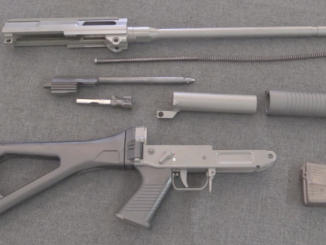
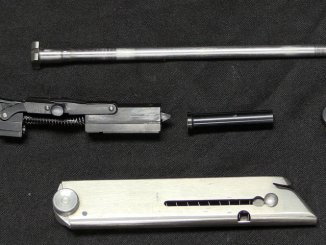
Hans Stamm developed a series of firearms in Switzerland in the early 1900s, and today we are looking at a Model 1916 light machine gun. This was developed while Stamm was working for the Saurer company, where he headed its small arms division. Stamm’s prior straight pull manual rifle and long-recoil semiautomatic rifles had failed to win any commercial or military interest, and so in his last major design he turn to yet another new action type: long recoil. He developed a water-cooled light machine gun in 1915, and then two air-cooled models in 1916. The final of 5 examples made was a double-barreled air-cooled example, tested by the Swiss military. Unfortunately, no good data survives on Swiss testing of the guns, but they were not acquired by the military.
Previous Stamm designs:
1902 Gas-Operated Semiauto: https://youtu.be/LFJJBu4a5Lo
1907 Straight-Pull: https://youtu.be/gc8k4uv1gMk
1913 Long Recoil: https://youtu.be/TiNctGUk1KI
Many thanks to the Swiss Shooting Museum in Bern for giving me access to these two very rare rifles to film for you! The museum is free to the public, and definitely worth visiting if you are in Bern – although it is closed for renovation until autumn 2025:
https://www.schuetzenmuseum.ch/en/

What I find as curious is that so many times Ian talks about a firearm designer that goes from company to company, without producing a commercially viable design. How did they keep getting jobs after all the failures? Were they really paid to sit around for years and years, tinkering with a design, but never coming up with an actual product?
Most such “itinerant” gun designers were like Herr Stamm, being hired by companies whose main business was not firearms.
Before WW1, pretty much every major manufacturer of anything in Europe wanted to get into the armaments business, because there was a lot of potential in the export side; see Mauser’s “presence” in China after the Boxer Rebellion.
Saurer was a manufacturer of heavy trucks and before that, steam locomotives. They wanted to get into the arms business not just for export, but because by 1910 pretty much everybody knew that there was going to be a war in Europe at about the Napoleonic level. To the would-be munitions makers, that equaled profit.
And as Jimmy Durante used to say, everybody wanted to get in on the act.
clear ether
eon
Then there’s the fact that firearms design ain’t exactly a defined field, here in the West. The old Soviet Union was about the only place where I think they formalized the whole thing into an academized discipline.
Most gun designers are about like George Kelgren or Tony Neophytou: They’re unique talents, they don’t grow on trees, and since they’re mostly self-taught? You want a company producing guns, you’d better get off your ass, find one of these guys, and then make them happy.
That’s precisely what Fairchild Aircraft did with Eugene Stoner and his co-developers. It works, as you can plainly see.
David “Carbine” Williams was another one of these self-taught types, one who unfortunately did not fall into sponsorship with anyone until late in life, after having mucked things up for himself along the way. Winchester used him, and his work went on into a bunch of other designs. You have to wonder what the firearms world would have looked like, had someone like John M. Browning set up a mentorship/academic institution to help others along. Nobody here in the West ever did anything like that, and we’re poorer because of it.
You run into these guys like Hans Stamm, and you have to give them the benefit of the doubt. Sometimes, they’re a bit cranky and obsessive, like his contemporary Adolf Furrer, with his toggle-lock obsession. That’s fine, so long as you don’t let the mania get control…
One of the great unsung designers was John Foote, who started out designing and building revolvers in high school.
Today of course that would get him red-flagged and put under a psychiatric hold.
One reason the West is losing its tech base is that everybody wants to design websites, rather than anything in the real world.
The future may belong to the “influencers”, who will sit on a stool in front of a webcam babbling incoherently for hours on end.
Not exactly the oracle of Delphi. At least she managed to make sense every now and then.
clear ether
eon
Meh.
It’ll go on until it can’t, then it will morph into something unpredictable from the now, and entirely inevitable in the nascent future.
I’m of the opinion that a lot of what we’re going through at the moment is one of those seemingly-interminable consolidation phases in terms of historical technological development.
With regards to firearms, you go back and look at it all, there were periods of incredibly rapid development, punctuated by periods of utter stasis. How long did the Brits issue the Brown Bess, for example…?
It’s like that with everything. We’re sitting here in the middle of one of those periods of digestion, while all the major implications of previously-developed and disseminated tech are worked out. Consider the computer, as an example: Just like the printing press, you had the same sort of wildly optimistic uptake, the dissemination phase where everyone was using it to do “alarming things”, and… Yeah. If you go back and look at the panic surrounding the loss of control over information after the printing press came along, you’d recognize everything going on today. History rarely repeats itself exactly, but the miserable bitch does like to rhyme…
I think the frivolity is a bit of a reaction to it all; no doubt, people were horrified about the rise of diarists and novelists, back in the day, just as we are about Tik-Tok and all the rest of the “social media”. We’ll get through it.
The thing I find interesting is the “lost productivity” everyone discusses surrounding computers becoming ubiquitous. Everyone, every “authority” thought that the advent of the personal computer would exponentially increase productivity. That never happened, and everyone wants to know why…
Well, I do. If you lived through it, as I did, it’s blindingly obvious. When I enlisted in the Army back during the early 1980s, the Army was still on the “mimeograph standard”. Everything we did, paperwork-wise, was done on typewriters and mimeograph stencils. We had photocopiers, but those were just more expensive mimeograph machines…
That era of the Army necessitated a certain insouciant outlook towards things like scheduling; it simply was not possible, for example, to administer training schedules down to every last 15-minute block. You had very simple training schedule templates… It was either “Sergeant’s Time”, “Platoon Leader Time”, or “Company Commander Time”. Occasionally, you’d see things like events the Battalion Commander scheduled, but those were rare.
The one guy in the unit that could correct mimeograph masters was a veritable junior enlisted god; he could do no wrong, for fear that the company might lose his services, ‘cos if you pissed him off, the grapevine would get the word, and some other unit, likely a much higher echelon one, would snaffle him up.
Then, in came the computer. All of a sudden, changes to the schedules became doable. Too easily doable. Higher could demand more information, for what unknown pointless purpose nobody knew. You went from having time to wander around and actually do your job, coaching, teaching, and mentoring your subordinates to spending endless hours in the office, answering equally endless amounts of correspondence that really had no point and even less impact.
All that productivity increase? Vanished into the night and fog of higher authority exercising said authority to make more BS busywork that justified their existence. The development of “woke culture” was a totally non-accidental outcome of that environment, because now that they could inundate junior leadership with inanity, they did it. Again, exercising totally pointless control.
Advent of the computer actually did great damage to the old Army culture. Where before, they had to “power down” for the junior leadership (couldn’t do anything else, because of the control systems), they suddenly had the capability to effectively mass all the control up higher. Ironically, while they might have had a point to doing that back during the days of the post-Vietnam VOLAR Army, the period where they implemented that idiocy was seeing a huge upturn in the quality of the available personnel. Who they promptly alienated by treating them like idiots, and trying to control every aspect of their lives.
In short, I give it a few decades and we’ll figure it out. Either that, or we’ll be buried under a mass of pointless BS paperwork that chokes out our entire civilization…
@ Kirk;
The Reign of the Musket (first matchlock and then flintlock smoothbore) was the second-longest technological “plateau” in the history of weapon development, lasting from the late 15th to the early 19th Centuries. Only the longbow, in its various iterations, had a longer service life.
The shortest service duration? The percussion muzzle-loading rifle-musket. From its debut in the Crimean War (1853-56) to its apotheosis in the American Civil War (1861-65) its dominance on the battlefield lasted a total of twelve years.
The single-shot breechloader (first combustible cartridge, then separate-primed metallic, and finally internally-primed metallic, rimfire or centerfire) lasted only marginally longer, from about 1856 to 1886, when it was almost completely superseded by repeating rifles, notably bolt-actions.
The self-loading rifle, after several false starts from the 1890s on, finally became the new standard around 1945. And it evolved into the modern Small-Caliber High-Velocity rifle (SCHV) within a decade after that, although the handwriting had been on the wall as early as the 1895 Remington-Lee Navy 6 x 60SRmm and its offspring, the .220 Swift.
The most recent “false starts”? Caseless ammunition and all-polymer structures. The one can’t tolerate the field environment, the other can’t tolerate the stress and heat of firing.
(The designers- and Ordnance- really need to talk to the rocket scientists about those issues. The real rocket scientists, I mean.)
I’m not sure where small-arms design, especially infantry rifle design, is going to go next. If it was me, Combustible Plastic-Cased Telescoped Ammunition (CPCTA) with electric ignition and maybe even a Dardick-style “revolver breech” might be worth looking at, if not necessarily for rifles maybe for aircraft cannon and heavy MGs, or even ROWs for point-blank battlefield “airspace denial”. (Imagine the rate-of-fire for “drone hosing”…)
The one thing I’m pretty sure won’t change much anytime soon is the service pistol. The 1911 has been around for over a century, and it shows no sign of senescence yet.
cheers
eon
“…This is chambered for the Swiss GP11
cartridge and it has a 20 round
magazine. So, you can see the stripper
clip guide up here. Uh fixed flush
magazine doesn’t or a fixed blind
magazine. Doesn’t use a detachable one…”
Did they intended to use one big charger with capacity 20 or smaller ones e.g. with capacity 10? How fast such weapon can be loaded by 2nd person when compared to machine gun with detachable magazine sticking downwards (like kg m/21)? How fast such weapon can be loaded by 2nd person when compared to machine gun with detachable box magazine sticking upwards (like Vickers-Berthier)?
Another point would be that the Swiss used 6-round stripper clips. Why doesn’t the magazine reflect that, being sized for a multiple of six?
I honestly can’t see a fixed magazine like that ever being of any real utility in an actual machinegun situation; filling it with stripper clips just takes too damn long. Trying to imagine the crew drill just makes me laugh, a little hysterically: Can you picture being in the middle of a firefight, and having your panic-stricken Assistant Gunner trying to keep up with you, while loading the gun with stripper clips, six at a time…?
Keystone Kop action, that. But, then again, this was early days and they really didn’t know any better.
13:35 – EEEK! He’s using an Ace Hardware conventional screwdriver on this relic in lieu of hollow ground gunsmith tools.
He should know better, and his hosts should have put the kibosh on that, eh?
Yeah… See, here would be the key thing about museum curators. They’re mostly idiots about technical issues that would leave anyone with actual training and experience in the field of whatever mechanism they’re working with aghast and horrified. I would wager good money that there’s not a single hollow-ground screwdriver in that museum, and that the curators probably don’t know what the hell one is.
It’s only when you get to the really technical museums where they know these things, and you’d be shocked, surprised, and totally dismayed to learn how poorly a lot of museums work on these complex artifacts. Tank restoration? LOL… Don’t even get me started. Some places do it obsessively well, others just slap paint on the exterior and call it good.
I am, myself, horrified to see that commodity-grade screwdriver being used, but I’ll bet you good money that the nearest set of real small arms tools was probably miles away from the museum. And, that the curator probably knows very little about actually working on said small arms; even your average commodity-grade gunsmith probably knows rather more on the subject.
6:47 – EEEK! He’s using an Ace Hardware conventional screwdriver on this relic in lieu of hollow ground gunsmith tools.
He should know better, and his hosts should have put the kibosh on that, eh?
“And by this point the long recoil action isn’t going anywhere…” (A group of Frenchmen after having too much wine), “A long recoil action sounds perfect for a light machine gun!” And the rest is a very “Chauchat” history!
Actually such action find some place in bigger weapons used during WW2, namely
25mm 72-K towed AA gun https://www.militaryfactory.com/armor/detail.php?armor_id=489 was used by Soviet Union for defense of strategic objects
37mm T9 http://navweaps.com/Weapons/WNUS_37mm-56_m4.php was used as armament of U.S. PT boats
40mm Bofors was used as armament of Royal Navy ships
That openwork barrel jacket is interesting. it’s very like the one on the German Parabellum machine gun, the “lightweight” Maxim type developed as a flexible gun for aircraft.
https://smallarmsreview.com/wp-content/uploads/2020/10/017-3.jpg
clear ether
eon
Similar approach was later used in Praga I machine gun, already covered as https://www.forgottenweapons.com/praga-i-a-blow-forward-bullpup-semi-auto-selectable-vickers-gun/