The Danes adopted the M1 Garand after World War Two, and continued using it as their standard service rifle all the way until 1975 – and alongside it they used the M1D as a sniper or DMR rifle. The Danish Home Guard decided to upgrade those M1D rifles in the 1960s, however, and looked to H&K for an answer. In 1966 they adopted a model of the G3 with a 4x Hensoldt optic under the designation m/66. Today I’m at Bear Arms looking at a clone of the m/66 built by Kilo Guns on an original Danish parts kit and original surplus scope…
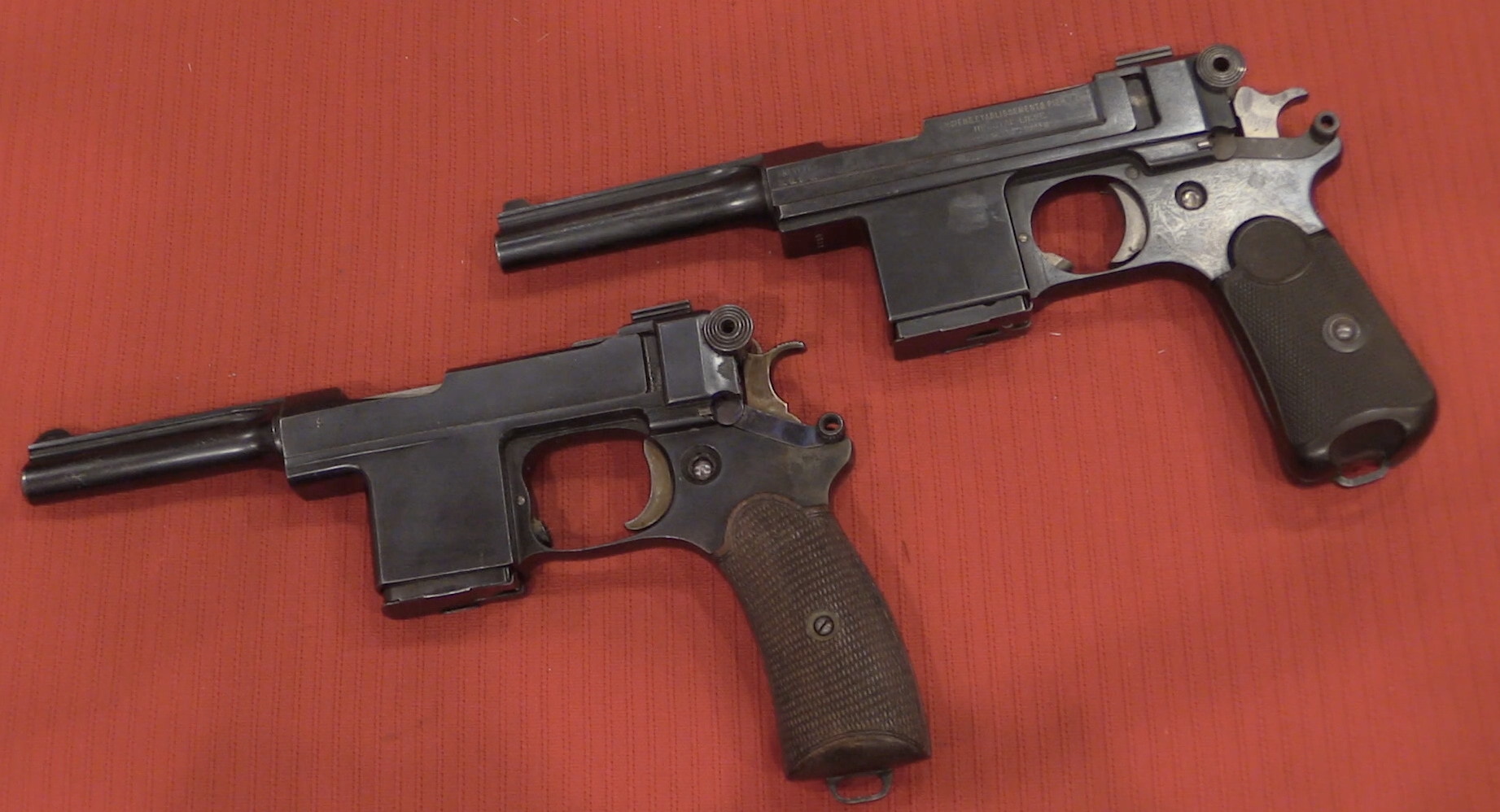
Bergmann
Bergmann 1908, 1910, and 1910/21 Pistols
By the time Bergmann found a production subcontractor in AEP for the Spanish order of 1903 Bergmann pistol, the Spanish had added a few new changes to their order, which became known as the Model […]
Bolt Action Rifles
Schultz & Larsen RPLT-42: Danish Occupation Rifle
When the Danish Coastal Police was formed under German occupation to patrol the Danish shores, they needed rifles. Rather than use valuable military arms, the government turned to the noted sporting and target rifle manufacturer […]
Prototype
Pistols of Denmark’s Artist-Turned-Inventor Bent Agner Nielsen
Bent Agner Nielsen was a Danish tinkerer born in 1925, who studied art as a young man and worked as a painter. In the 1970s he became interested in firearms, beginning with engraving work. This […]
I have a PTR 32. The roller-locked system is interesting if somewhat obsolescent. It has a unique feel as the bolt goes back into battery. Kind of interesting that the “silent bolt closure” was a feature that PTR chose not to incorporate.
That would’ve been nice, for sure. The PTR-32 doesn’t even need the feature as much as a normal full-caliber G3.
I never understood why the Germans didn’t use the serrated carrier on their G3s or the 91s for that matter but did so on the 33s and the 93s as well.
Being Danish, and a former member of the Home Guard, as well as a former ammunition technician with the Danish Army Materiel Command, I found this very interesting.
I have one minor correction, and a bit of supplemental information:
“HTK” is the acronym for “Hærens Tekniske Korps” (“Army Technical Corps”). The HTK didn’t actually become the “Army Materiel Command” (“Hærens Materielkommando” or “HMAK”) until 1967. Both organizations were tasked with the procurement, testing, maintenance and management of army materiel.
Back in the day (shortly after the last Ice Age ended) when I was in the Home Guard, a small number of M66’s had “trickled out” to some of the Home Guard units as standard infantry rifles (sans scope). They were much sought after, due to the fact that they supposedly had a better buffer than the standard infantry rifle, giving them reduced felt recoil. Since the M66’s were rare, I never had the opportunity to actually field strip or shoot one, so I cannot comment on the veracity of this.
Keep up the good work.
Thomas L. NIELSEN
Denmark (currently expat’ed to Luxembourg)
Ah ha! Ian, your research left a gap between the Garands and the HKs as precision rifles. There was a limited number of Italian Garands converted by the Danes to mount an enormous active Infra Red projector and telescope for front line service. Some of those receivers arrived in Canada with the somewhat suspect disposal of Danish war reserve M1s in the 1980s and 90s. Go to the Garand Collectors Association summer 2021 journal for their article on Danish IR bases. Those are truly, forgotten weapons when even the most knowledgeable collective of Garand minds could be surprised.