The Reising series are some of the forgotten weapons the were formally adopted by the US military and used during WWII without getting much attention today, being overshadowed by the Thompson and M3 Grease Gun. The Reising M50 was built by Harrington & Richardson and was adopted by the US Marine Corps, along with the rarer M55 folding stock version. Both were in .45 ACP.
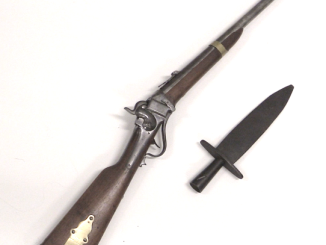
Single Shot Rifles
Beecher’s Bible: A Sharps 1853 from John Brown’s Raid on Harpers Ferry
On October 16, 1859 John Brown and 19 men left the Kennedy farmhouse and made their way a few miles south to the Harpers Ferry Arsenal. They planned to seize the Arsenal and use its […]

Antiques
Why The Most Expensive US Martial Pistol Exploded A Lot
The Colt Model 1847 Walker is one of the most valuable of all US military handguns in the collecting community, with examples sometimes breaking seven figures. However, the Walker was in many ways a remarkable […]
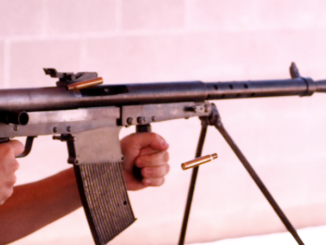
Light MGs
M1918 Chauchat: First Shots (Will It Work?)
This M1918 Chauchat is still awaiting NFA transfer, but my dealer was able to bring it out to a public range where I could do some initial testing on it. I was expecting to get […]
My late father in law told me he carried one of these during WWII as a Marine guard at the US Embassy in NZ. He did not think much of it.
Those Reisings were UGLY devices. Especially the M55s. Unpleasant lines.
Though apparently the M50s may have been halfway decent SMGs.
The reason for non-interchangeable parts in the Reising is because the Marines could not get enough Thompsons for their rapidly expanding forces. So they adopted the Reising. The problem is that they needed the gun yesterday. Because of this urgent need for guns, the Marines specified non-interchangeable parts as a production shortcut. I say again, they specified non-interchangeable parts as a production shortcut. Unfortunately, nobody told the Marines the guns were issued to. As a result, during communal cleaning and field rebuilds, parts were mixed up and the guns did not work as a result.
Also, the magazine with the embossed sides is actually a 12-round magazine made for use in training and on guard duty where ostensibly, you do not need as much ammo as you do in combat.
Ian,
I think you misspoke. You said “straight blowback” instead of “delayed blowback”. I was hoping that you would be able to strip it down and show how the action bar pushes the bolt up into the receiver notch. And the hammer works so as not to pre-fire until the bolt the fully closed.
I find it interesting that the Brits rejected it because it was too crude looking and than soon had to go to the STEN. The STEN did,IMO, better serve them. The Reising did take some time to make and used some special tooling. For anyone interested the book,”The Reising Submachine Gun Story” by Frank Iannamico has good info in it. First hand account, the military test results, manufacture method, etc.
FWIW, a Reising 50 was the the 1st parts kit I ever bought. I just had to see how they worked.
My great-uncle was involved in some way with H&R. He took me there several times when I was a kid, had a number of Colonel Reising stories and had a few Reising guns around the house. There is a .22 of very similar design, including the peculiar “underarm” charging handle, that H&R produced. There was also a semi-auto version of the Reising SMG, very rare thing.
H&R tried hard, but they seemed to have problems with every government contract they ever had. They built some real oddities for the civilian market, also. (Replica/retro 1873 Springfield trapdoors?). But their bread and butter was cheap guns. Cheesy .32 revolvers. Single-shot shotguns. Not junk exactly, but stuff built to a price.
At one time, every high school gym in America probably had a .22 starter gun that would only take blanks. H&R made those.
I used to wonder how in god’s name something as insanely bad as the M3/M3A1 submachinegun could become standard weapons. I was issued one as a tanker in the army. It was worse than “how far I can throw it” level.
Then I learned about these weapons.
Now I understand. Bad as it was, they were not the worst.
Not even close.
Shudder.
I am doubtless the ignorant one, but I had not heard much criticism of the M3b please elaborate pluses and minuses.
Seems a lot of these came down to New Zealand with the marines. It is most famous here for the one and only use of a machine gun in a crime. The infamous Basset Road machine gun murders of 1963.
http://en.wikipedia.org/wiki/Bassett_Road_machine_gun_murders
Thanks for this. I hope to own one of these someday. I too was hoping for a better explanation of the action, but the show & tell was still great.