
Check out Headstamp Publishing’s extensive catalog of excellent books:
https://www.headstamppublishing.com/home-forgotten
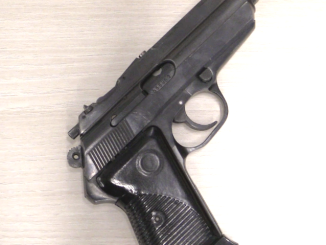
The Czechoslovakian military adopted the vz.38 pistol as a simple blowback action chambered for .380 ACP (well, the Czech military version of .380 ACP). Other countries were interested in other calibers though, and the factory looked at making the gun in 9x19mm Parabellum as well. They first tried a simple blowback version, but that was not satisfactory. So next they developed a locked breech model using a rotating barrel locking system. It also had several other features beyond the Czech pattern; a DA/SA trigger and a manual safety. Two examples of rotating barrel guns were made (300001 and 300002) for testing. That was the end of the project, although I am not sure specifically what the problem with the design was (or if there just wasn’t sufficient customer interest to justify further work). This is the only surviving example, as the other was destroyed during testing.
Many thanks to the VHU – the Czech Military History Institute – for giving me access to this unique prototype to film for you. The Army Museum Žižkov is a part of the Institute, and they have a 3-story museum full of cool exhibits open to the public in Prague. If you have a chance to visit, it’s definitely worth the time! You can find all of their details (including their aviation and armor museums) here:
Management directives: “Be as clever as you can be with the locking system; keep the shape as ugly as possible, and you may compensate for that with a beautiful high-polish finish.”
A pity the Browning drop-breech lock took over the world; it seems with a rotating barrel you save more in size (see PR57) and perhaps greater accuracy in exchange for the additional manufacturing cost.
It also works well for suppression with the can attached to the fixed bushing at the end.
Quibble… Browning’s design is anything other than a “dropped breech”. The various Browning derivatives are more properly termed “tilting barrel” designs. The commonly accepted understanding of “dropped breech” refers to early breech-loading mechanisms like the Snider and other conversions: Grok gives us this description of it as “a type of breech-loading firearm where the breechblock is opened by lowering or dropping it, typically via a lever mechanism.”
Also, I disagree vis-a-vis the “pity” of Browning’s tilting barrel design taking over the world market.
The thing you have to examine is “why”. Just like the trend in evolution that keeps throwing up crab-like organisms for certain environmental niches in the ocean, there are reasons that Browning’s little idea has been so successful.
And, it’s not just down to “He got there with it first…”, because if that was the sole reason, then someone would have eventually come up with a better system and that would have taken over. Nothing has, which should point to the essential fact that the tilting barrel concept is one that is workable, easily manufactured, and durable enough to make it the leading mechanism whenever someone goes to work up a locked-breech pistol.
I mean, if everyone is doing your girlfriend, then you’ve got a problem; if, on the other hand, everyone is copying your work…? Maybe you just hit on the best way to do it.
As an aside that just came back to me… Was trying to remember where I’d seen such a thing as a “dropped breech” design, and I knew I had, something recent. Finally remembered…
A “dropped breech” would be the obverse of the “rising chamber” design demonstrated by Steyr and ARES-Olin for their ACR submissions, which sadly didn’t go much of anywhere.
I kinda-sorta vaguely remember someone doing a pistol, using a similar mechanism, but I’ll be damned if I can find anything… So… Daweo? Daweo…?
Ok, quickie primer on early breechloaders.
1. “Dropped-breech”; Technically, this is the definition of the Peabody and its copies like the Bavarian Werder Lightning, the Martini breech, and etc. When you pull down on the trigger-guard, pull back on the operating lever, push on the reversed forward “trigger”, or etc., the breechblock rotates downward at the front, pivoting on a cross-pin at the rear. It may or may not be spring-loaded, or just operate on gravity, depending on the designer’s whim. (Yes, keeping it upright and rifle level while reloading probably helps.)
2. “Falling-block” breech; The Sharps breech is the basic falling-block type, the breechblock is a block that moves straight up and down. The British Alex Henry is another example of this, as is the modern Ruger Number One Single Shot. Most are operated by the trigger guard acting as an operating lever.
3. “Rotating block” breech; The Spencer and the Starr rifle/carbine both have this sort of breech. One reason it was fairly easy to convert the Starr from linen cartridge percussion to the .56 Spencer metallic cartridge was the close similarity of the two. again, generally trigger-guard-lever actuated. The Burnside is an odd subvariant of this type.
4. “Trapdoor” breech; Technically, this encompasses any breechblock which flips upward to open, whether at front (Berdan I, Springfield), side (Warner, Snider), rear (Morse), or whatever. That said, the side -swinging type is probably the strongest, the rear-swinging type only marginally weaker, and the front-hinged type by far the weakest and most dangerous. Generally operated by shoving it “up and over” with your thumb; may or may not have an automatic extractor/ejector. NB; the Joslyn, Krnka, and etc. are subcategories of the “side-swinging” type, and are not much stronger than the front-hinged variety.
5. “Rolling Block” breech; the Remington/Rider system. Possibly the strongest of all single-shot breech actions, depending on design and metallurgy. unlike the Trapdoor Springfield, with its un-endearing habit of blowing open and giving the shooter a faceful of hot gas and brass fragmentation in an overpressure event, in a rolling block “blowup” the barrel invariably splits before the breech fails. The darned thing is Just.That.Tough.
6. “Break-action” breech; this was actually one of the earliest cartridge-loading breeches, invented by Pauly around 1817. It still lives on today in single-shot, double-barrel, and even multi-barrel rifles, shotguns, and some pistols (Thompson Contender). There were a few break-action carbines and rifles in the 1860s, Gibbs, Gallagher, Smith, etc.; they generally were superseded by 1870.
Of them all, the rolling-block is the only one really adaptable to self-loading or automatic actions, as Madsen proved rather conclusively with their machine guns around the turn of the last century.
True self-loading actions pretty much require some sort of linear bolt movement. Yes, even “revolver-breech” types still have a bolt that moves back and forth, or in the case of a Gatling gun, one per barrel.
Until we develop some other way of loading a cartridge and locking the breech over it, there will probably always be a something like a “bolt” in there somewhere.
cheers
eon
If you need rapid-fire AND despise linear movement then use Honeywell Mk.18 mod.0 https://modernfirearms.net/en/grenade-launchers/u-s-a-grenade-launchers/mk-18-2/
“(…)“dropped breech”(…)kinda-sorta vaguely remember someone doing a pistol(…)”
My search unveiled dropping breech inside U.S.Patent US3710493A https://patents.google.com/patent/US3710493A where inventors are A. Gramiger and W. Baumann and was filled around 1970 in Switzerland (CH), Germany (DE) and US. Whilst drawing suggest long firearm observe that text inside Claims (which if I am remember correctly has higher priority than drawings) uses sporting gun words, therefore please detect if pistol does belong to sporting guns in 1970s U.S. patent language to decide if this is valid answer.
Agreed that the tilt-barrel is near-universal because economical and durable, just wishing there were more kids on the block with different advantages. Of course originally it was the Browning drop-the-whole-barrel design, not unlike those muzzle-loading cannon that recoiled back and down behind a parapet for re-loading. As I’m sure you know, JMB had to come up with the tilting barrel for Colt’s army trials when the double swinging links kept breaking. Of course this is indeed a dropped or lowered breech, it just takes the barrel with it — unless “dropped breech” is a technical term in gunnery, in which case I withdraw the assertion. Oops, just saw Eon’s post below …
“(…)more kids on the block with different advantages(…)”
S&W automatic pistol with rotating barrel https://www.smith-wesson.com/product/mp57
FN Five-seveN automatic pistol delayed blow-back https://modernfirearms.net/en/handguns/handguns-en/belgium-semi-automatic-pistols/fn-five-seven-eng/
K-100 rotating barrel and hammer https://modernfirearms.net/en/handguns/handguns-en/slovakia-semi-automatic-pistols/k-100-eng/
Q-100 rotating barrel and striker https://modernfirearms.net/en/handguns/handguns-en/slovakia-semi-automatic-pistols/q-100-eng/
“(…)locking system; keep the shape as ugly as possible, and you may compensate for that with a beautiful high-polish finish.(…)”
Wait… recoil-operated/rotation… grip closer to 90 degree angle than most other automatic pistols… designed in Central Europe… caliber 9 mm… this sounds very like Steyr Hahn https://modernfirearms.net/en/handguns/handguns-en/austria-semi-automatic-pistols/steyr-hahn-m1912-eng/ with catch that Austrian automatic pistol had single action trigger.
I was duly waiting for the “zbrojovka” (Czech – armoury)
https://translate.google.co.uk/?sl=auto&tl=en&text=zbrojovka&op=translate
= sbroyovkha
…being again pronounced as “żubrówka” (Polish staple vodka type)
https://translate.google.co.uk/?sl=auto&tl=en&text=%C5%BCubr%C3%B3wka&op=translate
= zshoobroovka
And I have not been disappointed.
Which is a great testimony to the cultural impact of Polish distillery industry Ian definitely had been exposed to during his so fruitful visit to Poland.
I think NATO instead of using various zbojovkas items against the Russian invasion should just leave plenty of żubrówka-filled barrels at the main direction of their assault.
Na zdrowie!
Na zdravi!
Cheers!
Pity not produced…
I rather like the double-action only .380 acp/ 9x17mm Browning court pistol … Except for the height of the bore axis above the firer’s hand, which I think is a real problem with this design, no? Almost a revolver in that regard.
I beiieve the Romanians used the Steyr Hahn 9x23mm stripper-clip pistols, which used a rotating barrel short recoil system. Perhaps that’s where the Czechoslovak designers saw this method of locking the barrel to the slide as a possibility? The Beretta Px4 pistol uses a variation on the theme of a rotating barrel short recoil system. That pistol is used worldwide by various police agencies as a service weapon, including in Romania, unless I’m mistaken. Certainly the Canadian border police and Providence Rhode Island PD use it.
“(…) Perhaps that’s where the Czechoslovak designers saw this method of locking the barrel to the slide as a possibility?(…)”
My bet is at Nickl https://unblinkingeye.com/Guns/VZ22/vz22.html
Ian, thanks once again for an awesome look at a forgotten weapon.
That system is just too clever a way to turn a blowback weapon into a locked breach lead projecting device.
Like yourself I would love to see the trial reports on the prototype.
The cams on the hinged part seem like an obvious fail point. There’s a lot of stress for that little pin.
I’d be willing to bet that that was one of, if not the, primary point of failure on the other prototype they did the “Test to destruction” on.
One of the major positive points on the Browning tilt-barrel designs is that it’s simple, durable, and pretty cheap to produce. People miss that, whenever they decry how “boring” it is. Boring works; be happy with boring, or be prepared to pay Ferrari prices for maintenance and upkeep.
I imagine a fair question is ‘Boring to whom?’ A soldier who finds his side arm ‘interesting’ is quite likely having a crisis with it due to its mechanics or his training. Bored procurement officers or firearms enfirearms are urged to go have interesting chats users the firearms’ users
‘Engineers’ not ‘enfirearms’