
Looking for a replacement for the MAC-50, the French Gendarmerie Nationale adopted the Beretta 92 in 1987 after finding it equal in quality to the SIG P226, but less expensive. In addition to the Gendarmerie, it was also adopted by the French Air Force, and a total of about 98,000 were made by the end of production in 1996 (plus a small last batch of 1500-2000 guns with B-series serial numbers). Aside from markings, these differ from regular Beretta 92s only in that the safety lever is a decocker only; they cannot be carried cocked and locked. This configuration was designated the 92G, for Gendarmerie. In France it was designated the PAMAS G1 – Pistolet Automatique – Manufacture d’Armes de St Etienne.
Thanks to Matt Larosiere and Nice Guns for sending me these two for filming! This is the first commercial import of these pistols into the US that I am aware of.
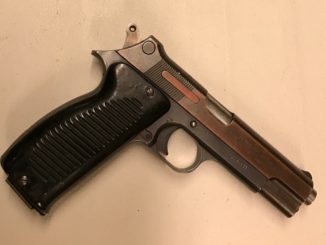
As to fit and finish, these compare favorably to an American-built 92 or a newer Taurus, maybe not quite Italian. They’re certainly a quality pistol in a useful configuration and ought to do well with collectors. I hope some leather gear comes in with them.
My SIG 2022 was made following the old pistol from the French military. I could take it apart exactly as I did with my military side arm. One handed. And the barrel fell when pushed against the forehead. I used to show my soldiers that it was a great way to not get shot…
What strikes me about all of this is that the Glock was a contender in the original testing, was rejected in favor of the same two pistol designs that came out on top of the US JSSAP testing, and… Yeah. Some years later, everyone is going “Yeah, about that… We’re just gonna go with the Glock to replace these…”
Which is either darkly humorous or just plain capital-I Ironic. Maybe both?
Based on actual experience when the INS went to obtain an automatic and went first with the Beretta and then the H&K before becoming part of Homeland Security, one of the Firearm Staff at Altoona, Pennsylvania, created a sh-tstorm and was transferred out when he said no plastic pistol would ever be approved, only metal like the 1911. There is some information that he and others screwed up the testing against the Glock. If you need a gun that can last 10,000+ rounds with +P ammunition, then maybe a Sig Sauer or another primarily non-polymer pistol is better. Few Federal Agents ever fire that many rounds with their pistol in 20 years. I carried a Glock for years, no problems.
The thing is, polymer lasts longer.
At least, until the plastic “dries out” and loses all the elastomers.
I really have to question anyone who claims that metal is more durable than plastic, because the round counts tell you the real deal. There was a pistol at one of the public indoor ranges where they rented handguns: That G17 had well over 100,000 rounds documented going through it. It still shot like new, and about all they replaced on it were the usual consumable springs.
And, I’m here to tell you: Some of that ammo was… Questionable. As in, the owner got in a pallet or two of unmarked Uzi carbine ammo, and he had it on special for a couple of years before he ran out of it. Some significant fraction of that ammo went through the Glock I mention, and those loads were seemingly damn close to “proof load” for a handgun.
I don’t care for the .40 S&W Glocks, and I don’t care for the .45 ACP ones, either… But, the 9mm and 10mm versions? You can abuse the hell out of those, and they’ll come back for more.
The normal plastic that good-quality gun parts are made out of is fiberglass-reinforced nylon, which doesn’t have anything to “dry out” or any elastomers to lose. It’s the same thing they make good-quality power tool housings from; it’s about the same strength as cast aluminum (though extruded aluminum like 7075 can be much stronger). I wish manufacturers would advertise it for what it is, rather than going to a stupid euphemism like “polymer”.
I have a blog post “The characters of plastics” about this: https://yarchive.net/blog/plastics/
It also talks about the main plastic that does dry out (PVC).
So far as the basic Beretta design goes, I’m still not a fan. Too many parts, too damn big for what you get in terms of cartridge power. If you’re going to commit to hauling around this much mass in a handgun, you may as well get something with more power out of the exercise. This size category of pistol really needs to be paired with something in the 10mm-.45 ACP to justify carrying that weight around.
The Glock 19 or the Compact version of the Beretta 92 were the sweet spot for 9mm in terms of size.
Then, there’s my other objection to the design: Complexity and excessive parts. As shown by the corrosion revealed when Ian took the grip panels off, the basic design is just… Horrible, from a maintenance standpoint. Too many tempting issues for the operator-level guys to go screwing with, and too many critical parts left vulnerable to their oversize mitts. I do not know how many of those transfer bar springs I had to replace over the years, but it must have been in the dozens… Which is really odd, considering that most of the time I was doing armorer or “show the armorer how to do his job…” duties, there were generally only a few M9 pistols in the house.
And, couple that with the Small Arms Repair Parts control issues brought in during the Clinton admin? Nightmare; my brigade deputy commander lost his spring cleaning his pistol the night before the night before they were supposed to go north into Iraq, and it took me most of the next day to run down a replacement in Kuwait. Nobody had the damn things, and if it hadn’t been for the small arms repair contractors with Dyncorp down at Camp Doha, he and I would have been screwed.
On that basis alone, I’d have replaced the M9. Swear to God, I think there must be some double-secret procurement criteria that never get made public to anyone that say the weapons have to be the biggest possible pain in the ass to administer and maintain…
My main objection to the M9 is the same as my basic problem with the earlier Beretta 951. That being having a Walther P.38 type locking system in a slide with thinner sidewalls and no “top”.
P.38s always had a problem with the slide cracking at the locking lug recesses; metallurgy was even more critical than usual for the design.
(Note that I used a mid-1960s P1, ex- West Berlin PD, as a “house gun” for years. The local raccoons that attacked my cats learned to fear that petite’ piece of machinery. Cat; “MEOW! eon, raccoon chased me in kitty door!” Me; BANG- problem solved with Federal 9BP 115-grain JHP.)
The Berettas had an even more critical metallurgy problem in that area, and from the 951 on through the entire M92 family never entirely solved it. The use of “Uzi carbine” 9mm ammunition by SEAL Team 6 among others didn’t help matters, or the M92’s reputation, any. (“You’re not a SEAL ’til you’ve eaten Italian steel”…)
I noted that all through this the old reliable P35 High Power (even the Hungarian and Argentine “clones”), the Glock 17 and 19, and the lowly Ruger P95 (Rejected in JSSAP because Ruger though chromium -plating the bore of a stainless-steel barrel was silly and wouldn’t do it) just kept chugging along no matter what hot-sopple 9 x 19mm they were fed.
I’m inclined to think that if you want a 9 that lasts it should have a Colt-Browning or Petter-type locking system, with a solid-topped slide and either locking lugs on top of the barrel (Browning) or a squared chamber that locks into a squared ejection port (Petter).
The latter is pretty much the default method today; even Walther went to that with the P99 and still uses it on their post-modern designs like PPX.
Now if they’d just get off that hand-shredding-while-slide-racking “fractal” design kick. A sidearm should ideally feel like a bar of soap from all angles, not an experiment in abstract steel sculpture.
clear ether
eon
“(…)inclined to think that if you want a 9 that lasts it should have a Colt-Browning or Petter-type locking system, with a solid-topped slide(…)”
Beretta seems to agree with that consider, their newer product known as APX https://modernfirearms.net/en/handguns/handguns-en/italy-semi-automatic-pistols/beretta-apx-eng/ uses uses Browning-type short recoil action with tilting barrel and do have solid-top slide (see 2ind image from top) https://www.youtube.com/watch?v=UlaldfLhK9s shows example after over 4700 shots and suggesting it did handle it well.
Good idea, but that slide looks like a f**king cheese grater.
Better wear gloves.
cheers
eon
If you look really close at my left hand, you can still see the scars from doing IA drills with my Beretta pistols…
That open-top slide is an abomination, for that fact alone. Never mind the amount of filth it virtually mandates going into the weapon. The one time I had to do “Shoot Beretta in sloppy wet mud”, I really came to regret my life-choices. Wasn’t too much after that lovely experience that I had to borrow a Glock from another shooter, and had the best day of my life on a range with a handgun. Sold off my Berettas not too long after, moved to a Glock 19 followed by the 20 and 29. I’d also gotten tired of waiting for the Bren Ten by that point…
According to Ezell in Handguns Of The World way back when, the Beretta open-top slide started with the 1915 in 9mm Glisenti (9 x 19mm case but .380 ACP powder charge and pressure levels) because (1) the Italian army was worried about mud, dirt and etc. getting stuck inside and (2) the 9mm Glisenti round, originally designed for the “Brixia” pistol, didn’t have enough “oomph” to operate the action of a pistol with a heavier slide.
Dunlap in Ordnance Went Up Front said the .380 Beretta M1934 blowback was extremely reliable in desert conditions. I do sort of wonder how it would have fared on Guadalcanal.
The culprit in the later Beretta 9 x 19mm designs was likely the locking system. The Wehrmacht had Walther test the Hell out of the “Armee Pistol” before they’d accept it, and the P.38 has a rep for working pretty much no matter what. I’ve long suspected that with the 951 and M9, Beretta did what Ord did with the MG42 and FG42 to create the M60. They copied the Walther system from one end to the other without necessarily understanding it.
Interestingly, in WW1 the P.08 showed up about as well as the Colt 1911 in operational reliability in trench conditions. Both had enough mechanical cycling power to throw the crap out with the empty cartridge each time. The various .32 ACP Spanish blowbacks the French Army bought in desperation weren’t so emphatic in that department.
cheers
eon
Ok, the first two reasons are 100% bullshit.
1) In 1915 the Italian Army would have accepted literally ANYTHING regarding handguns, provided it was cheap enough. They were not only buying the revolver Bodeo (that should have already been out phased out) made in Spain, but were also buying Spanish copies of the S&W top breakers, chambered in 10.35mm Italian Ordnance (revolver Tettoni). Had Beretta proposed a cheap copy of the Frommer Stop, they would have adopted it as well.
2) The 9mm Glisenti not having enough “oomph” to operate the action of a pistol with a heavier slide? Sorry, I know it’s not your fault, but that’s one of the most idiotic things I’ve ever read regarding firearms, and who wrote it demonstrated to know nothing on how recoil works, and of having never seen a Beretta 1915.
Power wise, the 9mm Glisenti is in the same ballpark of the 9mm Browning Long of the FN 1903. A pistol that weighted 930 g, most of them concentrated in the slide. Infact those cartridges (like the later 9mm Ultra) are the upper limit of what a blowback pistol can shoot without having dire weight disadvantages, and need a quite heavy slide to tame them. To fire the 9mm Glisenti with a total weight of only 850 g, the Beretta M1915, and the subsequent M1923 had to use a “trick”, a buffer (a hard buffer spring in the m1915, and rubber buffer pad in the M1923) that prevented the slide to impact the frame at destructive speed.
The Beretta M1915 had an open slide simply because Tullio Marengoni saw that, using one, he could simplify disassembling.
As for the reliability in desert conditions, the M1951 was adopted by Egypt over the Tokarev exactly for the better reliability shown in desert conditions, and, in the XM9 tests, the 92F did beat the P226 in that department.
A closed slide doesn’t prevent the sand to enter in the mechanism.
The story is a little longer and more convoluted.
First of all, the SEAL affair.
Beretta donated some 92SB to the SEAL, that quite liked them until two samples had the slide cracking (that, in that model, meant the rear part of it being projected rearward). It was later determined that, for one, it was impossible to know how many rounds it fired, but they were estimated to be over 30.000 (well over that was the estimated life cycle of the weapon). The other had fired recharges.
Beretta obviously didn’t accept responsabilities for what happened.
Disgruntled, the SEAL adopted the P226.
Ironically, at that time the P226 had a welded frame that was notoriously prone to breakages, and that caused several hand injuries to the SEAL.
As for the Army, the XM9 program estabilished a requisite of a life cycle, on average, not inferior to 5000 rounds (notice how ridicolously low is that number for modern standards, but that was all that was expected from a handgun in mid ’80s). To estabilish that, three samples for any model were tested to 7000 round count.
Of all the models tested, only the 92f and the H&K P7 reached the 7000 round threshold with all three samples without catastrofic failures.
When production models reached the troops however, during regular tests, it was seen that, even if the 5000 round count was respected, some sample had the slide cracking at relatively low round count and, since that meant a slide in the face of the shooter, the problem was deemed serious enough to stop the delivery of new guns and study it. The Army experts estabilished the problem was in the tellurium (an alloy element added to make the slides easier to machine) present in the alloy, and requested for the alloy to be changed. Beretta also implemented a modification that prevented the slide to be projected out of the frame in case of breakages.
However, Beretta technicians were not persuaded. It was not that them, or all the other security and armed forces that adopted the gun, never tested it for endurance, and that problem seemed to exists only in US Army tests.
So they obtained to look at the papers of the tests, and immediately noticed how the pistols had fired a mixed bags of ammos, but all the pistols that failed at low round count had fired, at some point, cartridges coming from a single batch of Federal made ammo. When that batch was not involved, the slides passed 20.000 rounds, sometimes 30.000, before cracking.
They obtained some sample of those cartridges, tested them, sent them to four independent labs, and all the results were that they developed pressure in excess of proofloads.
And some gun fired several thousands of those ammo before giving up.
At that point, Beretta sued the US Government for the unnecessary modifications required, the delay in accepting the guns, the bad press and so on.
The lawsuit was settled with the Government granting Beretta further 10 million $.
We’ll never know if that batch was involved in the XM9 program, but that would explain why the life-cycle test results were gernally worse than those of the analogous US Air Force test in 1981, especially for the S&W 459, that passed brilliantly the 1981 test, and was eliminated for early breakages in 1985.
“(…)Glock 19 or the Compact version of the Beretta 92 were the sweet spot for 9mm in terms of size.(…)”
Interestingly Turkish Yavuz 16 https://modernfirearms.net/en/handguns/handguns-en/turkey-semi-automatic-pistols/yavuz-16-eng/ does follow closely 92 (see images) and also hold 15 rounds, but is noticeably lighter (92: 950…975 g, Yavuz 16 full-size: 850 g, Yavuz 16 compact: 800 g) and unlike 92 does keep capacity 16 also in compact version.
What the hell is he talking about a “Safety”? The m92/M-9 have a de-cock, it’s it. If you mean you can keep the de-cock down, say it. I hate that the Army called it a safety for all those years.
It really is a safety, in that when it’s “down” the trigger is back and disconnected from the sear. To fire, you have to flip it back up, whereupon the trigger snaps back forward to the double-action position for a double-action first shot.
It’s been that way since that “hammer-dropping” safety was introduced on the Walther PP in 1928. Whether or not it’s a good idea is a subject that is still debated.
Note that back when I was working, a lot of officers who carried S&W automatics with that kind of safety, in 9mm or .45 ACP, carried with the safety on at all times. Because if some miscreant grabbed the sidearm out of their holster (a trick taught by old lags to young punks in stir), it provided an extra second or two to deal with the problem while the goon tried to figure out why the trigger wasn’t working for him…
clear ether
eon
Police work has a different set of needs and realities to the purpose that Gaston Glock was designing his pistols for.
Although, in all too many cases, the benefits of the Glock design philosophy wind up being beneficial for police work, due to a lack of interest on the part of police officers in skill-at-arms, and the lackadaisical attitude their administrators have towards training.
I would also point out that there are somewhat severe cultural differences between US police work with firearms and practices elsewhere in the world. I spent some time with an Austrian detective who’d done a bunch of patrol work as a junior officer, and his comment vis-a-vis US practice with handguns in particular was filthy and unprintable. Mostly due to jealousy, I surmise. The way he described it, in Austria? You make a cop draw his pistol for some reason, someone is getting shot. Period.
Why? Because the paperwork for said cop introducing a firearm into an interaction with the public was horrendous, and would be the same or even harder if they’d not shot anyone with said handgun. The mentality in those cases was basically “Well, you didn’t have to use it, you should have left it in your holster…”
Here in the US, the way he described his time doing ride-alongs, pistols were all too often used as “threat displays”. The officers drew them to show that they were “serious”, and the usual run of criminal perpetrators didn’t respond unless they did. He was used to his uniform and presence alone getting compliance in Austria that required a drawn gun here in the US.
As such, I am ambivalent about what’s actually required in police work. I can see the utility of a mechanical safety, but I can also see wanting the least amount of crap between me and the ability to shoot someone trying to kill me…
Ideal solution? People just need to cooperate with the cops, and cops need to be polite dealing with the public, with the fact that “normal citizens” do not have “How to interact with armed police while looking criminal” on their mental speed-dials. Most such interactions that go south are due to the cops having a script for dealing with the criminally-minded running, while the idjit civilian does not…
“(…)is he talking about a “Safety”?(…)M-9(…)”
This name does comply with official documentation, see NOMENCLATURE CROSS-REFERENCE LIST inside ARMY TM 9-1005-317-23&P
NAVY SW 370,AA-MMO-010/9mm
AIR FORCE TO 11W3-3-5-4
MARINE CORPS TM 1005A-23&P/2
COAST GUARD COMDTINST M8370.7 available at https://www.biggerhammer.net/manuals/m9/M9B.PDF