
Available from Morphys here:
https://auctions.morphyauctions.com/_C__MARBLES_1908_GAME_GETTER__22_RF____44_GAME_GET-LOT663251.aspx
Webster L. Marbles was a lifelong outdoorsman, who spent 30 years working as a surveyor, trapper, and lumberman among other jobs. He invented an axe with a safety cover to prevent accidents, and started the Marbles Safety Axe Company to produce it. Then in 1908, he designed a minimalist combination gun to provide everything he thought necessary in a firearm for surviving in the woods. It had a .22 rimfire barrel on top and a smoothbore .44 barrel below, with a break action system, single hammer to fire either barrel, folding stock, and both notch and aperture sights. As initially offered, the barrels were 12” (300mm) long. A variety of other options were added fairly quickly, including 15” and 18” barrels. A total of 9,981 of these Game Getters were made by the time production ended for the First World War. A simplified second model was reintroduced in 1921, but the guns were hit hard by the 1934 passage of the National Firearms Act, which required a $200 tax on all but the very longest barrel models. As a result, American sales fell off a cliff, and most of the remaining production went to Canada. Most Game Getters were never registered because of the exorbitant tax, and are contraband today. This example is one of the small number made with 18” barrels, the minimum needed to avoid NFA regulation and so it is legally treated like any normal rifle or shotgun.
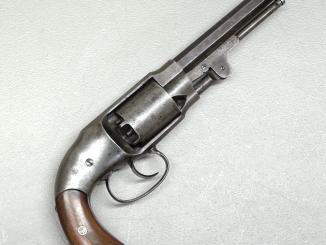
“Webster L. Marbles(…)folding stock(…)”
Did Marbles envisaged firing said fire-arm with stock folded? If no can this be done safely (that is without endangering user’s hand)?
@Daweo,
The example I got to handle once did not strike me as something you’d want to try and shoot without the stock extended. You could probably do it, but… Why?
The real issue for me, with that entire set of firearms, was “How the hell do you carry this thing?”
There weren’t any provisions for any such thing as a sling on the one I saw; you’d have to improvise something, and because of the barrel length, a holster didn’t seem like a solution, either.
Neither I nor the collector who shared his with me could come up with a really easy and accessible way to carry one of these, other than something like a saddle scabbard. I remain puzzled by this aspect of the Game Getter to this day.
Something like this might be more for being part of a “bug out kit” or “survive being unintentionally stranded in the woods kit” than for regular use. In these cases, the lighter weight of the gun and being able to be used as both shotgun and rifle, thus having fewer things to carry in order to survive, is an advantage.
I inherited a Civil War Union rifled musket that had the barrel bored out to .58 caliber smoothbore, and a shortened barrel and stock. These were sold to the late 1800 homesteaders to use either with shot or ball. This saved the cost of two guns and took up less space in the wagons where space and cargo weight limitations were a factor to those heading west into the promised land. So I see the same philosophy at work with Marbles’ gun
According to D.C. Cole (“Firearms in Apache Tribal Use”, Gun Digest 1975) when he was a boy on the reservation in the 1930s, Hawken-type “plains rifles” were commonly found in use.
Their .54 to .58 caliber octagon barrels of relatively “soft” iron were worn out smooth by that time, the rifling pretty much completely gone.
So they were used as shotguns, firing bird shot, buckshot, or “punkin balls” as needed.
That worked well enough to suit the Apache.
clear ether
eon
According to the 1910 Sears Roebuck catalog, the Game Getter in any barrel length came with a canvas scabbard intended to be secured by its four short leather straps to either a bicycle frame or a pack frame.
On the bike frame, you strapped it to the top lengthwise bar on a boy’s bike, butt to the rear, or the front upangled bar on a girl’s, butt upward. To deploy, simply unsnap the flap and draw it out by the pistol grip. (In each case, the butt should be “upside down” relative to you, to make it easier to draw.)
On a pack frame, you strapped it to the right left vertical bar if you were right-handed, to the right vertical bar if you were a southpaw, muzzles down in both cases. The butt was to be pointed backward so that you could reach over, grasp it with your hand, and draw it rather like drawing a bayonet from a scabbard strapped to the side of a soldier’s pack.
In any case, once it was out, you unfolded the pantograph-style shoulder stock and got down to business.
The Game Getter was probably the direct inspiration for the U.S. Air Force M6 Aircrew Survival Weapon;
https://en.wikipedia.org/wiki/M6_aircrew_survival_weapon
Which was a .22 Hornet over .410 gauge shotgun, with spare ammunition stored in the stock.
I still have a box of twenty-five rounds of .22 Hornet for an M6. Loaded with 40-grain JSP, there is a label on the box stating that the ammunition is to be used for foraging only, and that using it against enemy personnel violates the Hague Accords.
I guess you were supposed to shoot Chinese or etc. soldiers with .410 slug loads.
clear ether
eon
Yeah, that tracks.
The guy who had it wasn’t exactly an “advanced collector” and he didn’t have too much actual knowledge to go with the thing. I gathered he’d found it in a family estate he was cleaning out, and had no idea what it was, really.
Now that I think about it, I don’t know that the damn thing was even registered/legal. It was about a 16″ barrel, but I didn’t measure it, and I didn’t know enough at the time to recognize that shorter barrels were supposed to be registered items.
Be wary of stuff you find cleaning up after your dead elder family members… One of my more “fun” experiences was having a friend of a friend ask me one time “Hey, you know about guns, right…?”, and then pulling out this trunk of WWI and WWII memorabilia his great-grandfather had left his wife with when he died in the 1960s. He’d apparently been in the National Guard during both wars, and had an extensive collection of “stuff”. Most of which I highly recommended they turn over to a museum, because I wasn’t about to try and deal with the likely mess it would all be to try and legalize it, because that trunk had at least two things in it that should have been Class 3, and when he told me “I’m pretty sure Papaw would have done the paperwork…” about all I could say was “I think you need to find it, and consult with an attorney that knows about this crap, because I sure as hell don’t…”
Which is, I think, about the only thing a wise man can do in such circumstances.
https://images.gunsinternational.com/listings_sub/acc_212879/gi_103029952/Stunning-Marble-s-Game-Getter-22-410-Combo-Gun-18-W-Holster-Rig_103029952_212879_0A137970C863094B.jpg
It was carried in a very odd holster I suppose.
I’m familiar with the Marbles co. as most watchers of this video know them as not also makers of Safety Camp Axes but various camp/field knives. What I didn’t know that they make Gun Sites too! I’m wondering; wasn’t there another gun company that made a version Marbles ‘Game-Getter’ in the latter half of the 20th century. (I can’t believe I’m referring to the 20th c. in the past tense)
It won’t be exactly the same, but you can have a look on Chiappa’s Big Badger models : they resemble a lot the 19th-20th European folding poacher guns.
There a several “survival rifles” like Marbles’ that have been made. Look at the images for these searches:
https://search.brave.com/images?q=Quackenbush+rifle
https://search.brave.com/images?q=SURVIVAL+RIFLE
A bit of period advertising for the gun. Don’t know where it originally was published.
https://grangerartondemand.com/featured/marbles-game-getter-gun-granger.html
https://imgs.search.brave.com/2U5Qob2Kyapxet7WkWC0zMS-hW2LStE_uLeupYPD7nY/rs:fit:860:0:0:0/g:ce/aHR0cHM6Ly93d3cu/cGljY2xpY2tpbWcu/Y29tL010OEFBT1N3/ZVBsZWtqNGQvMTky/MC1QQVBFUi1BRC1N/YXJibGVzLUdhbWUt/R2V0dGVyLVBvY2tl/dC1BdXRvLndlYnA
Lot of todays DIYish poachers guns look like specimen shown.
Thanks for this video. Several videos ago, I asked about this gun. I called it a “bicycle gun”.
I have always been interested in Marble. I own two peep sights and a hunting knife made by Marble. I live in Michigan and have been to Gladstone but didn’t realize that the Marble factory was there at the time.
Once again thanks for the great video
A similar rifle was the Sevens Pocket / Bicycle Rifle. But it only came with single barrel. Advertising of the days showed how well it would fit in the frame of a bike. It came out in 1869 and at least some of them had a receiver sight as well. The Marbles would seem to be inspired by the Stevens, with the main difference being the shotgun barrel.
If anyone has read the book “I Remember Skeeter,” it is a reprint, of among other things, Skeeter Skelton’s stories from his depression era childhood that showed up in a gun magazine back in the 1960’s or thereabouts. In those stories his chum had a “stocked Stevens Pistol” while Skeeter had a Remington model 12 pump .22 rifle.
I have never really understood the appeal of bare bones ‘survival rifles’ today. The Charter Arms AR-7 beat most of the single .22/single .410 shotgun rigs hollow. And a Ruger 10/22 is only minimally heavier and easy to rig up a way to carry slung to a backback or stashed in boat or small plane